Modern Core Java Roadmap 2025+: From Java 21 LTS to Java 25 and Beyond
Java has never been more relevant. With Java 21 cementing a new era of expressive, high-performance code, and Java 25 on the horizon promising value types and faster startup times, 2025 is the perfect year to deepen your Java expertise and future-proof your career as a backend engineer.
TL;DR
"A comprehensive Core Java learning roadmap for 2025 and beyond — Java 21 LTS features, records, sealed classes, virtual threads, pattern matching, and."
Table of Contents
- Why Java Remains the Gold Standard for Enterprise Backends
- Java 21 LTS: The Features Every Java Developer Must Know
- Understanding Virtual Threads in Depth
- Records and Pattern Matching: Writing Less, Expressing More
- The Road to Java 25: What's Coming
- Recommended Learning Path for Java Engineers in 2025
- Industry Best Practices for a Java 21+ Codebase
Why Java Remains the Gold Standard for Enterprise Backends
Despite the relentless parade of new languages and frameworks, Java continues to dominate the enterprise landscape. According to the 2024 JetBrains Developer Ecosystem Survey, Java is still the most widely used language for backend development in large organizations, powering everything from financial trading platforms to healthcare record systems and e-commerce giants.
The reasons are structural, not nostalgic. Java offers a uniquely compelling combination: a mature, backward-compatible runtime (the JVM), an enormous ecosystem of battle-tested libraries, a strong type system that catches bugs at compile time, and a thriving open-source community led by OpenJDK. Critically, Java has also demonstrated that it can evolve. The cadence of six-month releases since Java 9, combined with Long-Term Support (LTS) releases every two years, has transformed the platform from a slow-moving behemoth into a modern, agile language.
For backend engineers, Java 21 LTS represents the biggest leap forward since Java 8. If you are still writing Java 11 or Java 17 code, this roadmap will show you exactly what you are missing and how to build a systematic path to mastering the modern Java ecosystem.
Java 21 LTS: The Features Every Java Developer Must Know
Java 21, released in September 2023, is the first LTS release since Java 17 and packages years of innovation into a stable, production-ready platform. Here are the flagship features every professional Java engineer must understand deeply.
Records (Finalized in Java 16)
Records are concise, immutable data carriers that eliminate the boilerplate of traditional POJOs. A record automatically generates a canonical constructor, accessors, equals(), hashCode(), and toString(). They are ideal for DTOs, value objects, and structured response types.
Sealed Classes (Finalized in Java 17)
Sealed classes give you precise control over which classes or interfaces can extend a type. This enables exhaustive pattern matching and aligns Java's type system more closely with algebraic data types found in functional languages.
Pattern Matching for switch (Finalized in Java 21)
Pattern matching for switch is a game-changer. Combined with sealed classes, it allows the compiler to verify that all cases are handled, eliminating whole classes of runtime errors.
Virtual Threads / Project Loom (Finalized in Java 21)
Virtual threads are lightweight threads managed by the JVM rather than the OS. They make it trivially easy to write highly concurrent code without the complexity of reactive programming. A single JVM process can now sustain millions of concurrent virtual threads.
Structured Concurrency (Preview in Java 21)
Structured concurrency treats a group of related tasks running in different threads as a single unit of work. If one subtask fails, the others are automatically cancelled, preventing thread leaks and simplifying error handling dramatically.
Sequenced Collections (Java 21)
Java 21 introduces three new interfaces — SequencedCollection, SequencedSet, and SequencedMap — that provide a unified API for collections with a defined encounter order. You can now call getFirst(), getLast(), and reversed() directly on List, Deque, and LinkedHashMap.
Understanding Virtual Threads in Depth
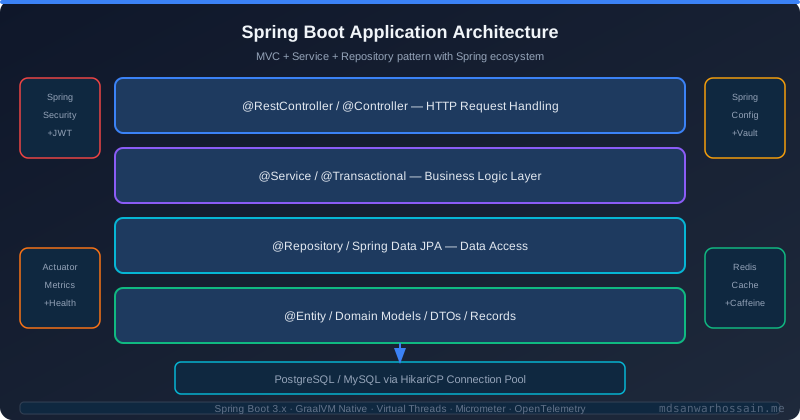
Virtual threads are arguably the most impactful addition to the Java platform since generics. To understand why, consider the traditional model: each platform thread maps one-to-one to an OS thread. OS threads are expensive — typically 1–2 MB of stack space each — so thread pools are used to share them. This model forces you into either blocking I/O (limited scalability) or reactive programming (high complexity).
Virtual threads are managed entirely by the JVM scheduler. They are mounted on carrier threads (OS threads) only when they are actively running CPU code. When a virtual thread blocks on I/O, it is unmounted, freeing the carrier thread for other work. The result: you can write straightforward, imperative, blocking code and achieve the throughput of a reactive system.
import java.util.concurrent.Executors;
import java.util.concurrent.ExecutorService;

public class VirtualThreadDemo {

    public static void main(String[] args) throws InterruptedException {

        // Create an executor that spawns a new virtual thread per task
        try (ExecutorService executor = Executors.newVirtualThreadPerTaskExecutor()) {

            for (int i = 0; i < 10_000; i++) {
                final int taskId = i;
                executor.submit(() -> {
                    // Simulate blocking I/O (e.g., database call, HTTP request)
                    try {
                        Thread.sleep(100);
                        System.out.println("Task " + taskId
                            + " completed on: " + Thread.currentThread());
                    } catch (InterruptedException e) {
                        Thread.currentThread().interrupt();
                    }
                });
            }
        } // executor.close() blocks until all tasks complete
    }
}
In this example, 10,000 tasks are submitted and each simulates a 100 ms blocking operation. With platform threads, this would require a thread pool of thousands of OS threads — a prohibitive resource cost. With virtual threads, the JVM manages the scheduling efficiently with a handful of carrier threads. This is how Java now competes with Node.js and Go for high-concurrency I/O workloads without abandoning the familiar imperative programming model.
"Virtual threads are not faster threads — they are cheaper threads. The value is not raw speed but the ability to scale to massive concurrency without reactive complexity." — Project Loom team
Records and Pattern Matching: Writing Less, Expressing More
Records and pattern matching work together to produce code that is simultaneously more concise and more correct. Consider a domain model for a payment system.
// Define a sealed hierarchy of payment types
sealed interface Payment permits CreditCard, BankTransfer, Crypto {}

record CreditCard(String cardNumber, double amount) implements Payment {}
record BankTransfer(String iban, double amount, String reference) implements Payment {}
record Crypto(String walletAddress, String currency, double amount) implements Payment {}

// Pattern matching switch — compiler enforces exhaustiveness
public class PaymentProcessor {

    public String process(Payment payment) {
        return switch (payment) {
            case CreditCard cc ->
                "Charging card ending in "
                + cc.cardNumber().substring(cc.cardNumber().length() - 4)
                + " for $" + cc.amount();

            case BankTransfer bt ->
                "Initiating SEPA transfer to " + bt.iban()
                + " (ref: " + bt.reference() + ") for $" + bt.amount();

            case Crypto c ->
                "Sending " + c.amount() + " " + c.currency()
                + " to wallet " + c.walletAddress();
        };
    }
}
Notice that the switch expression has no default case — the compiler knows the sealed hierarchy is exhaustive and will emit a compile error if you add a new Payment subtype without handling it in the switch. This catches bugs at compile time that would previously surface as runtime IllegalArgumentException errors.
Records also integrate beautifully with Java's deconstruction patterns (previewed in Java 21), allowing you to destructure records directly in switch cases for even more expressive code:
// Guarded pattern with deconstruction
String result = switch (payment) {
    case CreditCard(var card, var amt) when amt > 10_000 ->
        "High-value card transaction: $" + amt;
    case CreditCard(var card, var amt) ->
        "Standard card transaction: $" + amt;
    default -> "Other payment method";
};
The Road to Java 25: What's Coming
Java's project pipeline is the most exciting it has been in a decade. Here are the major initiatives shaping Java 25 and beyond.
Project Leyden: Faster Startup Times
Project Leyden aims to dramatically reduce Java application startup time and memory footprint through ahead-of-time (AOT) compilation and class data sharing improvements. This directly targets one of Java's most persistent criticisms in the cloud-native era — slow cold starts in serverless and containerized environments. Leyden will allow teams to produce condensers (specialized optimized images) without abandoning JVM compatibility.
Project Valhalla: Value Types
Project Valhalla introduces value types — classes whose instances can be stored inline in arrays and other data structures rather than as heap-allocated objects. This eliminates pointer indirection and dramatically improves cache locality for data-intensive applications. A Point[] of value types will lay out x/y coordinates contiguously in memory, just like a C struct array, giving Java competitive performance with C++ and Rust for numerical and scientific computing.
Project Panama: Native Interop
Project Panama replaces the aging Java Native Interface (JNI) with a safer, more ergonomic Foreign Function & Memory API. Already in preview in Java 21, Panama allows Java code to call native libraries and manipulate off-heap memory with full type safety, without writing a single line of C or maintaining JNI wrappers. This is a fundamental capability for AI/ML integration, where most tensor compute libraries are C/C++ based.
String Templates
String templates (previewed in Java 21, refined in subsequent releases) provide a type-safe, extensible mechanism for embedding expressions in strings. Unlike string interpolation in other languages, Java's template processor model allows custom processors to validate or transform the result — preventing SQL injection, XSS, and other injection attacks at the language level.
Recommended Learning Path for Java Engineers in 2025
A structured learning path saves months of aimless exploration. Here is a proven sequence for a Java engineer targeting production-grade Java 21+ proficiency:
- Foundations audit: Ensure solid command of Java 8 features (Streams, Lambdas, Optional, CompletableFuture) before advancing. Many Java 21 features build on these concepts.
- Java 9–17 catchup: Study modules (Java 9), local variable type inference (
var, Java 10), text blocks (Java 15), andinstanceofpattern matching (Java 16). These are prerequisites to understanding Java 21's more advanced patterns. - Java 21 core features: Deep-dive records, sealed classes, pattern matching for
switch, and sequenced collections with hands-on exercises. Build a small domain model that uses all three together. - Concurrency rework: Migrate a thread-pool-based service to virtual threads. Benchmark the throughput difference. Understand structured concurrency and scoped values.
- Framework integration: Learn how Spring Boot 3.x and Quarkus 3.x leverage Java 21 features — native compilation, virtual thread support in web containers, and record-based projections in Spring Data.
- Advanced topics: Study the Foreign Function & Memory API (Panama), SequencedCollections, and follow JEPs in progress for Java 23/24/25 to stay ahead of the curve.
Industry Best Practices for a Java 21+ Codebase
Upgrading to Java 21 is not just about enabling new syntax — it requires rethinking several long-held conventions:
Embrace Records for DTOs and Value Objects
Replace all Lombok @Value and @Data classes used as immutable data containers with records. Records are a first-class language feature with better IDE support, less magic, and no annotation processing overhead.
Prefer Virtual Threads for I/O-Bound Services
For REST APIs, database-heavy services, and anything that spends most of its time waiting on network or disk I/O, enable virtual threads in your Spring Boot or Quarkus application. In Spring Boot 3.2+, this is a single configuration line: spring.threads.virtual.enabled=true. Avoid pooling virtual threads — the whole point is to create them freely.
Use Sealed Interfaces to Model Domain State Machines
Wherever you have a domain concept with a finite set of states (order statuses, payment states, user roles), model it as a sealed interface with records for each state. This makes invalid states unrepresentable and forces callers to handle all cases explicitly.
Adopt the Functional Core, Imperative Shell Pattern
Java 21's expressive type system makes the functional core / imperative shell architecture more natural than ever. Keep your domain logic in pure functions operating on records and sealed types. Push I/O, database calls, and side effects to the outermost shell. This architecture dramatically improves testability and aligns well with virtual threads.
Pin Your LTS and Upgrade Systematically
In production, always run on an LTS release (Java 21 until Java 25 arrives). Track preview features in non-preview releases on a dedicated branch. Upgrade between LTS versions within the first year of the new LTS's release — the migration cost compounds when you skip versions.
"The teams that win with Java in 2025 are not the ones who know the most frameworks. They are the ones who know the language deeply enough to make every abstraction count."
Java's evolution from a verbose, ceremony-heavy language into a modern, expressive platform is one of the great engineering stories of the last decade. Java 21 LTS is not just an incremental upgrade — it is a genuine paradigm shift for how we write concurrent, data-intensive backend systems. The engineers who invest in this roadmap today will be the architects and tech leads of tomorrow's most resilient systems.
Leave a Comment
Related Posts

Software Engineer · Java · Spring Boot · Microservices