DevOps Delivery Tricks That Actually Work in 2026
Great DevOps is not about adding more tools. It is about reducing friction from idea to production while strengthening reliability, security, and operational feedback loops.
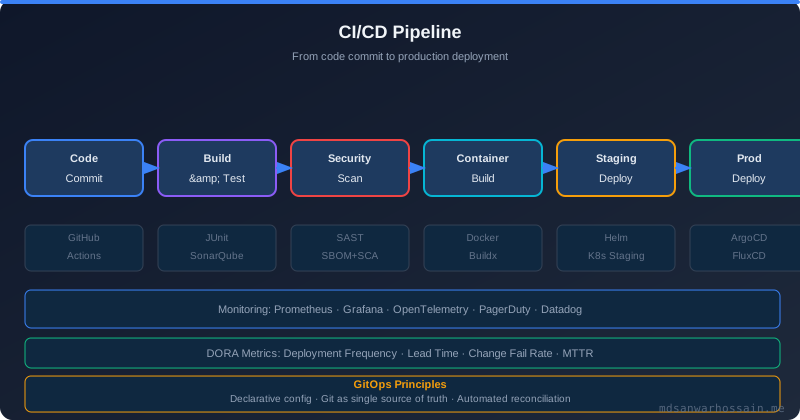
Many organizations adopt CI/CD and call themselves DevOps-ready, yet still struggle with slow releases, fragile deployments, and recurring incidents. The issue is rarely one missing platform feature. It is usually a gap in operating habits: unclear quality gates, weak rollback design, noisy alerts, and inconsistent ownership between product and platform teams. This article covers practical DevOps tricks that consistently improve throughput and system stability in real engineering environments.
1) Optimize for lead time and change failure rate together
Speed without reliability creates chaos. Reliability without speed creates stagnation. Track both lead time to production and change failure rate as primary delivery metrics. Teams that focus on one and ignore the other usually oscillate between rushed releases and process-heavy slowdowns. Use weekly trend reviews to understand when delivery speed starts hurting quality or when caution starts blocking business value.
2) Make CI pipelines strict, fast, and deterministic
A pipeline that is slow or flaky quickly loses team trust. Keep CI steps parallelized where possible and cache dependencies intelligently. Fail fast on formatting, linting, and unit tests before expensive integration stages. Pin tool versions to avoid inconsistent results across environments. Deterministic pipelines reduce debugging time and make delivery more predictable.
Also treat pipeline-as-code as production code: versioned, reviewed, and tested with changesets.
3) Introduce quality gates that map to risk
Not all changes should have identical release gates. A UI text fix should not require the same approvals as payment logic changes. Build a risk-based matrix: low-risk changes follow a lightweight path, while high-risk changes require stronger test coverage, security checks, and staged rollout. Risk-aware gates keep teams fast without normalizing unsafe deployments.
4) Design rollback strategy before deployment
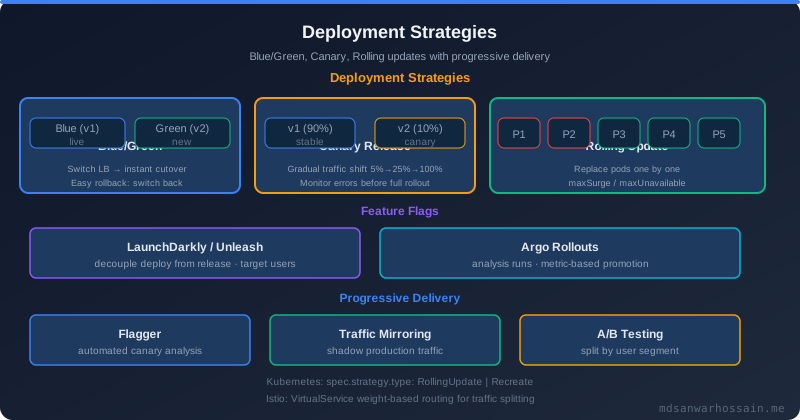
Many teams discover rollback pain during incidents because backward compatibility was not planned. Use deployment patterns that support safe reversibility: blue-green, canary, and feature-flag-driven releases. For schema changes, use expand-and-contract migration strategy so old and new versions can coexist during transition windows. A deployment is not complete if rollback is unclear.
5) Treat feature flags as operational controls
Feature flags are powerful for progressive delivery and incident mitigation, but unmanaged flags create technical debt. Define ownership, expiration dates, and cleanup workflows. Separate release flags from experiment flags and from emergency-disable toggles. Maintain a dashboard that shows active flags and their blast radius to avoid hidden complexity.
6) Standardize golden paths with platform engineering
Developer experience improves dramatically when platform teams provide paved roads: service templates, secure defaults, observability bootstrap, deployment manifests, and policy-as-code guardrails. Golden paths reduce cognitive load and prevent teams from reinventing infrastructure for every service. The goal is not central control; it is safe autonomy with consistent standards.
7) Shift security left without blocking engineers
Security checks work best when integrated into normal flow. Add dependency scanning, secret detection, IaC policy checks, and container image validation directly in CI. Provide clear remediation guidance in pipeline output so teams can fix issues quickly. Security tooling that only says failed without context creates frustration and bypass pressure.
8) Build deployment observability for the first 30 minutes
The highest-risk period after release is often the first 30 minutes. Create release dashboards with key service metrics, error trends, and saturation indicators. Compare baseline and canary metrics in real time. Define automatic rollback thresholds for severe regression signals. Fast detection and decisive response protect users and reduce incident duration.
9) Use incident reviews to improve delivery system, not blame people
Blameless post-incident reviews are central to mature DevOps culture. Focus on contributing factors, detection gaps, and process improvements. Turn findings into concrete action items: better alerts, stronger tests, improved runbooks, and safer defaults. The quality of your incident learning loop directly shapes future delivery reliability.
10) Measure toil and automate repeated operational work
If engineers repeatedly perform manual environment setup, repetitive diagnostics, or routine remediation tasks, delivery capacity drops. Track operational toil and automate high-frequency low-complexity tasks first. Automation should include proper guardrails and auditability. The objective is to free engineers for higher-value design and product work.
11) Improve handoffs with release communication templates
Even strong pipelines fail when communication is weak. Use standardized release notes that summarize scope, affected services, migration requirements, rollback plan, and monitoring focus points. Share these notes with support and operations teams before major releases. Better communication reduces confusion and shortens response time if issues appear.
12) Keep environments consistent through infrastructure as code
Configuration drift is a common source of production surprises. Define infrastructure and policy declaratively in version control. Use environment promotion workflows that mirror production as closely as practical. Validate IaC changes in preview environments and require peer review for high-impact resource modifications. Consistency reduces deployment entropy.
13) Build on-call sustainability into team design
DevOps excellence requires healthy on-call practice. Rotate fairly, improve runbooks continuously, and track alert noise as a quality metric. If on-call burden is consistently high, delivery speed will eventually fall due to fatigue and context switching. Sustainable operations are a strategic capability, not a side concern.
14) Close the loop with quarterly platform health reviews
DevOps systems decay if left unattended. Run quarterly reviews of deployment frequency, failure trends, pipeline duration, rollback success rate, and mean time to recovery. Evaluate whether current tooling still matches team needs and product scale. Retire low-value process steps and simplify wherever possible. Improvement compounds when feedback loops are regular.
15) Use agentic AI to reduce delivery toil responsibly
Agentic AI copilots can draft pipeline steps, Terraform modules, and release notes, but they need guardrails. Restrict AI access to approved templates, require human review for any change that touches security controls, and log prompts for traceability. The biggest wins come from pairing AI with clear golden paths: developers ask for a “secure Java service template,” and the copilot fills in vetted defaults for Dockerfiles, SBOM generation, and policy-as-code checks.
AI is also helpful during incidents. Create chat-ready runbooks that include observability queries and feature-flag toggles. Let the agent execute only read-only diagnostics by default and gate any write action behind explicit operator approval. This keeps mean time to diagnose low without introducing risky automation.
The most effective DevOps teams in 2026 are not the ones with the largest toolchain. They are the teams that combine disciplined automation, risk-based release controls, shared ownership, and relentless learning from incidents. If you apply the patterns above, your organization can ship faster with fewer outages and higher engineering confidence. That is the real promise of modern DevOps.
Table of Contents
Real-World Problem: The Friday Deploy Disaster
A SaaS company with 50 engineers followed a "merge to main deploys to production" model that worked well for 18 months. On a Friday afternoon, a developer merged a database migration that added a NOT NULL column without a default value. The deployment succeeded, but within minutes the application began throwing SQL exceptions for existing rows that lacked the new column value. Rollback was complicated because the database migration had already run and rolling back the code did not undo the schema change. The incident lasted four hours and required emergency manual database surgery.
The root cause was not malicious — it was a missing deployment readiness gate. The team lacked: an automated schema migration dry-run in staging before production, a deployment window policy that restricted high-risk changes on Fridays, and a practiced rollback procedure that included database rollback steps. After the incident, they implemented all three and added a risk classification to every PR that automatically adjusted the deployment gate based on whether the change included schema migrations, payment code, or authentication modifications.
Architecture: A Modern Delivery System Design
A mature delivery system in 2026 consists of five interconnected feedback loops, not a linear pipeline. The inner loop runs on a developer's machine: fast unit tests, linting, and local container builds with Testcontainers. The CI loop runs on every push: full test suite, security scans, and container builds. The staging loop deploys every merge to main to a staging environment and runs integration, contract, and smoke tests against the live deployment. The canary loop rolls out production deployments to 5% of traffic, observes metrics for 15 minutes, and automatically promotes or rolls back based on error rate and latency thresholds. The learning loop captures post-incident findings, DORA metrics, and developer satisfaction scores and feeds them back into platform improvements.
The key insight is that each loop provides different signal at different cost. Inner loop feedback is instant and free. Production canary feedback takes 15 minutes but catches issues that no test environment can replicate. Teams that skip loops to go faster usually pay with reliability; teams that add redundant loops pay with speed. The goal is the minimum set of loops that catch the realistic failure modes of your specific system.
Key Takeaways
- Track both lead time to production and change failure rate as primary delivery metrics — speed without reliability is false progress.
- Design rollback strategy before deployment, including database rollback steps for schema changes using expand-and-contract migration.
- Apply risk-based quality gates — low-risk changes get lightweight gates; high-risk changes (payments, auth, schema) get stronger gates.
- Treat feature flags as operational controls with ownership, expiration dates, and a cleanup workflow to prevent technical debt accumulation.
- Monitor the first 30 minutes after every production deployment with dedicated dashboards and automatic rollback thresholds for error rate regressions.
- Measure operational toil and automate high-frequency low-complexity tasks — this directly increases engineering capacity for product work.
Conclusion
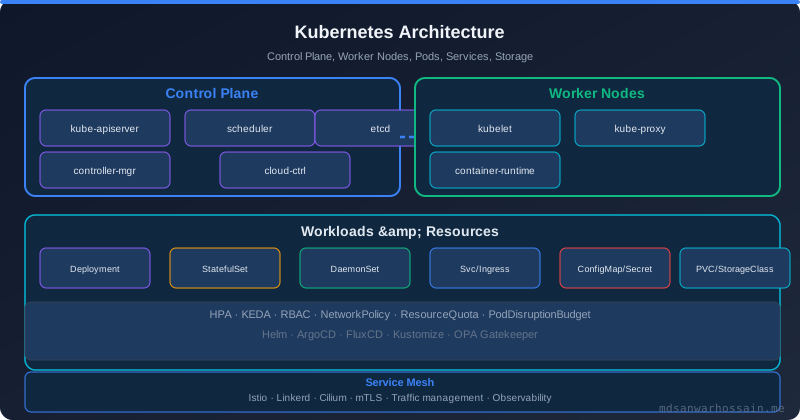
DevOps in 2026 is a sociotechnical system, not a tool configuration problem. The teams that ship reliably have aligned on cultural practices — blameless incident reviews, shared ownership of reliability, transparent metrics — as much as technical practices. No pipeline configuration compensates for unclear ownership or no-fault deployment culture that normalizes rushing changes without testing. Invest equally in the human and technical sides of your delivery system. The compound result is an organization that can confidently say yes to business needs while maintaining the operational stability that keeps users and engineers alike productive and engaged.
Frequently Asked Questions
What is Optimize for lead time and change failure rate together and how does it work?
Speed without reliability creates chaos. Reliability without speed creates stagnation. Track both lead time to production and change failure rate as primary delivery metrics. Teams that focus on one and ignore the other usually oscillate between rushed releases and process-heavy slowdowns. Use weekly trend reviews to understand when delivery speed starts hurting quality or when caution starts blocking business value.
What is Make CI pipelines strict, fast, and deterministic and how does it work?
A pipeline that is slow or flaky quickly loses team trust. Keep CI steps parallelized where possible and cache dependencies intelligently. Fail fast on formatting, linting, and unit tests before expensive integration stages. Pin tool versions to avoid inconsistent results across environments. Deterministic pipelines reduce debugging time and make delivery more predictable. Also treat pipeline-as-code as production code: versioned, reviewed, and tested with changesets.
What is Introduce quality gates that map to risk and how does it work?
Not all changes should have identical release gates. A UI text fix should not require the same approvals as payment logic changes. Build a risk-based matrix: low-risk changes follow a lightweight path, while high-risk changes require stronger test coverage, security checks, and staged rollout. Risk-aware gates keep teams fast without normalizing unsafe deployments.
How does the Design rollback strategy before deployment work?
Many teams discover rollback pain during incidents because backward compatibility was not planned. Use deployment patterns that support safe reversibility: blue-green, canary, and feature-flag-driven releases. For schema changes, use expand-and-contract migration strategy so old and new versions can coexist during transition windows. A deployment is not complete if rollback is unclear.
What is Treat feature flags as operational controls and how does it work?
Feature flags are powerful for progressive delivery and incident mitigation, but unmanaged flags create technical debt. Define ownership, expiration dates, and cleanup workflows. Separate release flags from experiment flags and from emergency-disable toggles. Maintain a dashboard that shows active flags and their blast radius to avoid hidden complexity.
Leave a Comment

Software Engineer · Java · Spring Boot · Microservices