Platform Engineering in 2026: Building Internal Developer Platforms That Scale
High-performing engineering organizations have stopped giving every team a blank infrastructure canvas. Instead, they build opinionated platforms that encode security, reliability, and compliance into the delivery path itself—making the right way the easy way.
TL;DR
"Platform engineering in 2026: building internal developer platforms, golden paths, and self-service workflows for fast, secure software delivery."
There is a pattern repeating in every fast-scaling engineering organization: as the number of services, teams, and cloud resources grows, the cognitive overhead of building, deploying, and operating software becomes a competitive liability. Teams spend 30–40% of their time not on product features but on infrastructure configuration, security compliance, onboarding new services, and reinventing deployment patterns. Platform engineering exists to solve this problem at scale.
An Internal Developer Platform (IDP) is not just a collection of DevOps tools. It is a carefully designed product for software engineers—one that abstracts infrastructure complexity, enforces security baselines, and enables self-service delivery with guardrails. The companies winning on developer experience in 2026 are the ones that treat their platform as a first-class product, not an IT utility.
Table of Contents
What Is Platform Engineering, Really?
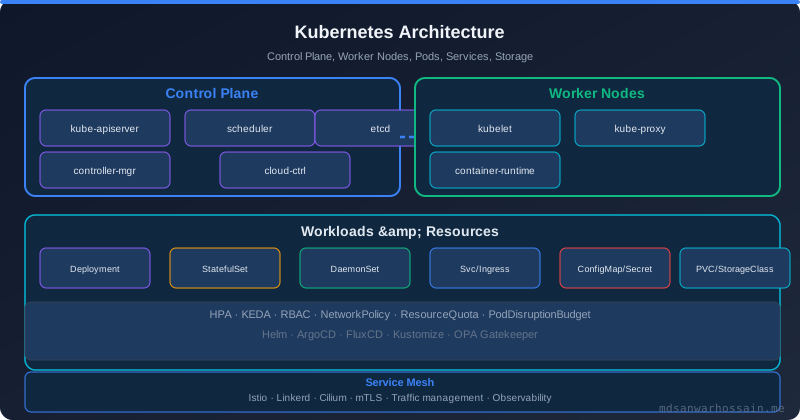
Platform engineering is the discipline of building and operating self-service infrastructure capabilities for software development teams. The key deliverable is an Internal Developer Platform: a set of tools, workflows, and APIs that let product engineers provision infrastructure, deploy services, manage secrets, monitor applications, and satisfy compliance requirements—all without needing to be Kubernetes or cloud infrastructure experts.
Think of it as the difference between giving every chef in a restaurant full access to a raw kitchen versus giving them a well-stocked, organized kitchen with a prep team. The chefs still cook; they just spend more time cooking and less time finding ingredients.
Real-World Use Cases
Self-service service creation
A developer needs a new microservice. With a mature IDP, they select a service template (e.g., "Java Spring Boot API with observability and CI/CD"), answer a few configuration questions, and within minutes have a fully provisioned repository with a working pipeline, security defaults, and monitoring dashboards. Without a platform, this same process involves tickets to multiple teams and takes days or weeks.
Standardized deployment workflows
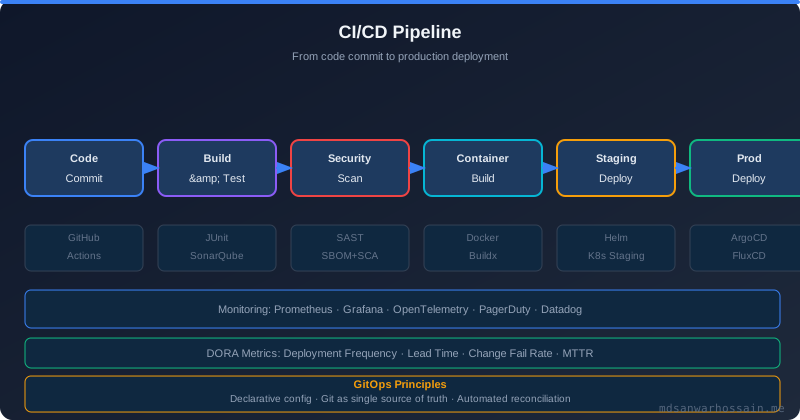
Platform engineering teams provide golden path deployment pipelines that include security scanning, SBOM generation, canary rollout logic, and automatic rollback triggers. Product teams use these pipelines without needing to configure them—and the platform team can update security policies across all services simultaneously by modifying the shared pipeline template.
Developer onboarding acceleration
A well-built IDP dramatically reduces the time a new engineer needs to become productive. Service catalog, documentation, environment setup scripts, and access request workflows are all surfaced through a single portal—reducing onboarding time from weeks to days.
Core Pillars of a Modern IDP
1) Golden paths over free-for-all infrastructure
Golden paths are opinionated, pre-built templates for common service patterns: REST APIs, event consumers, background workers, and scheduled jobs. Each template includes built-in observability, CI/CD pipeline, security controls, and deployment manifests. Teams are free to deviate from golden paths, but the path of least resistance leads through them—which means most teams use them by default, and security and reliability standards are automatically applied at scale.
2) Service catalog as the single source of truth
A service catalog (tools like Backstage or OpsLevel provide this) gives every engineer visibility into what services exist, who owns them, what APIs they expose, what dependencies they have, and what their current health status is. Without a catalog, organizations develop sprawl: orphaned services, duplicate functionality, and unclear ownership that slows down incident response. A good catalog is living infrastructure documentation.
3) Policy as code for compliance at scale
Security and compliance requirements encoded in manual approval processes do not scale. Policy as code tools (Open Policy Agent, Kyverno, Conftest) let platform teams express compliance requirements programmatically and enforce them automatically in pipelines and Kubernetes admission controllers. When a new compliance requirement arrives, platform teams update the policy codebase once—and it propagates across all services immediately.
4) Shift-left security with integrated tooling
Platform teams own the shared security tooling that product teams rely on: dependency scanning, container image vulnerability checks, secrets detection, SAST, and DAST integrations. By centralizing these tools in the platform, organizations ensure consistent coverage without burdening product teams with security tool selection and maintenance. The platform surfaces findings with clear remediation guidance, keeping security a fast feedback loop rather than a late-stage gate.
5) Product mindset for platform development
The most common platform engineering failure mode is building tooling that nobody uses. Platform teams succeed when they treat their platform as a product with real users—adopting roadmaps, measuring satisfaction, running user research, and prioritizing features based on developer pain points. Measure platform success with developer Net Promoter Score, service onboarding lead time, and percentage of services using golden path templates.
6) Observability bootstrap included by default
Every service created through the IDP should come with observability pre-wired: structured logging, distributed tracing integration, RED metrics, and basic alerting rules. Engineers should not have to set up monitoring from scratch for every new service. A platform team that bakes observability defaults into service templates dramatically reduces the "dark service" problem—where new services go to production with no visibility until an incident occurs.
Tools & Technologies
- Backstage — Open-source service catalog and developer portal framework by Spotify
- Crossplane — Kubernetes-native infrastructure provisioning with composable APIs
- ArgoCD / Flux — GitOps continuous delivery operators for Kubernetes
- Open Policy Agent (OPA) — Policy-as-code engine for Kubernetes and CI/CD
- Kyverno — Kubernetes-native policy management with admission control
- Terraform / OpenTofu — Infrastructure as code for cloud resource management
- Port — Commercial IDP platform with customizable developer portal and catalog
Agentic AI in Platform Engineering
Agentic AI is beginning to transform platform engineering workflows. AI assistants can handle routine platform requests—"provision a new staging environment," "create a secrets path for service X," "add a new team to the access control policy"—by interpreting natural-language requests and executing them against platform APIs with appropriate guardrails. This reduces ticket volume for platform teams while giving product engineers faster self-service.
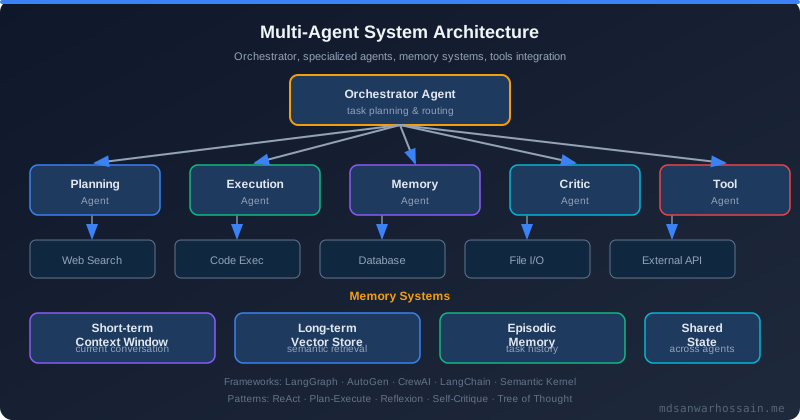
More advanced use cases include AI-driven infrastructure cost optimization (identifying unused resources, right-sizing over-provisioned services), intelligent incident routing based on service catalog metadata, and automated compliance gap analysis across the service fleet. The key governance principle: AI can recommend and prepare changes, but infrastructure modifications should require human approval before execution.
Future Trends
Platform engineering will continue to evolve toward AI-native IDPs where natural language becomes the primary interface for infrastructure requests. Multi-cloud abstraction layers will mature, allowing organizations to move workloads across cloud providers with minimal friction. Developer experience metrics will become as rigorous as system reliability metrics, with platforms continuously optimizing for reduced cognitive load and faster time-to-production.
Building Your First IDP: A Practical Roadmap
Most teams approach platform engineering wrong — they try to build everything at once and end up with a half-finished portal that nobody uses. The successful approach is incremental: start with the highest-friction problem your developers face and solve it completely before moving on. Based on our experience at BRAC IT and industry patterns, this is the sequence that works:
| Phase | Focus | Key Deliverable | Success Metric |
|---|---|---|---|
| 1 (Month 1–2) | Golden paths | Standard service template (Backstage) | New service scaffolded in < 10 min |
| 2 (Month 3–4) | Self-service deploy | Opinionated CI/CD templates (GitHub Actions + ArgoCD) | Deploy without ops ticket |
| 3 (Month 5–6) | Observability | Auto-provisioned Grafana dashboards per service | Zero manual dashboard setup |
| 4 (Month 7–9) | Security automation | OPA policy-as-code, secret scanning in CI | Zero manual security review for standard changes |
| 5 (Month 10–12) | Cost governance | Cloud cost showback per team, rightsizing alerts | 10–20% cloud cost reduction |
At BRAC IT: Our Platform Engineering Journey
In 2022, BRAC IT's engineering team had grown to 40 developers working across a monolith and 8 microservices. Deployment was a manual process: a developer would message the DevOps team on Slack, the DevOps engineer would SSH into the server, pull the latest image, and restart the service. Average deployment time: 45 minutes. On bad days, 3 hours. Engineers were waiting more than coding.
The trigger for platform engineering was a post-mortem from a major outage. A developer had deployed a service with a misconfigured database connection string. There were no automated checks, no staging promotion gates, no automatic rollback. We lost 4 hours of production uptime. The post-mortem conclusion: the problem was not the developer's error — it was that we had no golden path that made the right way the easy way.
Eighteen months later, our platform includes: Backstage for service catalog (every team registers their service, docs auto-generate from the README), GitHub Actions templates with mandatory security scanning and automated test gates, ArgoCD for GitOps deployments with automatic rollback on health check failure, and Prometheus/Grafana dashboards that are provisioned automatically when a new service is registered. Our DORA metrics transformed:
- Deployment frequency: 2/week → 14/week per team
- Lead time for changes: 3 days → 4 hours
- MTTR: 3.5 hours → 28 minutes
- Change failure rate: 18% → 4%
The lesson: platform engineering is not about tooling. It is about removing friction from the critical path. Every hour a developer spends on deployment, monitoring setup, or security configuration is an hour not spent building product. The platform team's job is to make all of that invisible.
Measuring Platform Success
Platform teams often struggle to justify investment because the benefits are diffuse — faster deployments, fewer incidents, less context-switching — and hard to attribute directly. Track these four DORA metrics monthly and present them to leadership alongside platform investment:
Deployment Frequency measures how often you push to production. High performers deploy on-demand, multiple times per day. If your frequency is low, the platform is not reducing deployment friction fast enough.
Lead Time for Changes is the time from commit to production. Includes CI time, code review wait time, and deployment time. Platform investment in CI caching, parallel test execution, and self-service deployment directly reduces this.
Mean Time to Recovery (MTTR) measures how quickly you restore service after an incident. Platform investments in observability (auto-dashboards, distributed tracing) and deployment tooling (one-click rollback) directly reduce MTTR.
Change Failure Rate is the percentage of deployments that cause an incident. Platform investment in automated testing gates, security scanning, and canary deployment reduces this.
Beyond DORA, run a quarterly Developer Net Promoter Score survey: "On a scale of 0–10, how likely are you to recommend our developer platform to a new joiner?" Platform teams at BRAC IT are held accountable to a target developer NPS of 7+. When it drops, the platform team treats it as a production incident — something is broken in the developer experience and needs immediate attention.
Backstage Service Catalog: Making It Stick
Backstage is the most widely adopted IDP foundation, but many teams deploy it and find that developers stop using it within weeks. The reason: Backstage provides value only when the data in it is accurate and complete. A service catalog where 40% of services have missing documentation, broken links, and stale oncall information is worse than no catalog — it actively misleads engineers during incidents.
Make catalog accuracy non-negotiable by automating it into your deployment pipeline. A service that fails to register a valid catalog-info.yaml before deployment gets blocked:
apiVersion: backstage.io/v1alpha1
kind: Component
metadata:
  name: loan-service
  description: Core loan origination and lifecycle management
  annotations:
    github.com/project-slug: bracit/loan-service
    pagerduty.com/service-id: "PXXXXXXX"
    grafana/dashboard-url: "https://grafana.internal/d/loan-service"
    runbooks.bracit.com/incidents: "https://wiki.internal/runbooks/loan-service"
spec:
  type: service
  lifecycle: production
  owner: group:lending-team
  providesApis:
    - loan-api
  consumesApis:
    - credit-bureau-api
    - payment-gateway-api
  dependsOn:
    - resource:default/loan-db
    - resource:default/loan-kafka-topic
The annotations block is where Backstage earns its value: each annotation creates a deep-link from the service page to PagerDuty (one-click incident creation), Grafana (live dashboards), and internal runbooks. During a production incident, the on-call engineer sees the failing service in Backstage and has immediate access to all operational context without searching across five different tools.
Run a weekly catalog quality report. Services missing oncall annotation, documentation link, or dependency declarations are flagged and the owning team's engineering manager receives a Slack message. After four weeks of this enforcement, our catalog completeness at BRAC IT rose from 62% to 96%.
Conclusion
Platform engineering is the force multiplier that allows engineering organizations to scale delivery without proportionally scaling infrastructure complexity. By building opinionated golden paths, enforcing policy as code, and treating the developer platform as a product, platform teams enable product engineers to move faster and more safely. In 2026, the organizations with mature IDPs ship faster, have fewer security incidents, and retain engineering talent more effectively. The investment in platform engineering is ultimately an investment in every team's ability to deliver value.
Leave a Comment
Related Posts

Software Engineer · Java · Spring Boot · Microservices