Secure Software Supply Chain: SBOM, SLSA, and Provenance for Modern Teams
As software depends on ever-larger dependency graphs and complex build pipelines, release security depends on proving what was built, where it came from, and how every step was verified. The age of "it came from our CI" as sufficient assurance is over.
TL;DR
"Secure software supply chain guide: SBOM, SLSA levels, artifact signing, dependency scanning, and provenance verification for modern engineering teams."
In December 2020, a routine software update from a trusted vendor silently delivered a backdoor to thousands of organizations around the world. The SolarWinds attack was not a zero-day exploit or a brute-force breach—it was a supply chain compromise. Attackers inserted malicious code into a legitimate build process, and the resulting signed artifact was delivered and trusted by enterprise security teams worldwide. This event permanently changed how the security community thinks about software provenance and build integrity.
Software supply chain security has since evolved from a niche concern to a boardroom priority. Executive orders, regulatory frameworks, and customer contracts increasingly require organizations to demonstrate the provenance, integrity, and composition of every software artifact they produce. This guide covers the practical controls that engineering teams need to implement—and the standards that are rapidly becoming industry baseline requirements.
Table of Contents
Understanding the Software Supply Chain Attack Surface
The software supply chain includes every step from source code to production: source repositories, third-party dependencies, build systems, CI/CD pipelines, container registries, and deployment infrastructure. An attacker who compromises any one of these steps can potentially inject malicious code into production software that looks entirely legitimate. Common attack vectors include:
- Dependency confusion attacks — Publishing malicious packages to public registries with names that collide with internal package names
- Typosquatting — Registering packages with names similar to popular libraries to catch typos in dependency declarations
- Compromised maintainer accounts — Gaining control of legitimate package maintainer credentials to inject malicious code into widely-used libraries
- Build system compromise — Attacking CI/CD infrastructure to modify artifacts during compilation, not at the source code level
- Container image poisoning — Publishing compromised base images to public registries
Real-World Use Cases
Enterprise software procurement
Procurement and vendor management teams increasingly require Software Bills of Materials (SBOMs) from software vendors as part of contract requirements. An SBOM lets procurement teams understand the full dependency graph of vendor software, assess exposure to known vulnerabilities, and accelerate incident response when a new CVE affects a transitive dependency.
Regulated industry compliance
Healthcare, financial services, and government contractors face regulatory requirements that mandate demonstrable software integrity controls. SLSA attestations and provenance records provide the audit trail that compliance frameworks require—reducing the manual evidence gathering that previously consumed security teams' time during audits.
Incident response acceleration
When a critical vulnerability is announced (like Log4Shell in 2021), organizations with mature SBOM practices can identify affected services within minutes by querying their artifact database. Organizations without SBOMs face days or weeks of manual inventory work under severe time pressure. The difference in response capability is stark and measurable.
Core Supply Chain Security Controls
1) Generate SBOMs continuously in CI
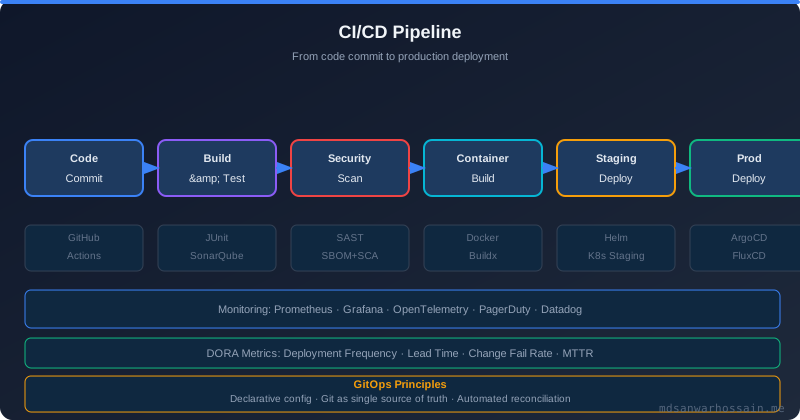
A Software Bill of Materials is a structured inventory of every component in a software artifact: libraries, frameworks, transitive dependencies, their versions, and their known licenses. Generate SBOMs automatically as part of every build and store them alongside the artifacts they describe. Use standardized formats—SPDX and CycloneDX are the dominant standards in 2026. Attach SBOMs to container images using OCI annotations so deployment systems can access them without separate lookups. A SBOM that is generated once and filed away provides limited value; one that is continuously updated and queryable enables real-time vulnerability management.
2) Implement continuous dependency vulnerability scanning
Dependency scanners compare your SBOM against vulnerability databases (the National Vulnerability Database, OSV, GitHub Advisory Database) to identify known CVEs in your dependencies. Integrate scanning into CI pipelines so new vulnerabilities are caught before they reach production—not discovered during a security audit or, worse, during an active exploit. Tools like Trivy, Grype, and Snyk provide fast, accurate scanning for container images, application manifests, and SBOMs. Define breaking severity thresholds: block deployment for Critical and High vulnerabilities by default, require exception documentation for waivers.
3) Sign artifacts and generate provenance attestations
Artifact signing with cryptographic keys proves that an artifact came from a specific signer and has not been tampered with since signing. Keyless signing via Sigstore's Cosign tool, backed by the Rekor transparency log, has become the modern standard—eliminating the key management burden while providing strong tamper evidence. For every container image, binary, or artifact, generate a provenance attestation that records: who built it, when, from what source commit, using what build process, and with what environment. This attestation, signed and stored in the transparency log, enables deployment-time verification that only approved artifacts reach production.
4) Adopt SLSA levels incrementally
Supply-chain Levels for Software Artifacts (SLSA) is a framework that defines security controls in increasing levels of assurance. SLSA Level 1 requires provenance generation. Level 2 requires hosted build services with signed provenance. Level 3 requires hardened build environments with strong isolation and non-forgeability guarantees. Start at SLSA Level 1 for all new services and prioritize SLSA Level 2+ for critical workloads: payment processing, authentication services, and customer data handling. Incremental adoption prevents the "perfect security as an obstacle to any security" failure mode.
5) Enforce artifact verification at deployment time
Generating SBOMs and signing artifacts is only useful if deployment systems actually verify them. Use admission controllers (Kubernetes policy engines like Kyverno or OPA/Gatekeeper) to reject any workload whose container image lacks a valid, trusted signature or whose provenance fails verification checks. This creates a deployment policy that enforces supply chain security automatically—no manual process can be bypassed or forgotten. Define trusted signing identities explicitly and rotate signing keys on a defined schedule.
6) Secure your build environment
A compromised build environment can produce malicious artifacts with valid signatures—defeating provenance controls that verify only the signing step, not the build integrity. Harden CI/CD environments: use ephemeral build runners that are destroyed after each job, restrict network access to only required registries and APIs, pin tool versions cryptographically, and log all build environment access for audit. Principle of least privilege applies to build systems as much as to production infrastructure.
7) Pin dependencies with cryptographic hashes
Version pinning (e.g., library==2.3.1) prevents unintentional upgrades but does not prevent a malicious actor from replacing a specific version with compromised content. Hash pinning (locking to a specific SHA256 digest) ensures you always use exactly the artifact you verified—not a replacement that happens to share the same version number. Use hash pinning for all direct dependencies in production systems and automate dependency update pull requests so hash pins are refreshed when you intentionally upgrade.
8) Monitor for new vulnerabilities in production artifacts
Vulnerability scanning at build time does not protect against CVEs that are published after deployment. Implement continuous monitoring that re-evaluates deployed artifacts against current vulnerability databases daily. When a new critical CVE affects a running workload, alert the owning team immediately with context: affected service, component, severity, and recommended remediation. This closes the window between vulnerability publication and organizational awareness from weeks to hours.
Tools & Technologies
- Sigstore / Cosign — Keyless artifact signing and verification backed by transparency logs
- Syft — Fast SBOM generation for container images and filesystems (SPDX, CycloneDX)
- Grype / Trivy — Container and SBOM vulnerability scanners with CI integration
- Snyk — Developer-friendly dependency and container vulnerability scanning with fix guidance
- SLSA GitHub Actions — Official provenance generation workflows implementing SLSA framework
- Kyverno / OPA Gatekeeper — Kubernetes admission controllers for policy enforcement including artifact verification
- Rekor — Open-source immutable transparency log for software supply chain metadata
Agentic AI for Supply Chain Security
Agentic AI tools are beginning to accelerate supply chain security operations. AI agents can automatically triage vulnerability scan results—prioritizing findings based on reachability analysis, production exposure, and business criticality rather than raw CVSS scores alone. They can draft remediation pull requests for dependency upgrades, generate SBOM query reports for incident response, and monitor transparency logs for suspicious signing activity. The governance principle: AI can automate analysis and recommendation, but vulnerability waiver decisions and signing key management must remain under human control with full audit trails.
Future Trends
Software supply chain security will see continued regulatory pressure, with SBOM requirements becoming standard in enterprise procurement and government contracts globally. Expect tighter integration of supply chain security controls into major cloud provider CI/CD platforms, making SLSA compliance accessible without custom tooling. AI-powered software composition analysis will improve reachability analysis—moving beyond "this vulnerability exists in your dependency" to "this vulnerability is exploitable in your code path."
Conclusion
Supply chain security is no longer optional for engineering teams that want to claim production-grade security posture. The controls described here—SBOM generation, continuous vulnerability scanning, artifact signing, provenance attestation, and deployment-time verification—form the foundation of a defensible software supply chain. Start with the controls that give you the highest visibility for the least operational burden: SBOM generation and dependency scanning in CI. Then layer in signing, provenance, and admission control as your team's maturity grows. Every layer you add makes your software harder to compromise without detection.
Frequently Asked Questions
What is Understanding the Software Supply Chain Attack Surface and how does it work?
The software supply chain includes every step from source code to production: source repositories, third-party dependencies, build systems, CI/CD pipelines, container registries, and deployment infrastructure. An attacker who compromises any one of these steps can potentially inject malicious code into production software that looks entirely legitimate. Common attack vectors include: Dependency confusion attacks — Publishing malicious packages to public registries with names that collide with internal package names Typosquatting — Registering packages with names similar to popular libraries to catch typos in dependency declarations Compromised maintainer accounts — Gaining control of legitimate package maintainer credentials to inject malicious code into widely-used libraries Build system compromise — Attacking CI/CD infrastructure to modify artifacts during compilation, not at the source code level
What is Enterprise software procurement and how does it work?
Procurement and vendor management teams increasingly require Software Bills of Materials (SBOMs) from software vendors as part of contract requirements. An SBOM lets procurement teams understand the full dependency graph of vendor software, assess exposure to known vulnerabilities, and accelerate incident response when a new CVE affects a transitive dependency.
What is Regulated industry compliance and how does it work?
Healthcare, financial services, and government contractors face regulatory requirements that mandate demonstrable software integrity controls. SLSA attestations and provenance records provide the audit trail that compliance frameworks require—reducing the manual evidence gathering that previously consumed security teams' time during audits.
What is Incident response acceleration and how does it work?
When a critical vulnerability is announced (like Log4Shell in 2021), organizations with mature SBOM practices can identify affected services within minutes by querying their artifact database. Organizations without SBOMs face days or weeks of manual inventory work under severe time pressure. The difference in response capability is stark and measurable.
What is Generate SBOMs continuously in CI and how does it work?
A Software Bill of Materials is a structured inventory of every component in a software artifact: libraries, frameworks, transitive dependencies, their versions, and their known licenses. Generate SBOMs automatically as part of every build and store them alongside the artifacts they describe. Use standardized formats—SPDX and CycloneDX are the dominant standards in 2026. Attach SBOMs to container images using OCI annotations so deployment systems can access them without separate lookups. A SBOM that is generated once and filed away provides limited value; one that is continuously updated and queryable enables real-time vulnerability management.
Leave a Comment
Related Posts

Software Engineer · Java · Spring Boot · Microservices