Grails vs Spring Boot: When to Use Each for JVM Enterprise Applications
The "Grails is dead" narrative is wrong — and costly for the engineers who believe it. Grails 6 is actively maintained, runs on Spring Boot 3 under the hood, and gives small-to-medium teams a productivity advantage that pure Spring Boot can't match. But Spring Boot wins in microservices, cloud-native deployments, and ecosystems where Kotlin or Java is the team language. This guide gives you the honest decision framework.
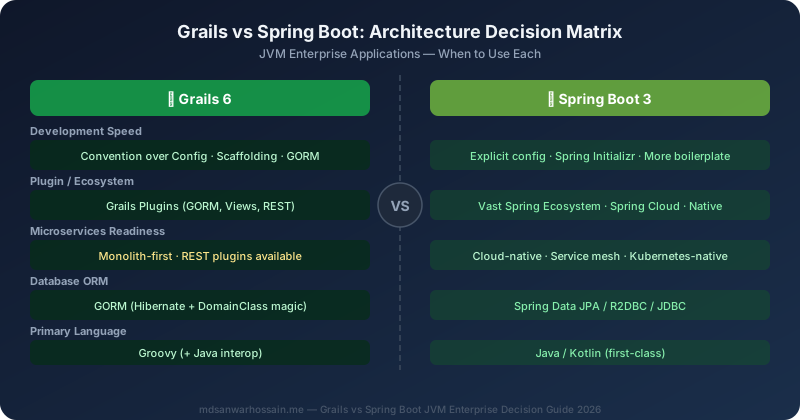
TL;DR
"Grails vs Spring Boot for JVM enterprise applications: an honest technical comparison covering GORM vs Spring Data JPA, Groovy vs Java/Kotlin, plugin."
Table of Contents
- Why Grails Still Matters in 2026
- GORM vs Spring Data JPA: The Productivity Gap
- Groovy vs Java/Kotlin: Language Trade-offs
- Plugin Ecosystem Comparison
- Spock Testing: Where Grails Outshines Spring Boot
- Microservices Readiness: Where Spring Boot Wins
- Performance Comparison
- Decision Framework: Which to Choose?
- Migrating from Grails to Spring Boot (Strangler Fig)
- Grails 6 New Features You Should Know
- Conclusion
Why Grails Still Matters in 2026
Grails is not a legacy framework — it is a different productivity trade-off. While Spring Boot 3 requires you to explicitly declare every bean, configure every data source, and write a lot of boilerplate JPA repository code, Grails gives you:
- GORM — dynamic finders, criteria queries, and Hibernate-backed domain classes with zero XML
- Convention over configuration — controllers, services, and domain classes are auto-discovered by name
- Scaffolding — generate full CRUD controllers and views in seconds:
grails generate-all com.example.Book - Groovy — concise language with optional typing, closures, and no semicolons
Grails 6 ships with Spring Boot 3.x under the hood. That means you get Spring Security, Spring Data, and Spring Cloud integrations — with less boilerplate than a raw Spring Boot project.
GORM vs Spring Data JPA: The Productivity Gap
The most significant difference between the two frameworks is in persistence. Here is the same repository in both frameworks:
// Spring Boot — Spring Data JPA (explicit, verbose)
@Entity
public class Book {
    @Id @GeneratedValue(strategy = GenerationType.IDENTITY)
    private Long id;
    private String title;
    private String author;
    private BigDecimal price;
    // getters, setters, equals, hashCode — or use Lombok
}

@Repository
public interface BookRepository extends JpaRepository<Book, Long> {
    List<Book> findByAuthorOrderByTitleAsc(String author);
    List<Book> findByPriceLessThan(BigDecimal maxPrice);
    Optional<Book> findByTitleIgnoreCase(String title);
}

// Usage in service
@Service
public class BookService {
    private final BookRepository bookRepository;
    public BookService(BookRepository bookRepository) {
        this.bookRepository = bookRepository;
    }
    public List<Book> cheapBooks(BigDecimal limit) {
        return bookRepository.findByPriceLessThan(limit);
    }
}
// Grails — GORM domain class (convention-driven, minimal)
class Book {
String title
String author
BigDecimal price
static constraints = {
title blank: false, maxSize: 255
author blank: false
price min: 0.0G
}
}
// Usage in Grails service — zero repository class needed
class BookService {
List<Book> cheapBooks(BigDecimal limit) {
Book.findAllByPriceLessThan(limit) // dynamic finder
// or:
Book.where { price < limit }.list() // criteria API
}
}The Grails version is roughly 60% fewer lines of code for equivalent functionality. For a domain model with 20+ entities, this compounds into weeks of saved development time.
Groovy vs Java/Kotlin: Language Trade-offs
Grails uses Groovy as its primary language. Groovy is a JVM language that compiles to Java bytecode and is fully interoperable with Java:
// Groovy in Grails — expressive and concise
class BookController {
    BookService bookService

    def index() {
        [books: bookService.listAll()]  // map literal — auto-rendered to view
    }

    def save(BookCommand cmd) {
        if (cmd.hasErrors()) {
            respond cmd.errors, view: 'create'
            return
        }
        bookService.save(cmd)
        redirect action: 'index'
    }
}

// Groovy closures for data transformation
def expensiveAuthors = Book.findAll()
    .groupBy { it.author }
    .findAll { author, books -> books.sum { it.price } > 1000 }
    .keySet()
// Spring Boot — equivalent in Java (Kotlin would be more concise)
@RestController
@RequestMapping("/books")
public class BookController {
private final BookService bookService;
public BookController(BookService bookService) {
this.bookService = bookService;
}
@GetMapping
public ResponseEntity<List<Book>> index() {
return ResponseEntity.ok(bookService.listAll());
}
@PostMapping
public ResponseEntity<?> save(@Valid @RequestBody BookCommand cmd, BindingResult result) {
if (result.hasErrors()) {
return ResponseEntity.badRequest().body(result.getAllErrors());
}
bookService.save(cmd);
return ResponseEntity.status(HttpStatus.CREATED).build();
}
}The Groovy advantage: closures, dynamic typing, GStrings, and powerful collection manipulation DSLs make data-centric code significantly shorter. The trade-off is IDE support — IntelliJ handles Groovy well, but Kotlin gets better tooling today.
Plugin Ecosystem Comparison
| Concern | Grails Plugin | Spring Boot Equivalent |
|---|---|---|
| Security | spring-security-core |
Spring Security 6 |
| REST API | grails-rest (JSON views) |
@RestController + Jackson |
| MongoDB | gorm-mongodb |
Spring Data MongoDB |
| Caching | cache-redis |
Spring Cache + Caffeine/Redis |
| Async | grails-async (GPars) |
Spring WebFlux / Virtual Threads |
| Testing | Spock Framework (built-in) | JUnit 5 + Mockito + AssertJ |
| API Docs | swagger-grails4 |
SpringDoc OpenAPI 3 |
| Service Discovery | Limited | Spring Cloud Netflix / Consul |
Spock Testing: Where Grails Outshines Spring Boot
Grails projects default to Spock, a Groovy-based testing framework that produces the most readable test code on the JVM:
// Grails + Spock — data-driven integration test
class BookServiceSpec extends Specification {

    BookService bookService = new BookService()

    def "findCheapBooks returns only books under the price limit"() {
        given:
        new Book(title: "Clean Code", author: "Robert Martin", price: 29.99).save(flush: true)
        new Book(title: "DDIA", author: "Martin Kleppmann", price: 49.99).save(flush: true)

        when:
        def result = bookService.cheapBooks(35.0G)

        then:
        result.size() == 1
        result[0].title == "Clean Code"
    }

    @Unroll
    def "price validation rejects #price"() {
        when:
        def book = new Book(title: "Test", author: "Author", price: price)

        then:
        !book.validate()
        book.errors['price'] != null

        where:
        price << [-1.0G, -100.0G, null]
    }
}
The given / when / then blocks and @Unroll data tables produce tests that read like specifications, making them significantly easier to review and maintain than JUnit 5 + Mockito equivalents.
Microservices Readiness: Where Spring Boot Wins
Spring Boot is the clear winner for microservices architectures. Here is why:
- Spring Cloud: Netflix Eureka, Consul, Ribbon, Feign, Circuit Breaker — first-class support with Spring Boot
- GraalVM Native Image: Spring Boot 3 + GraalVM compiles to a native binary with <50ms startup and minimal memory. Grails is not supported
- Spring WebFlux: Reactive, non-blocking I/O for high-throughput microservices. Grails async plugins exist but are less mature
- Kotlin support: Spring Boot has first-class Kotlin support with coroutines, data classes, and extension functions
- Container size: A bare-bones Spring Boot microservice can be <150 MB. Grails apps typically start at 200–300 MB due to the full Groovy runtime
Performance Comparison
| Metric | Grails 6 | Spring Boot 3 (JVM) | Spring Boot 3 (Native) |
|---|---|---|---|
| Cold start (JVM) | 3–8 s | 2–5 s | 30–80 ms |
| Throughput (req/s)* | ~25k | ~28k | ~25k |
| Heap at idle | 220–350 MB | 150–250 MB | 20–60 MB |
| Dev hot reload | Very fast (Groovy) | Spring DevTools | N/A |
| Docker image size | ~280 MB | ~200 MB | ~50 MB |
* Throughput is similar because both frameworks use the same underlying Tomcat/Undertow servers.
Decision Framework: Which to Choose?
Choose Grails When:
- Rapid prototyping or MVP — scaffolding + GORM cuts initial development time by 40–60%
- Small-to-medium teams (2–8 engineers) where convention-over-configuration productivity matters more than flexibility
- Data-centric monoliths — admin panels, internal tools, CRUD-heavy back-offices
- Groovy expertise on the team — Groovy devs are significantly more productive in Grails
- Spock testing is a priority — Grails comes with Spock out of the box
- Maintaining existing Grails applications — migrating to Spring Boot just to follow trends is rarely worth the cost
Choose Spring Boot When:
- Microservices architecture — Spring Cloud + service mesh + Docker/Kubernetes is unmatched
- Kotlin or Java team — Spring Boot 3 with Kotlin coroutines is an excellent DX
- GraalVM Native Image — sub-100ms cold starts for serverless or edge deployments
- Large teams (10+ engineers) — explicit configuration is easier to reason about at scale
- Reactive workloads — WebFlux + R2DBC for non-blocking, high-throughput APIs
- Hiring — the Spring Boot talent pool is vastly larger than Grails
Migrating from Grails to Spring Boot (Strangler Fig)
If you have an existing Grails monolith and need to migrate incrementally to Spring Boot microservices, the Strangler Fig pattern is your friend:
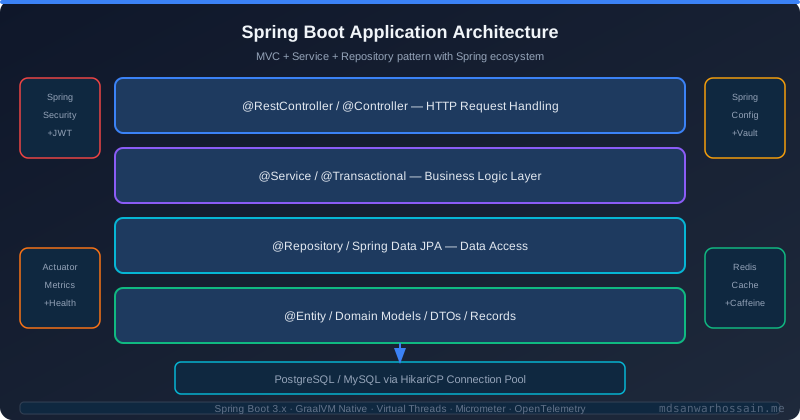
// Step 1: Expose Grails as a REST API (already built-in with grails-rest plugin)
// grails-app/controllers/com/example/BookController.groovy
import grails.rest.RestfulController

class BookController extends RestfulController<Book> {
    BookController() {
        super(Book)
    }
    // All CRUD endpoints are generated automatically:
    // GET    /books        → index()
    // POST   /books        → save()
    // GET    /books/{id}   → show()
    // PUT    /books/{id}   → update()
    // DELETE /books/{id}   → delete()
}

// Step 2: Add a Spring Boot microservice as a new service
// The Spring Boot service calls the Grails API via RestTemplate or WebClient
// while you progressively migrate domain-by-domain

@Service
public class BookClient {
    private final WebClient webClient;

    public BookClient(WebClient.Builder builder) {
        this.webClient = builder.baseUrl("http://grails-app:8080").build();
    }

    public Flux<BookDto> fetchAll() {
        return webClient.get()
            .uri("/books")
            .retrieve()
            .bodyToFlux(BookDto.class);
    }
}

// Step 3: Route new traffic to Spring Boot, old traffic to Grails
// Use an API Gateway (Spring Cloud Gateway or nginx) to split traffic
// based on feature flags or URL paths
Grails 6 New Features You Should Know
- Spring Boot 3.x under the hood — Jakarta EE namespace, virtual threads (Java 21), GraalVM hints (experimental)
- GORM 9 — improved Hibernate 6 compatibility, better schema generation, multi-tenancy improvements
- Micronaut for Grails — use Micronaut's dependency injection (AOT compilation) instead of Spring's for faster startup
- Groovy 4 — Java module system support, better performance, sealed classes
- REST Profile — create a pure REST API Grails project without views:
grails create-app myapi --profile=rest-api
Conclusion
The "Spring Boot vs Grails" debate is a false binary. Both are built on the same foundation — Spring Framework, Hibernate/JPA, and Tomcat. The real question is: what trade-offs serve your team's context?
If you need to ship a data-centric application quickly with a small team, Grails' convention-over-configuration approach and GORM magic will outperform a raw Spring Boot project in developer velocity. If you need cloud-native microservices, GraalVM native executables, or Kotlin-first development, Spring Boot is the better foundation.
And if you have a running Grails application — keep it. Migrate incrementally via the Strangler Fig pattern when (and only if) the business need justifies the cost.
Frequently Asked Questions
Why Grails Still Matters in 2026?
Grails is not a legacy framework — it is a different productivity trade-off . While Spring Boot 3 requires you to explicitly declare every bean, configure every data source, and write a lot of boilerplate JPA repository code, Grails gives you: Grails 6 ships with Spring Boot 3.x under the hood. That means you get Spring Security, Spring Data, and Spring Cloud integrations — with less boilerplate than a raw Spring Boot project. GORM — dynamic finders, criteria queries, and Hibernate-backed domain classes with zero XML Convention over configuration — controllers, services, and domain classes are auto-discovered by name Scaffolding — generate full CRUD controllers and views in seconds: grails generate-all com.example.Book Groovy — concise language with optional typing, closures, and no semicolons
What is the difference between GORM vs Spring Data JPA?
The most significant difference between the two frameworks is in persistence. Here is the same repository in both frameworks: // Spring Boot — Spring Data JPA (explicit, verbose) @Entity public class Book { @Id @GeneratedValue(strategy = GenerationType.IDENTITY) private Long id; private String title; private String author; private BigDecimal price; // getters, setters, equals, hashCode — or use Lombok } @Repository public interface BookRepository extends JpaRepository<Book, Long> { List<Book> findByAuthorOrderByTitleAsc(String author); List<Book> findByPriceLessThan(BigDecimal maxPrice); Optional<Book> findByTitleIgnoreCase(String title); } // Usage in service @Service public class BookService { private final BookRepository bookRepository; public BookService(BookRepository bookRepository) { this.bookRepository = bookRepository; } public List<Book> cheapBooks(BigDecimal limit) { return bookRepository.findByPriceLessThan(limit); } } // Grails — GORM domain class (convention-driven, minimal) class Book { String title String author BigDecimal price static constraints = { title blank:.
What is the difference between Groovy vs Java/Kotlin?
Grails uses Groovy as its primary language. Groovy is a JVM language that compiles to Java bytecode and is fully interoperable with Java: // Groovy in Grails — expressive and concise class BookController { BookService bookService def index() { [books: bookService.listAll()] // map literal — auto-rendered to view } def save(BookCommand cmd) { if (cmd.hasErrors()) { respond cmd.errors, view: 'create' return } bookService.save(cmd) redirect action: 'index' } } // Groovy closures for data transformation def expensiveAuthors = Book.findAll() .groupBy { it.author } .findAll { author, books -> books.sum { it.price } > 1000 } .keySet() // Spring Boot — equivalent in Java (Kotlin would be more concise) @RestController @RequestMapping("/books") public class BookController { private final BookService bookService; public BookController(BookService bookService) { this.bookService = bookService; } @GetMapping public ResponseEntity<List<Book>> index() {.
What is Spock Testing and how does it work?
Grails projects default to Spock, a Groovy-based testing framework that produces the most readable test code on the JVM: // Grails + Spock — data-driven integration test class BookServiceSpec extends Specification { BookService bookService = new BookService() def "findCheapBooks returns only books under the price limit"() { given: new Book(title: "Clean Code", author: "Robert Martin", price: 29.99).save(flush: true) new Book(title: "DDIA", author: "Martin Kleppmann", price: 49.99).save(flush: true) when: def result = bookService.cheapBooks(35.0G) then: result.size() == 1 result[0].title == "Clean Code" } @Unroll def "price validation rejects #price"() { when: def book = new Book(title: "Test", author: "Author", price: price) then: !book.validate() book.errors['price'] != null where: price << [-1.0G, -100.0G, null] } } The given / when / then blocks and @Unroll data tables produce tests that read like specifications, making.
What is Microservices Readiness and how does it work?
Spring Boot is the clear winner for microservices architectures. Here is why: Spring Cloud : Netflix Eureka, Consul, Ribbon, Feign, Circuit Breaker — first-class support with Spring Boot GraalVM Native Image : Spring Boot 3 + GraalVM compiles to a native binary with <50ms startup and minimal memory. Grails is not supported Spring WebFlux : Reactive, non-blocking I/O for high-throughput microservices. Grails async plugins exist but are less mature Kotlin support : Spring Boot has first-class Kotlin support with coroutines, data classes, and extension functions
Leave a Comment
Related Posts

Software Engineer · Java · Spring Boot · Grails