Spring Boot Microservices Best Practices: Production-Grade Architecture in 2026
Building microservices is easy. Building microservices that survive production is not. This guide covers the architectural patterns, Spring Boot configurations, and operational practices that separate proof-of-concept systems from production-grade platforms.
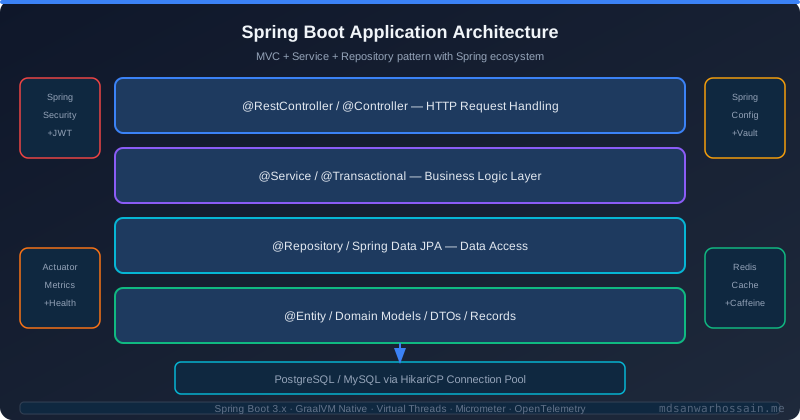
Spring Boot 3.x with Java 21 virtual threads represents the most mature Java microservices stack available in 2026. The ecosystem — Spring Cloud, Resilience4j, Micrometer, Spring Security OAuth2 — has absorbed years of production learnings from organizations running at scale. But having excellent building blocks doesn't automatically yield excellent architecture. This guide walks through the key decisions and configurations that matter most in production: how services discover each other, how they fail gracefully, how they communicate, how they're secured, and how they're deployed and observed.
Table of Contents
- Project Structure for Microservices
- Service Discovery with Eureka and Consul
- Circuit Breaker with Resilience4j
- Config Server and Externalized Configuration
- Inter-Service Communication: RestClient vs WebClient vs OpenFeign
- Event-Driven Communication with Kafka
- Distributed Tracing with Micrometer + Zipkin
- Security: OAuth2 / JWT Across Services
- Health Checks and Readiness Probes
- Deployment Patterns: Docker and Kubernetes
- Conclusion
Project Structure for Microservices
In a multi-service repository, consistency in project structure pays dividends in onboarding speed and code navigation. A recommended layout for each service:
user-service/
├── src/main/java/com/example/userservice/
│   ├── UserServiceApplication.java
│   ├── config/           # Spring configs, security, beans
│   ├── controller/       # REST controllers (thin layer only)
│   ├── service/          # Business logic
│   ├── domain/           # JPA entities, domain objects
│   ├── repository/       # Spring Data JPA repositories
│   ├── dto/              # Request/response DTOs
│   ├── exception/        # Custom exceptions + global handler
│   ├── event/            # Kafka events (produced/consumed)
│   └── client/           # Feign or RestClient interfaces
├── src/main/resources/
│   ├── application.yml
│   └── application-{profile}.yml
├── src/test/java/
│   ├── unit/             # Pure unit tests
│   └── integration/      # @SpringBootTest + Testcontainers
└── Dockerfile
Keep controllers thin: they should only handle HTTP concerns (request parsing, response mapping, HTTP status codes). All business logic lives in service classes. This makes services testable in isolation without the Spring MVC layer.
Service Discovery with Eureka and Consul
In Kubernetes deployments, native DNS-based service discovery often suffices — Kubernetes Services provide stable DNS names, and load balancing is handled by kube-proxy. However, for fine-grained client-side load balancing and health-aware routing, Spring Cloud's service discovery abstractions remain relevant.
Spring Cloud Eureka Setup
# application.yml for a Eureka client
spring:
  application:
    name: user-service
eureka:
  client:
    service-url:
      defaultZone: http://eureka-server:8761/eureka/
    registry-fetch-interval-seconds: 10
  instance:
    prefer-ip-address: true
    lease-renewal-interval-in-seconds: 10
    lease-expiration-duration-in-seconds: 30
Production tip: Always set prefer-ip-address: true in containerized environments. Hostname resolution is unreliable in Docker/Kubernetes without explicit DNS configuration.
For Consul-based discovery, Spring Cloud Consul provides the same abstraction with better support for multi-datacenter deployments and built-in health checking integration.
Circuit Breaker with Resilience4j
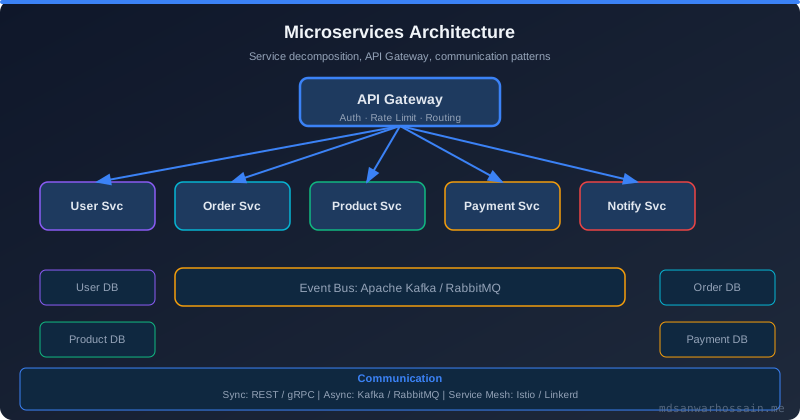
A circuit breaker prevents cascading failures when a downstream service degrades. Resilience4j is the Spring Boot-native choice in 2026, replacing the deprecated Hystrix. Configure it declaratively:
# application.yml
resilience4j:
  circuitbreaker:
    instances:
      orderService:
        slidingWindowSize: 10
        failureRateThreshold: 50
        waitDurationInOpenState: 10s
        permittedNumberOfCallsInHalfOpenState: 3
        automaticTransitionFromOpenToHalfOpenEnabled: true
  retry:
    instances:
      orderService:
        maxAttempts: 3
        waitDuration: 500ms
        exponentialBackoffMultiplier: 2
  timelimiter:
    instances:
      orderService:
        timeoutDuration: 3s
// Service usage with annotations
@Service
public class OrderClientService {
@CircuitBreaker(name = "orderService", fallbackMethod = "fallbackOrder")
@Retry(name = "orderService")
@TimeLimiter(name = "orderService")
public CompletableFuture<OrderDTO> getOrder(Long orderId) {
return CompletableFuture.supplyAsync(() -> orderClient.findById(orderId));
}
private CompletableFuture<OrderDTO> fallbackOrder(Long orderId, Exception ex) {
log.warn("Circuit breaker triggered for order {}: {}", orderId, ex.getMessage());
return CompletableFuture.completedFuture(OrderDTO.empty());
}
}Config Server and Externalized Configuration
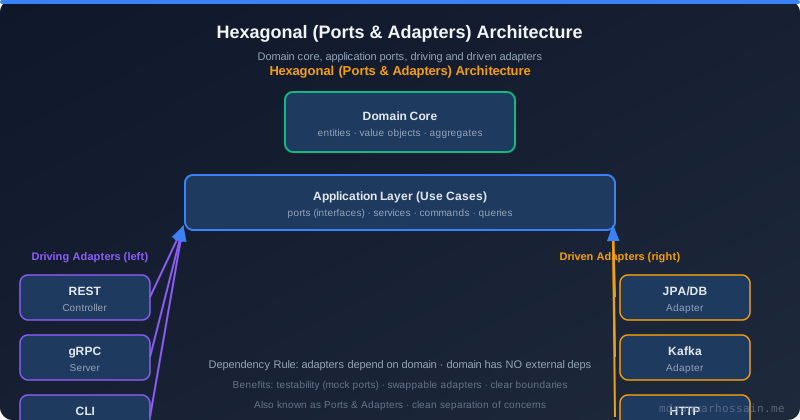
Spring Cloud Config Server centralizes externalized configuration, critical for keeping secrets out of service JARs and enabling runtime configuration changes.
# Config server bootstrap
spring:
  cloud:
    config:
      server:
        git:
          uri: https://github.com/your-org/service-configs
          default-label: main
          search-paths: '{application}'
          clone-on-start: true
In Kubernetes, prefer using native ConfigMaps and Secrets mounted as environment variables or files, with Spring Cloud Kubernetes for dynamic refresh. This avoids running a dedicated Config Server and integrates with your existing RBAC controls.
Inter-Service Communication: RestClient vs WebClient vs OpenFeign
Choosing the right HTTP client for inter-service calls affects readability, testability, and performance. Here's when to use each in 2026:
OpenFeign (Declarative, preferred for most cases)
@FeignClient(name = "inventory-service", fallbackFactory = InventoryClientFallback.class)
public interface InventoryClient {

    @GetMapping("/api/v1/inventory/{productId}")
    InventoryDTO getInventory(@PathVariable Long productId);

    @PutMapping("/api/v1/inventory/{productId}/reserve")
    void reserveStock(@PathVariable Long productId, @RequestBody ReserveRequest request);
}
OpenFeign's declarative style dramatically reduces boilerplate and integrates naturally with Resilience4j, Eureka, and Micrometer tracing. Use it as your default for synchronous service-to-service calls.
Spring's RestClient (Fluent, for complex cases)
// Spring Boot 3.2+ RestClient — synchronous, virtual-thread friendly
@Bean
RestClient inventoryRestClient(RestClient.Builder builder) {
    return builder
        .baseUrl("http://inventory-service")
        .defaultHeader(HttpHeaders.CONTENT_TYPE, MediaType.APPLICATION_JSON_VALUE)
        .build();
}

// Usage
InventoryDTO dto = restClient.get()
    .uri("/api/v1/inventory/{id}", productId)
    .retrieve()
    .body(InventoryDTO.class);
With Java 21 virtual threads, RestClient provides near-reactive throughput with blocking semantics — easier to reason about than WebClient for most teams. Use WebClient only when you're already in a reactive stack.
Event-Driven Communication with Kafka
Kafka is the standard for reliable asynchronous inter-service communication. Define events as first-class domain objects with Avro or JSON schema:
// Event class with schema versioning in mind
public record OrderCreatedEvent(
    @JsonProperty("orderId")     Long orderId,
    @JsonProperty("userId")      Long userId,
    @JsonProperty("totalAmount") BigDecimal totalAmount,
    @JsonProperty("createdAt")   Instant createdAt,
    @JsonProperty("version")     int version   // always include for schema evolution
) {}

// Producer
@Service
@RequiredArgsConstructor
public class OrderEventPublisher {
    private final KafkaTemplate<String, OrderCreatedEvent> kafkaTemplate;

    public void publishOrderCreated(OrderCreatedEvent event) {
        kafkaTemplate.send("order.created", event.orderId().toString(), event)
            .whenComplete((result, ex) -> {
                if (ex != null) {
                    log.error("Failed to publish OrderCreatedEvent for order {}", event.orderId(), ex);
                    // Dead letter queue or retry logic here
                }
            });
    }
}

// Consumer with idempotency guard
@KafkaListener(topics = "order.created", groupId = "inventory-service",
               containerFactory = "kafkaListenerContainerFactory")
public void handleOrderCreated(OrderCreatedEvent event,
                                Acknowledgment ack) {
    if (idempotencyStore.alreadyProcessed(event.orderId())) {
        ack.acknowledge();
        return;
    }
    inventoryService.reserveForOrder(event);
    idempotencyStore.markProcessed(event.orderId());
    ack.acknowledge();
}
Always implement idempotency on Kafka consumers. At-least-once delivery means your consumer will receive duplicate messages. Design for it from day one.
Distributed Tracing with Micrometer + Zipkin
Spring Boot 3.x uses Micrometer Tracing (formerly Spring Cloud Sleuth) as its tracing abstraction. Configure it with a Zipkin or OTLP exporter:
# application.yml
management:
  tracing:
    sampling:
      probability: 1.0   # 0.1 for production (10% sampling)
  zipkin:
    tracing:
      endpoint: http://zipkin:9411/api/v2/spans

# Maven dependency
# io.micrometer:micrometer-tracing-bridge-brave
# io.zipkin.reporter2:zipkin-reporter-brave
With this configuration, every request automatically propagates trace IDs across service boundaries via HTTP headers (b3 or W3C traceparent). When a request fails, you can query Zipkin or Jaeger by trace ID and see the full span tree across all involved services — invaluable for debugging distributed failures.
Security: OAuth2 / JWT Across Services
In a microservices architecture, security must be enforced at the API Gateway and validated at each service. The recommended pattern is OAuth2 Bearer tokens validated via JWT:
# Resource server configuration in each microservice
spring:
  security:
    oauth2:
      resourceserver:
        jwt:
          issuer-uri: https://auth-server/realms/myapp
          # or jwk-set-uri for explicit JWKS endpoint
@Configuration
@EnableWebSecurity
public class SecurityConfig {
@Bean
SecurityFilterChain securityFilterChain(HttpSecurity http) throws Exception {
return http
.csrf(AbstractHttpConfigurer::disable)
.sessionManagement(s -> s.sessionCreationPolicy(STATELESS))
.authorizeHttpRequests(auth -> auth
.requestMatchers("/actuator/health", "/actuator/info").permitAll()
.requestMatchers(HttpMethod.GET, "/api/v1/products/**").hasAuthority("SCOPE_products:read")
.anyRequest().authenticated()
)
.oauth2ResourceServer(oauth2 -> oauth2.jwt(Customizer.withDefaults()))
.build();
}
}Service-to-service calls should use dedicated client credentials grants, not user tokens. Use Spring Security's OAuth2AuthorizedClientManager for automated token acquisition and refresh in service clients.
Health Checks and Readiness Probes
Spring Boot Actuator provides /actuator/health with component-level detail. Configure Kubernetes probes to use separate liveness and readiness endpoints:
# application.yml
management:
  endpoint:
    health:
      probes:
        enabled: true   # enables /health/liveness and /health/readiness
      show-details: when-authorized
  health:
    livenessstate:
      enabled: true
    readinessstate:
      enabled: true
# Kubernetes deployment probe configuration
livenessProbe:
httpGet:
path: /actuator/health/liveness
port: 8080
initialDelaySeconds: 30
periodSeconds: 10
failureThreshold: 3
readinessProbe:
httpGet:
path: /actuator/health/readiness
port: 8080
initialDelaySeconds: 20
periodSeconds: 5
failureThreshold: 3Add custom health indicators for critical dependencies (Kafka connectivity, external API availability) so that Kubernetes knows to remove a pod from service rotation before it starts returning errors to clients.
Deployment Patterns: Docker and Kubernetes
A production-ready Dockerfile for Spring Boot using layered JARs and a minimal base image:
FROM eclipse-temurin:21-jre-alpine AS base
WORKDIR /app

# Layered JAR extraction for better Docker caching
FROM base AS builder
COPY target/*.jar app.jar
RUN java -Djarmode=layertools -jar app.jar extract

FROM base
COPY --from=builder /app/dependencies/ ./
COPY --from=builder /app/spring-boot-loader/ ./
COPY --from=builder /app/snapshot-dependencies/ ./
COPY --from=builder /app/application/ ./

# Run as non-root
RUN addgroup -S appgroup && adduser -S appuser -G appgroup
USER appuser

# Container-aware JVM flags
ENV JAVA_OPTS="-XX:+UseContainerSupport -XX:MaxRAMPercentage=75.0 \
               -XX:+UseZGC -Djava.security.egd=file:/dev/./urandom"

EXPOSE 8080
ENTRYPOINT ["sh", "-c", "java $JAVA_OPTS org.springframework.boot.loader.launch.JarLauncher"]
When using layered JAR images, align layer boundaries with change frequency: dependencies should be in lower stable layers, while application classes remain in top layers so rebuild/push cycles stay fast. In Kubernetes, pair readiness probes with startup probes for services that perform heavy warmup (cache hydration, schema validation), otherwise liveness checks can restart pods before startup completes. Also configure graceful shutdown (server.shutdown=graceful, spring.lifecycle.timeout-per-shutdown-phase) so rolling deployments drain in-flight requests cleanly instead of returning 5xx during pod termination.
At scale, deployment reliability depends on observability-driven rollouts: use canary or progressive delivery with automated rollback triggers tied to error rate, latency, and saturation metrics. Keep per-service SLOs and deploy guards in CI/CD so changes are blocked when operational budgets are already exhausted. For JVM services, verify container memory headroom under peak traffic to avoid OOM kills caused by off-heap/native memory growth not visible in heap-only metrics. Finally, standardize deployment templates (probes, resources, security context, network policies) across services to reduce configuration drift and production surprises.
Key Kubernetes deployment practices: use resource requests and limits to enable proper scheduling, configure Horizontal Pod Autoscaler based on CPU and custom metrics, use PodDisruptionBudgets to ensure availability during rolling updates, and use multiple replicas with pod anti-affinity to spread across nodes.
Key Takeaways
- Keep controllers thin — all business logic belongs in the service layer for testability.
- Use Resilience4j circuit breakers with retry and time limiter for all synchronous inter-service calls.
- OpenFeign is the default choice for service-to-service HTTP; RestClient for complex scenarios; WebClient only in fully reactive stacks.
- Always implement idempotency on Kafka consumers — at-least-once delivery is a guarantee, not an edge case.
- Use Spring Security OAuth2 resource server with JWT validation in each service; client credentials for service-to-service auth.
- Enable Kubernetes-native health probes with separate liveness and readiness endpoints.
- Use layered JAR Docker builds and
-XX:+UseContainerSupportfor container-aware JVM behaviour. - Micrometer Tracing provides automatic trace propagation across services with minimal configuration.
Conclusion
Production-grade Spring Boot microservices are built on a foundation of deliberate decisions: how services discover each other, how they handle partial failures, how they communicate synchronously and asynchronously, how they enforce security across trust boundaries, and how they expose enough operational information to be debuggable at 3 AM. The Spring ecosystem in 2026 provides excellent primitives for all of these concerns. The challenge is understanding when and how to apply each one. Start with the patterns covered here, instrument early, and let operational experience guide your evolution. The best microservices architecture is not the most sophisticated one — it's the one your team can understand, operate, and extend confidently.
Frequently Asked Questions
What is Project Structure for Microservices and how does it work?
In a multi-service repository, consistency in project structure pays dividends in onboarding speed and code navigation. A recommended layout for each service: user-service/ ├── src/main/java/com/example/userservice/ │ ├── UserServiceApplication.java │ ├── config/ # Spring configs, security, beans │ ├── controller/ # REST controllers (thin layer only) │ ├── service/ # Business logic │ ├── domain/ # JPA entities, domain objects │ ├── repository/ # Spring Data JPA repositories │ ├── dto/ # Request/response DTOs │ ├── exception/ # Custom exceptions + global handler │ ├── event/ # Kafka events (produced/consumed) │ └── client/ # Feign or RestClient interfaces ├── src/main/resources/ │ ├── application.yml │ └── application-{profile}.yml ├── src/test/java/ │ ├── unit/ # Pure unit tests │ └── integration/ # @SpringBootTest + Testcontainers └── Dockerfile Keep controllers thin: they should only handle.
What is Service Discovery with Eureka and Consul and how does it work?
In Kubernetes deployments, native DNS-based service discovery often suffices — Kubernetes Services provide stable DNS names, and load balancing is handled by kube-proxy. However, for fine-grained client-side load balancing and health-aware routing, Spring Cloud's service discovery abstractions remain relevant.
How do you configure Spring Cloud Eureka Setup?
# application.yml for a Eureka client spring: application: name: user-service eureka: client: service-url: defaultZone: http://eureka-server:8761/eureka/ registry-fetch-interval-seconds: 10 instance: prefer-ip-address: true lease-renewal-interval-in-seconds: 10 lease-expiration-duration-in-seconds: 30 Production tip: Always set prefer-ip-address: true in containerized environments. Hostname resolution is unreliable in Docker/Kubernetes without explicit DNS configuration. For Consul-based discovery, Spring Cloud Consul provides the same abstraction with better support for multi-datacenter deployments and built-in health checking integration.
What is Circuit Breaker with Resilience4j and how does it work?
A circuit breaker prevents cascading failures when a downstream service degrades. Resilience4j is the Spring Boot-native choice in 2026, replacing the deprecated Hystrix. Configure it declaratively:
How do you configure Config Server and Externalized Configuration?
Spring Cloud Config Server centralizes externalized configuration, critical for keeping secrets out of service JARs and enabling runtime configuration changes. # Config server bootstrap spring: cloud: config: server: git: uri: https://github.com/your-org/service-configs default-label: main search-paths: '{application}' clone-on-start: true In Kubernetes, prefer using native ConfigMaps and Secrets mounted as environment variables or files, with Spring Cloud Kubernetes for dynamic refresh. This avoids running a dedicated Config Server and integrates with your existing RBAC controls.
Leave a Comment
Related Posts

Software Engineer · Java · Spring Boot · Microservices