Java Weak, Soft & Phantom References: GC-Aware Caching and Memory-Sensitive Design Patterns
Java reference types are powerful but frequently misunderstood in production systems. This guide explains when to use soft, weak, and phantom references for safer cache design, leak-resistant lifecycles, and predictable garbage-collection behavior under memory pressure.
Table of Contents
- The Memory Leak That Wasn't Obvious
- The Four Reference Types in Java
- Building a SoftReference-Backed Image Cache
- WeakReference in Practice: Canonical Maps and Listener Cleanup
- PhantomReference: The Finalize() Replacement
- ReferenceQueue Processing: Running a Cleanup Thread
- Production Failure Scenarios
- When NOT to Use Non-Strong References
- Optimization Techniques
- Key Takeaways
- Read More
The Memory Leak That Wasn't Obvious
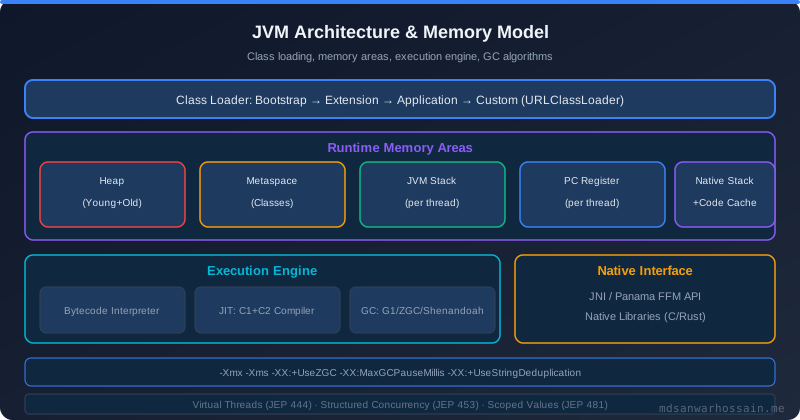
It was 2 AM on a Tuesday when the on-call alert fired. The production service—a high-throughput image-processing pipeline—had been running smoothly for months. Then heap usage started climbing. Slowly at first, then faster. By the time the alert threshold was crossed, the JVM was spending 40% of its time in garbage collection, nearly at a standstill.
The engineer on-call pulled a heap dump. Analysis in Eclipse Memory Analyzer revealed a massive HashMap holding thousands of byte[] arrays—the image cache. The cache had a size limit, or so the code claimed. But the limit was never being enforced. The root cause? The cache used strong references, meaning even when the system was under memory pressure, the GC could not reclaim a single cached image until an explicit eviction ran—and eviction was triggered only on cache reads, which had slowed to a trickle due to the GC pauses themselves.
The fix was a two-line change: replace the strong-reference HashMap with a SoftReference-backed cache. This is the story of how Java's reference types work, when to use each one, and the production pitfalls that will catch you if you are not careful.
The Four Reference Types in Java
Java's java.lang.ref package defines a hierarchy of reference strengths. Understanding the hierarchy is the key to designing memory-conscious applications.
Strong References (the default)
Every variable assignment creates a strong reference. The GC will never collect an object that is reachable via a strong reference chain from a GC root. This is the right default for most objects, but it makes caches dangerous: you are telling the JVM "I need this forever, even if you are about to throw an OutOfMemoryError."
// Strong reference — GC cannot collect imageData
byte[] imageData = loadImage("profile-42.jpg");
SoftReference — the memory-sensitive cache
SoftReference tells the JVM: "Keep this alive as long as you have enough heap. Evict it when you need the memory." The JVM guarantees that all soft references will be cleared before throwing OutOfMemoryError. This makes SoftReference ideal for optional caches where stale data can be reloaded at cost.
import java.lang.ref.SoftReference;

SoftReference<byte[]> softImage = new SoftReference<>(loadImage("profile-42.jpg"));

// Later:
byte[] img = softImage.get();
if (img == null) {
    // GC evicted it under memory pressure — reload
    img = loadImage("profile-42.jpg");
}
The JVM's specific eviction policy for soft references is implementation-defined, but HotSpot uses a heuristic based on how long ago the reference was last accessed and the current free heap ratio. The -XX:SoftRefLRUPolicyMSPerMB JVM flag (default 1000 ms per MB of free heap) controls this trade-off.
WeakReference — existence tied to client usage
WeakReference is even weaker: the GC may collect the referent during any GC cycle, regardless of available memory, as long as no strong or soft reference to the object exists. This is useful for canonical maps (where you want a single instance per key) and for tracking objects without preventing their collection.
import java.lang.ref.WeakReference;

WeakReference<ExpensiveObject> weakRef = new WeakReference<>(new ExpensiveObject());

// At any point:
ExpensiveObject obj = weakRef.get();
if (obj == null) {
    // Object was GC'd — this is expected and normal
}
PhantomReference — post-mortem cleanup
PhantomReference is the strangest of the four. You can never retrieve the referent through a phantom reference—get() always returns null. Its only purpose is to receive a notification via a ReferenceQueue after the referent has been finalized and is about to be reclaimed. Phantom references are the modern, safe replacement for Object.finalize().
import java.lang.ref.PhantomReference;
import java.lang.ref.ReferenceQueue;

ReferenceQueue<NativeResource> queue = new ReferenceQueue<>();
PhantomReference<NativeResource> phantom =
    new PhantomReference<>(new NativeResource(), queue);

// phantom.get() always returns null — never call it for the object
// Use queue polling to detect GC and release native resources
Building a SoftReference-Backed Image Cache
Here is a production-grade image cache that uses SoftReference and a ReferenceQueue to clean up stale entries automatically:
import java.lang.ref.ReferenceQueue;
import java.lang.ref.SoftReference;
import java.util.concurrent.ConcurrentHashMap;

public class SoftImageCache {

    private static class CacheEntry extends SoftReference<byte[]> {
        final String key;

        CacheEntry(String key, byte[] value, ReferenceQueue<byte[]> queue) {
            super(value, queue);
            this.key = key;
        }
    }

    private final ConcurrentHashMap<String, CacheEntry> map = new ConcurrentHashMap<>();
    private final ReferenceQueue<byte[]> queue = new ReferenceQueue<>();

    public byte[] get(String key) {
        expungeStaleEntries();
        CacheEntry entry = map.get(key);
        return entry == null ? null : entry.get();
    }

    public void put(String key, byte[] value) {
        expungeStaleEntries();
        map.put(key, new CacheEntry(key, value, queue));
    }

    @SuppressWarnings("unchecked")
    private void expungeStaleEntries() {
        CacheEntry entry;
        while ((entry = (CacheEntry) queue.poll()) != null) {
            map.remove(entry.key, entry);
        }
    }
}
The critical detail here is the expungeStaleEntries() method. When the GC clears a soft reference, it enqueues the reference object itself (not the referent—that is gone) onto the ReferenceQueue. If you never drain this queue, you accumulate empty CacheEntry wrappers in your ConcurrentHashMap, which is itself a memory leak—albeit a smaller one.
WeakReference in Practice: Canonical Maps and Listener Cleanup
The canonical map pattern
A canonical map ensures that for a given key there is at most one live instance of a value. This is useful for interning objects like symbol tables, configuration objects, or parsed schemas that are expensive to create but identical in content.
import java.lang.ref.WeakReference;
import java.util.WeakHashMap;

public class SchemaRegistry {
    // WeakHashMap: when the key is GC'd, the entry disappears automatically
    private final WeakHashMap<String, CompiledSchema> cache = new WeakHashMap<>();

    public synchronized CompiledSchema getOrCompile(String schemaJson) {
        CompiledSchema schema = cache.get(schemaJson);
        if (schema == null) {
            schema = SchemaCompiler.compile(schemaJson);
            cache.put(schemaJson, schema);
        }
        return schema;
    }
}
WeakHashMap pitfall: In WeakHashMap, it is the key that is weakly referenced, not the value. If the value strongly references the key (directly or through a closure), the key will never be collected and your map will grow unbounded. This is one of the most common bugs when first using WeakHashMap.
Weak event listeners
GUI frameworks and event bus systems often suffer from "lapsed listener" bugs where objects remain alive because they are registered as listeners. WeakReference solves this elegantly:
public class WeakEventBus {
    private final List<WeakReference<EventListener>> listeners = new CopyOnWriteArrayList<>();

    public void subscribe(EventListener listener) {
        listeners.add(new WeakReference<>(listener));
    }

    public void publish(Event event) {
        listeners.removeIf(ref -> {
            EventListener l = ref.get();
            if (l == null) return true; // dead reference, remove it
            l.onEvent(event);
            return false;
        });
    }
}
The subscriber does not need to call unsubscribe(). When the subscriber is no longer referenced by application code, it will be GC'd and the dead weak reference will be cleaned up on the next publish call. This mirrors the pattern used in some observability agents and is directly relevant to concurrent workloads discussed in Java Structured Concurrency.
PhantomReference: The Finalize() Replacement
Finalizers (Object.finalize()) are notoriously problematic: they run on a single finalizer thread, they can be called in any order, and an object can be "resurrected" inside finalize() which confuses the GC. Since Java 9, finalize() is deprecated. PhantomReference with ReferenceQueue is the correct replacement for releasing native resources (file handles, native memory, GPU buffers) when a Java wrapper object is collected.
import java.lang.ref.PhantomReference;
import java.lang.ref.ReferenceQueue;

public class NativeBufferManager {

    static class BufferPhantom extends PhantomReference<NativeBuffer> {
        private final long nativePtr;

        BufferPhantom(NativeBuffer buf, ReferenceQueue<NativeBuffer> queue) {
            super(buf, queue);
            this.nativePtr = buf.getNativePointer();
        }

        void freeNative() {
            NativeLib.free(nativePtr);
        }
    }

    private final ReferenceQueue<NativeBuffer> refQueue = new ReferenceQueue<>();
    private final Set<BufferPhantom> phantoms = ConcurrentHashMap.newKeySet();

    public NativeBuffer allocate(int size) {
        NativeBuffer buf = new NativeBuffer(NativeLib.malloc(size), size);
        phantoms.add(new BufferPhantom(buf, refQueue));
        return buf;
    }

    public void processQueue() {
        BufferPhantom phantom;
        while ((phantom = (BufferPhantom) refQueue.poll()) != null) {
            phantom.freeNative();
            phantoms.remove(phantom);
        }
    }
}
Critical note: You must hold a strong reference to the PhantomReference objects themselves (hence the phantoms set above). If you don't, the phantom reference wrapper will be GC'd before the referent, and you'll never receive the queue notification.
ReferenceQueue Processing: Running a Cleanup Thread
For production systems, a dedicated daemon thread continuously draining the reference queue is often the right architecture:
public class ReferenceQueueCleaner implements Runnable {
    private final ReferenceQueue<?> queue;
    private volatile boolean running = true;

    public ReferenceQueueCleaner(ReferenceQueue<?> queue) {
        this.queue = queue;
    }

    @Override
    public void run() {
        while (running) {
            try {
                // Blocks until a reference is enqueued or timeout
                Cleanable ref = (Cleanable) queue.remove(1000L);
                if (ref != null) ref.clean();
            } catch (InterruptedException e) {
                Thread.currentThread().interrupt();
                running = false;
            }
        }
    }

    public void stop() { running = false; }
}

// Wire it up at startup:
Thread cleanerThread = new Thread(new ReferenceQueueCleaner(refQueue), "ref-cleaner");
cleanerThread.setDaemon(true);
cleanerThread.start();
Java 9+ introduced java.lang.ref.Cleaner as a standard library abstraction over exactly this pattern. If you are on Java 9 or later, prefer Cleaner over rolling your own. The JDK itself uses it internally (e.g., DirectByteBuffer cleanup). This kind of lifecycle-aware resource management dovetails naturally with the structured lifecycles described in Java Structured Concurrency.
Production Failure Scenarios
Scenario 1: SoftReference cache with -Xmx that is too generous
A team set -Xmx16g on a service that typically uses 2 GB. The SoftRefLRUPolicyMSPerMB default meant soft references stayed alive for up to 14,000 seconds (almost 4 hours!) of free heap. The cache never evicted, effectively behaving like a strong reference cache and causing memory pressure during traffic spikes when the working set grew to fill the heap.
Fix: Tune -XX:SoftRefLRUPolicyMSPerMB=200 to shorten retention, or use a bounded cache (Caffeine, Guava) instead of raw SoftReference.
Scenario 2: WeakHashMap key self-reference
A request-scoped context object stored itself (via a lambda closure) as a value in a WeakHashMap keyed by itself. The value's closure captured this, creating a strong reference from value back to key. The key could never be collected, and the map grew to hold millions of dead request contexts.
Scenario 3: Phantom reference never enqueued
A developer created phantom references but forgot to register a ReferenceQueue (passed null to the constructor). Without a queue, phantom references are never enqueued after GC—so the cleanup callback never ran and native file handles leaked until the OS limit was hit.
When NOT to Use Non-Strong References
- Don't use SoftReference for primary data structures. If your application cannot function without the data (not just slower), strong references are the only correct choice.
- Don't use WeakReference as a cheap nullable wrapper. Use
Optionalor nullable types. Weak references add GC interaction overhead and surprising nullability. - Don't use PhantomReference for simple RAII-style cleanup. Use try-with-resources and
AutoCloseable. Phantom references are for cases where you cannot control the caller's lifecycle. - Don't rely on SoftReference eviction timing for correctness. GC is non-deterministic. If your logic requires eviction to happen at a specific time, use an explicit cache eviction policy.
Optimization Techniques
Combine SoftReference with size bounds
SoftReferences alone don't cap memory usage—they just allow GC to reclaim when pressured. For a truly bounded cache, combine SoftReference with an explicit size limit using a LinkedHashMap in LRU mode or Caffeine's maximumWeight:
Cache<String, byte[]> imageCache = Caffeine.newBuilder()
    .maximumWeight(256 * 1024 * 1024) // 256 MB hard cap
    .weigher((k, v) -> v.length)
    .softValues()                      // allow GC eviction under pressure
    .recordStats()
    .build();
Use identity-based WeakHashMap carefully
By default WeakHashMap uses equals()/hashCode() for key lookup. If your keys are mutable objects, their hash code can change after insertion, making the entry unreachable even while the key is still alive. Prefer immutable keys or use an identity-based weak map (Collections.synchronizedMap(new WeakHashMap<>()) with identity semantics via a custom key wrapper).
Heap dump analysis for reference leaks
In Eclipse Memory Analyzer (MAT), use the "List objects with outgoing references" query and filter by java.lang.ref.SoftReference / WeakReference to count live reference wrappers. A growing count of wrappers whose referent is null indicates you have a ReferenceQueue processing gap.
Key Takeaways
- SoftReference: Use for optional caches where data can be reloaded. The JVM will reclaim under memory pressure, preventing OOM. Always pair with
ReferenceQueueto avoid accumulating empty wrappers. - WeakReference: Use for canonical maps and non-owning references. Perfect for listener patterns. Beware of value-to-key strong reference cycles in
WeakHashMap. - PhantomReference: Use for post-GC native resource cleanup. Replace all uses of
finalize()withPhantomReference+ReferenceQueueorjava.lang.ref.Cleaner. - ReferenceQueue: Always drain it. A dedicated daemon thread or the standard
CleanerAPI is the production-grade approach. - For most caching use cases, prefer Caffeine or Guava Cache over raw reference types—they compose soft values, size bounds, TTL, and stats in a single abstraction.
Tags:
Read More
Explore related deep-dives on Java concurrency and memory management:
- Java Structured Concurrency: Virtual Threads and Scoped Lifetimes
- Browse all Java performance and backend engineering articles →
Leave a Comment
Related Posts

Software Engineer · Java · Spring Boot · Microservices