LLM Fine-Tuning vs Prompt Engineering vs RAG: When to Use Each in 2026
Engineers building LLM-powered products face the same critical question: should I fine-tune, add RAG, or engineer better prompts? Getting this wrong costs real money — sometimes six figures in GPU bills. This comprehensive guide gives you a battle-tested decision framework based on what actually ships in production.
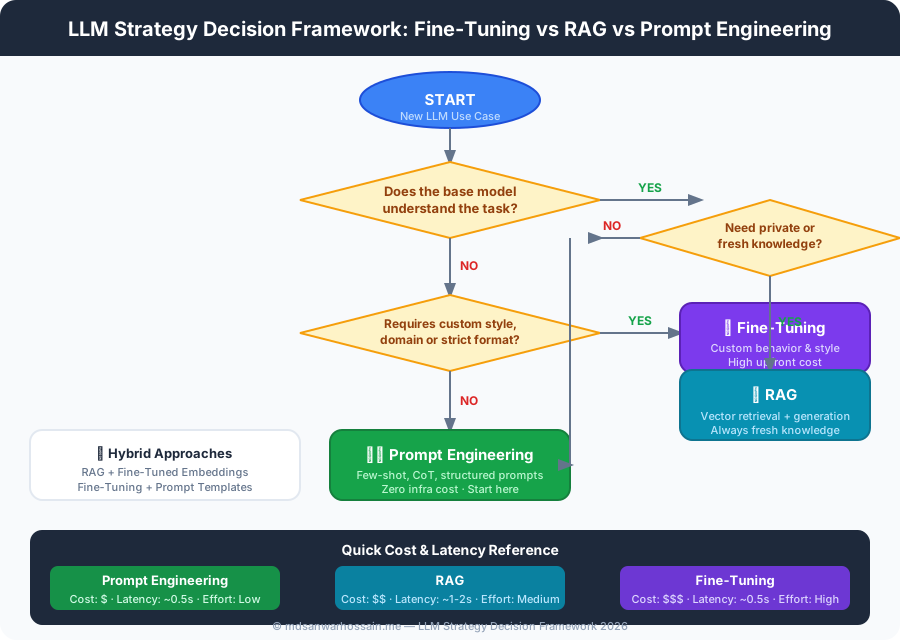
TL;DR — Decision Rule in One Sentence
"Start with prompt engineering (hours, near-zero cost). Add RAG when you need fresh or private knowledge (days, moderate cost). Resort to fine-tuning only when the required behavior cannot be achieved through prompting or retrieval alone (weeks, high cost)."
Table of Contents
- Understanding the Three Approaches
- The Decision Framework: Step-by-Step
- Prompt Engineering — When & How
- RAG — When & How
- Fine-Tuning — When & How
- Cost & Performance Comparison
- Hybrid Approaches in Production
- Real-World Examples by Industry
- LLM Cost Optimization Strategies
- 2026 Trends & What's Changing
- Conclusion & Checklist
1. Understanding the Three Approaches
Before picking a strategy, you must understand what each approach actually changes in the inference pipeline. They operate at fundamentally different layers of the stack.
Prompt Engineering — Shaping Input, Not the Model
Prompt engineering is the discipline of constructing the text you send to an LLM to maximize output quality. The model's weights are never modified. You're working entirely within the context window. Techniques include:
- Zero-shot prompting: Direct instruction without examples. Works well when the model already understands the task domain.
- Few-shot prompting: Include 2–8 labeled input/output examples in the prompt. Dramatically improves format and quality for structured outputs.
- Chain-of-thought (CoT): Instruct the model to "think step by step" before giving an answer. Reduces errors on reasoning-heavy tasks by 20–40%.
- System prompt engineering: Define persona, constraints, output format, and tone in the system message. The highest-leverage single change in most production LLM apps.
- Prompt chaining: Decompose a complex task into a sequence of smaller prompts, feeding the output of each as input to the next.
RAG (Retrieval-Augmented Generation) — Injecting External Knowledge
RAG keeps the model's weights frozen but dynamically extends what the model "knows" by retrieving relevant documents at inference time and including them in the prompt context. The architecture has three core components:
- Indexing pipeline: Documents are chunked, embedded into vectors, and stored in a vector database (Pinecone, Weaviate, pgvector).
- Retrieval: At query time, the user query is embedded and the k most similar chunks are fetched. Hybrid retrieval (dense + sparse BM25) improves coverage.
- Augmented generation: Retrieved chunks are prepended to the prompt as context. The LLM generates answers grounded in retrieved facts.
RAG solves the knowledge cutoff problem entirely — you can update your document store without touching the model. It also enables source citation and dramatically reduces hallucination on factual questions.
Fine-Tuning — Changing the Model's Weights
Fine-tuning updates the model's parameters on a curated dataset of input/output pairs. Unlike prompting and RAG, it permanently changes the model's behavior, not just the context. Major approaches in 2026:
- Full fine-tuning: All parameters updated. Maximum customization, maximum compute cost. Practical only on open-source models (Llama 3, Mistral).
- LoRA / QLoRA: Low-Rank Adaptation trains a small number of adapter parameters while the base model is frozen. ~10–50× cheaper than full fine-tuning. The industry standard for efficient fine-tuning.
- Instruction tuning: Fine-tune on (instruction, response) pairs to improve task-following ability. Used to create instruction-following variants like Alpaca, Vicuna.
- RLHF / DPO: Reinforcement Learning from Human Feedback or Direct Preference Optimization. Used to align model outputs with human preferences — critical for safety and tone control.
- API fine-tuning: OpenAI, Google (Gemini), and Anthropic offer managed fine-tuning APIs. No GPU management required but limited architectural control.
2. The Decision Framework: Step-by-Step
Use this five-question flowchart before committing to any approach. Each question eliminates expensive options where simpler ones suffice.
Question 1: Does a zero-shot or few-shot prompt already work?
Test GPT-4o or Claude Sonnet with a carefully written system prompt and 3–5 examples. If the output quality meets your threshold → stop here. Ship with prompt engineering. 70–80% of simple task automation falls here. Cost: essentially $0 infra overhead.
Question 2: Does the task require knowledge the model doesn't have?
If the model must answer questions about your company's private documents, real-time data (prices, inventory, news), or events after its training cutoff → choose RAG. Fine-tuning bakes knowledge in statically; RAG keeps it dynamic. Private data + real-time = RAG, always.
Question 3: Is the failure mode a behavior/style problem, not a knowledge problem?
If the model understands what to do but outputs the wrong tone, format, or brand voice — and you've exhausted few-shot + system prompt approaches — then fine-tuning on curated output examples is appropriate. Examples: legal summary style, medical discharge note format, a specific coding style guide.
Question 4: Do you have training data and GPU budget?
Fine-tuning requires at minimum 500–1,000 high-quality labeled examples (ideally 5,000+). LoRA on a 7B model needs an A100 for 2–8 hours ($50–$400 on cloud). Full fine-tuning of a 70B model costs $2,000–$20,000+. If you lack data or budget → return to prompt engineering or RAG.
Question 5: Does inference latency or cost at scale justify fine-tuning a smaller model?
If you're making millions of API calls per day and a fine-tuned 7B model (running on dedicated hardware) matches GPT-4's quality at 1/10th the per-token cost → fine-tuning pays for itself. Run the math: (daily requests × token cost difference) / fine-tuning cost = payback period in days.
3. Prompt Engineering — When & How
Choose prompt engineering when: the base model understands the domain, quality is acceptable with good instructions, and you need to ship fast with minimal infra investment.
Production Prompt Engineering Checklist
- ✅ Write explicit, unambiguous system prompts with role, task, constraints, and output format
- ✅ Use few-shot examples that cover edge cases, not just the happy path
- ✅ Specify output format (JSON schema, markdown headers, bullet structure) to reduce parsing errors
- ✅ Add chain-of-thought for reasoning tasks: "Think through your answer step by step before responding"
- ✅ Version your prompts in Git and track quality metrics per version (BLEU, LLM-as-judge, task-specific metrics)
- ✅ Use structured output (OpenAI response_format, Instructor library) to enforce JSON schemas
- ✅ Test prompt regressions automatically on every deployment with a golden eval set
Example: Customer Support Classification
A SaaS company routes support tickets by department. Zero-shot prompt with poor results → switched to few-shot with 6 labeled examples per category. Result: accuracy went from 71% to 93% with no infra changes. Cost: 2 hours of prompt iteration. No fine-tuning needed.
// System Prompt Template (production-grade)
You are a support ticket classifier for Acme SaaS. Your job is to
classify incoming tickets into exactly one of these categories:
[billing, technical, account, feature-request, general]

Rules:
- Output ONLY a valid JSON object: {"category": "", "confidence": <0.0-1.0>}
- If confidence < 0.75, set category to "general"
- Never explain your reasoning in the output

Examples:
User: "My invoice charged me twice this month"
Output: {"category": "billing", "confidence": 0.97}

User: "The API returns 500 on /v2/widgets endpoint"
Output: {"category": "technical", "confidence": 0.94}

Now classify this ticket:
User: {{TICKET_TEXT}}
4. RAG — When & How
Choose RAG when: your use case requires private, proprietary, or frequently updated knowledge that cannot be embedded in a prompt or baked into model weights. RAG is the right answer for ~60% of enterprise LLM applications.
RAG Architecture Decision Points
| RAG Variant | Best For | Complexity |
|---|---|---|
| Naive RAG | Simple Q&A over static docs | Low |
| Hybrid RAG (dense + sparse) | Mixed vocabulary, technical content | Medium |
| Agentic RAG | Multi-hop, complex queries | High |
| Graph RAG | Entities, relationships, knowledge graphs | High |
| Multimodal RAG | Images, tables, mixed-media docs | Very High |
What RAG Cannot Fix
RAG is not a silver bullet. It fails when:
- The task requires implicit reasoning not present in any document (e.g., code debugging logic)
- Context window limits prevent retrieving enough background (use chunking + reranking strategies)
- Low-quality corpus: garbage in, garbage out — retrieved chunks amplify bad content
- Latency is critical: Adding a retrieval step adds 300ms–2s per request depending on vector DB and network
5. Fine-Tuning — When & How
Fine-tuning is widely over-used by engineers who reach for it before exhausting cheaper alternatives. The real production cases where fine-tuning wins:
Legitimate Fine-Tuning Use Cases
- Domain-specific language: Medical ICD coding, legal contract clauses, financial XBRL tags — specialized terminology the base model consistently gets wrong.
- Output format enforcement: When you need exact JSON structure or specific structured output every time, and JSON mode + few-shot still fails at scale (>0.5% parse error rate).
- Style and tone consistency: Brand voice that must be deeply consistent across millions of outputs (marketing copy, product descriptions in a specific style).
- Safety and refusal behavior: Custom content filters, refusal patterns, and safety rails that cannot be enforced via system prompts alone.
- Cost optimization at scale: Fine-tuned GPT-3.5 or a 7B open-source model matching GPT-4 quality at 1/10th the cost for a specific, narrow task.
- Low-latency edge deployment: Fine-tuned quantized 3B–7B models for on-device inference (mobile, browser, edge hardware).
LoRA Fine-Tuning: The 2026 Industry Standard
Low-Rank Adaptation (LoRA) has become the default fine-tuning approach for most teams. It trains small rank-decomposition matrices added to the model's attention layers, keeping the base model frozen. Key parameters:
# QLoRA fine-tuning config (Hugging Face PEFT)
from peft import LoraConfig, get_peft_model

lora_config = LoraConfig(
    r=16,               # Rank — higher = more capacity, more memory
    lora_alpha=32,      # Scaling factor (typically 2× rank)
    target_modules=["q_proj", "v_proj"],  # Attention layers to adapt
    lora_dropout=0.05,
    bias="none",
    task_type="CAUSAL_LM"
)

model = get_peft_model(base_model, lora_config)
# Result: only ~1-3% of parameters are trained → 10-50× cheaper
Fine-Tuning Data Requirements
| Dataset Size | Expected Outcome | Use Case Fit |
|---|---|---|
| < 500 examples | Likely worse than few-shot | ❌ Too small |
| 500–2,000 examples | Modest style/format gains | ⚠️ Minimum viable |
| 2,000–10,000 examples | Strong task-specific improvement | ✅ Good range |
| > 10,000 examples | Near-optimal task performance | ✅ Excellent |
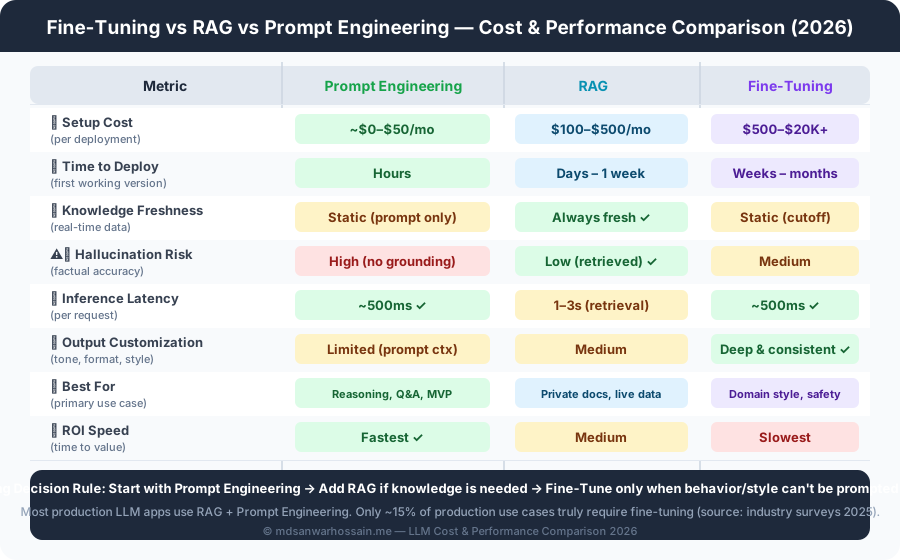
6. Cost & Performance Comparison
Cost is often the deciding factor in production. Here are realistic numbers for 2026 based on public pricing and community benchmarks.
Monthly Cost Estimates (10M tokens/day workload)
| Strategy | Infra Cost/Month | One-Time Setup | Maintenance |
|---|---|---|---|
| Prompt Engineering (GPT-4o) | $1,500–$5,000 | $0 | Low |
| RAG + GPT-4o | $2,000–$7,000 | $500–$2,000 | Medium (re-indexing) |
| Fine-Tuned GPT-3.5 | $300–$800 | $200–$2,000 | High (retraining) |
| Fine-Tuned 7B (self-hosted) | $400–$1,200 | $500–$5,000 | High (retraining + ops) |
Key insight: Fine-tuning a smaller model pays off at scale only if your task is narrow enough that a 7B model can match GPT-4o quality. For general-purpose tasks, the quality delta usually doesn't justify the ops burden.
7. Hybrid Approaches in Production
The most capable production LLM systems combine approaches. The combinations that deliver the best ROI in 2026:
RAG + Prompt Engineering (Most Common)
A strong system prompt + few-shot examples defines output format and behavior, while RAG provides grounded factual content. The prompt template instructs the model to "answer only using the provided context" to minimize hallucination. This combination covers 60–70% of enterprise AI assistant use cases.
Fine-Tuned Embeddings + RAG
Fine-tune the embedding model (not the LLM) on domain-specific text pairs to dramatically improve retrieval relevance. For example, fine-tuning a sentence-transformer on medical note pairs improved retrieval precision by 34% in a clinical QA system without touching the generator LLM.
Fine-Tuned Generator + RAG
Fine-tune the LLM for output format and style, use RAG for factual grounding. The fine-tuning teaches the model how to structure answers; RAG provides what content to include. Used in enterprise code generation assistants where style (comments, naming) must match company standards but API/library knowledge comes from a live docs retrieval index.
Multi-Agent with Specialized Fine-Tuned Models
Route subtasks to specialized fine-tuned models orchestrated by a general-purpose LLM. For example: a routing agent (GPT-4o-mini) dispatches tasks to a fine-tuned billing classifier, a fine-tuned code debugger, and a RAG-based documentation assistant. Each specialist is cheap; the coordinator is smart.
8. Real-World Examples by Industry
Healthcare — Clinical Q&A
Strategy: RAG over clinical guidelines (UpToDate, NICE) + Prompt Engineering
Why not fine-tune: Guidelines update constantly; fine-tuned knowledge would be stale in weeks
Result: 89% accuracy on clinical Q&A vs 71% for base model without RAG
Legal — Contract Review
Strategy: Fine-Tuning (style) + RAG (precedent lookup)
Why fine-tune: Output must follow exact legal clause structure; prompt-only produced inconsistent formatting
Result: 40% reduction in attorney revision time; clause extraction F1 improved from 0.74 to 0.91
E-commerce — Product Descriptions
Strategy: Fine-Tuning only (brand voice)
Why not RAG: All knowledge (product specs) is in the input; no external retrieval needed
Result: Brand voice consistency score improved from 62% to 94%; 3× throughput vs GPT-4o at 1/8th cost using fine-tuned GPT-3.5
Developer Tools — Code Generation
Strategy: Prompt Engineering + RAG (API docs)
Why not fine-tune: API docs change on every release; fine-tuned model would hallucinate deprecated methods
Result: Pass@1 improved 31% over baseline; hallucinated API calls dropped by 78% with RAG grounding
9. LLM Cost Optimization Strategies
Regardless of which strategy you choose, these techniques reduce LLM operational costs significantly:
Token Optimization
- Trim prompts ruthlessly: Every unnecessary word costs money at scale. A 200-token reduction per request = $6,000/month savings at 10M daily calls
- Use smaller context windows when possible: GPT-4o-mini at 128K context costs ~95% less than GPT-4o for the same task with shorter contexts
- Cache frequent responses: Semantic caching (using vector similarity to detect equivalent queries) reduces API calls by 20–40% for FAQ-type workloads
- Compress retrieved RAG chunks: Summarize or extract key sentences from retrieved documents before including them in the prompt
Model Routing
Route requests to the cheapest model that can handle the complexity. Use an LLM router (fine-tuned classifier) to assign each request to a tier:
- Simple, structured tasks → GPT-4o-mini or Claude Haiku ($0.15/1M input tokens)
- Moderate reasoning tasks → GPT-4o or Claude Sonnet ($2.50–$3/1M input tokens)
- Complex reasoning, code → GPT-4.5 or Claude Opus ($15–$75/1M input tokens)
Production teams report 40–65% cost reduction from intelligent routing without measurable quality degradation on blended workloads.
Batch Processing & Async Workloads
Non-real-time tasks (report generation, document processing, bulk classification) should use batch APIs, which offer 50% cost reduction for asynchronous workloads on OpenAI and Anthropic. Always separate real-time and batch workloads in your architecture.
10. 2026 Trends & What's Changing
Context Windows Are Killing Some Fine-Tuning Use Cases
As context windows grow to 1M–2M tokens (Gemini 1.5 Pro, GPT-4.5), some knowledge injection use cases that previously required fine-tuning can now be handled by stuffing the entire knowledge base into a mega-context prompt. However, long-context LLMs still struggle with the "lost in the middle" problem — retrieval quality degrades for facts buried in the middle of very long contexts.
Speculative Decoding & Smaller Fine-Tuned Models
Speculative decoding (using a small "draft" model to generate tokens that the larger model verifies) is making fine-tuned smaller models more attractive for latency-sensitive use cases. A fine-tuned Mistral 7B draft model + Llama 3 70B verifier achieves frontier model quality at 2–3× throughput improvement.
Synthetic Data Generation for Fine-Tuning
The limiting factor for fine-tuning is often labeled data, not compute. In 2026, the standard practice is to generate synthetic training data using GPT-4o or Claude, then filter with an automated quality judge. This reduces human labeling costs by 70–90% and makes fine-tuning viable for teams that previously lacked training data.
Continuous RAG & Real-Time Indexing
Event-driven indexing pipelines (document change → embedding update → vector store upsert) now enable RAG systems with sub-minute knowledge freshness. This closes the gap that previously made fine-tuning attractive for "almost-real-time" knowledge — RAG can now handle it.
11. Conclusion & Decision Checklist
The right LLM strategy is not about what's most technically impressive — it's about what delivers the best business outcome with the minimum viable complexity. In practice:
- ~50% of use cases stop at prompt engineering with a well-crafted system prompt + few-shot examples
- ~35% of use cases need RAG to ground responses in private or live knowledge
- ~15% of use cases genuinely require fine-tuning — specific behavior, style, safety, or cost-at-scale
Pre-Decision Checklist
- ☐ Have I written a high-quality system prompt with few-shot examples and measured results?
- ☐ Does the task require knowledge not in the base model's training data? → Consider RAG
- ☐ Is the knowledge updated frequently (>weekly)? → RAG is strongly preferred over fine-tuning
- ☐ Is the failure a format/style issue that prompting cannot fix? → Consider fine-tuning
- ☐ Do I have 2,000+ high-quality labeled examples? → Fine-tuning becomes viable
- ☐ Is my daily volume high enough that a cheaper fine-tuned model pays back within 3 months? → Fine-tuning for cost
- ☐ Have I considered fine-tuning only the embeddings (for RAG) instead of the generator?
- ☐ Can I use a hybrid: RAG for knowledge + prompting for format + fine-tuning for style?
Every mature LLM engineering team eventually converges on a layered strategy: strong prompt templates as the foundation, RAG as the knowledge layer, and selective fine-tuning for the narrow cases where it truly adds value. Start simple, measure obsessively, and add complexity only when the data justifies it.