10 Microservices Anti-Patterns That Kill Your System in Production (With Real Fixes)
Microservices promised independent deployability, team autonomy, and infinite scalability. What many teams got instead was a distributed system that fails in ten places simultaneously, a deployment pipeline that requires coordinating six teams, and latency that climbed from 15ms to 800ms because a simple user profile fetch now crosses four service boundaries. The architecture isn't wrong — the implementation is. These are the ten anti-patterns responsible for most microservices failure stories in production, with the concrete engineering fixes that restore the architecture's original promise.
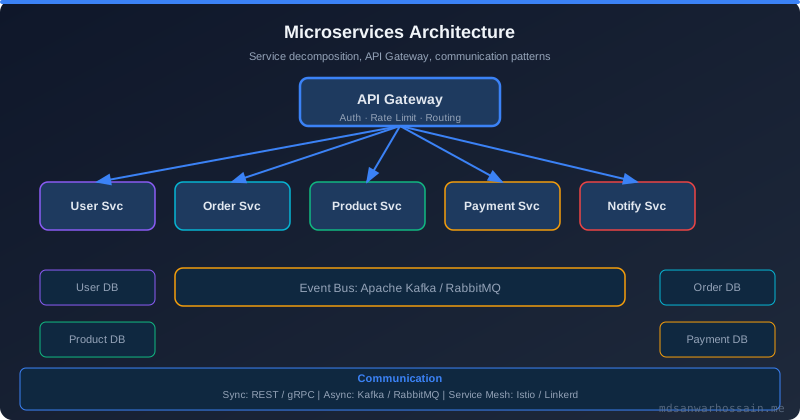
Table of Contents
1. Distributed Monolith
What it is: Services that are deployed separately but must be deployed together. You extracted 12 services from a monolith, but every feature still requires changes to 4–6 of them simultaneously. Database migrations in ServiceA require schema changes in ServiceB because they share implicit data structure assumptions. Releases require a deployment runbook with a strict service ordering to avoid breaking the system. You have all the operational complexity of microservices and none of the independent deployability benefit.
Real failure scenario: An e-commerce team deployed 15 services. A simple "add discount code to checkout" feature required coordinating changes in: OrderService (apply discount), ProductService (validate code against products), UserService (track usage per user), NotificationService (new email template), and the API Gateway (new endpoint). Four teams, four PRs, four review cycles, one coordinated deployment — 3 weeks for a feature that took 2 days in the monolith. A deployment script error in the ordering caused a 45-minute production outage when OrderService deployed before ProductService finished migrations.
Fix: Align service boundaries with Domain-Driven Design bounded contexts, not technical layers. If two services are always deployed together, they are one service. Apply the "two-pizza team" rule: can one small team own, deploy, and operate this service independently? If not, you haven't found the right boundary. Use event-driven integration (Kafka, SNS/SQS) to decouple service lifecycles — services consume events at their own pace without requiring synchronized deployments.
2. Chatty Services (N+1 Network Calls)
What it is: The distributed equivalent of the N+1 query problem. To render a user's order history page, the frontend calls OrderService to get 20 order IDs, then makes 20 individual calls to ProductService to fetch product details for each order, plus 20 calls to ShippingService for tracking status. One user action generates 41 synchronous HTTP calls. At 10ms per call with 1% network jitter, this is 410ms minimum latency before rendering can begin — on a good day.
Real failure scenario: A travel platform's booking detail page made 67 individual service calls: the flight service, hotel service, car rental service, insurance service, and loyalty service — each called once per booking item. During a Black Friday sale, the loyalty service latency spiked to 800ms under load. The booking detail page, which needed to call loyalty once per flight segment, suddenly took 800ms × (average 4 segments) = 3.2 seconds just for loyalty data. Users abandoned carts. The loyalty service's degradation cascaded into a booking abandonment spike.
Fix: Implement the API Aggregator pattern (BFF — Backend for Frontend) that assembles composite responses from multiple services in a single server-side call. Use batch APIs: instead of GET /products/{id} × 20, add GET /products?ids=1,2,3...,20. Adopt GraphQL federation for frontend-driven data fetching. Cache frequently-accessed reference data (product catalog, user preferences) in the calling service to eliminate repeat cross-service calls. Finally, fan out parallel calls with structured concurrency rather than sequential chaining — parallel calls take max(individual latencies) instead of sum(latencies).
3. Shared Database
What it is: Multiple services sharing the same database schema — and often the same tables — as an "integration layer." Service A writes to the orders table, Service B reads from it. Service C joins across orders and users in a single SQL query. This is the integration database anti-pattern, and it's the most common reason microservices migrations fail to deliver their promised benefits.
Real failure scenario: An insurance platform had 8 services sharing one PostgreSQL database. A schema migration adding a NOT NULL column to policies required coordinating schema deployment with 6 different services to ensure none would fail when reading/writing the new column. The migration required a 4-hour maintenance window with all 8 services taken offline simultaneously — the exact scenario microservices were supposed to eliminate. A bad index added by the team owning PolicyService caused table scans that degraded ClaimsService's query performance, even though they were "separate services."
Fix: Database per service is the microservices database law. Each service owns its data store exclusively — no other service queries it directly. Cross-service data needs are satisfied through service APIs or event-driven data replication. Implement the Saga pattern for distributed transactions spanning multiple services. Accept eventual consistency for data that must be synchronized across service boundaries — the consistency model is a trade-off, not a flaw.
4. Synchronous Chain of Death
What it is: Service A calls Service B synchronously, which calls Service C, which calls Service D — a deep synchronous call chain where every service in the chain must be healthy for any request to succeed. The overall availability of the chain is the product of individual service availabilities: four 99.9% services chained synchronously produce 99.9%⁴ = 99.6% availability — 3.5 hours of downtime per year compounded from services that individually have only 8.7 hours of downtime.
Real failure scenario: A logistics platform's order placement flow: API Gateway → OrderService → InventoryService → PricingService → TaxService → FulfillmentService → NotificationService — 6 synchronous hops. When the TaxService's external tax rate API had a 15-second timeout spike, every in-flight order placement request held open connections all the way back to the API Gateway for 15 seconds. Thread pools at OrderService exhausted first (it was downstream of InventoryService and PricingService). Orders stopped processing. The tax service came back in 90 seconds, but it took 8 minutes for the thread pool exhaustion to drain and orders to flow again.
Fix: Break synchronous chains with asynchronous messaging. Identify which steps in the chain must complete before responding to the client (synchronous boundary) and which can complete asynchronously (fire and notify). In the logistics example: validate order and confirm inventory synchronously, then emit an OrderAccepted event to Kafka and return 202 Accepted. Tax calculation, pricing, and fulfillment scheduling consume the event asynchronously — no more 6-hop synchronous chain. Circuit breakers (Resilience4j) are a mitigation, not a cure: they prevent thread pool exhaustion but don't eliminate the fundamental coupling.
5. God Service
What it is: One service that has grown to own too many responsibilities — the microservices equivalent of a God Class. Often the original UserService or OrderService that accumulated business logic over time because "it was easier to add it here." The God Service becomes the single point of failure for the entire system, the deployment bottleneck (every team needs to change it), and the hiring bottleneck (only a few engineers understand it fully).
Real failure scenario: A fintech startup's UserService handled authentication, user profile management, KYC verification, fraud risk scoring, notification preferences, API key management, and OAuth token issuance. It was called by every other service, deployed 15 times per day, and had 12 engineers from 5 teams contributing to it simultaneously. A race condition in the OAuth token refresh code (introduced by a change targeting API key management) caused authentication to fail intermittently — but diagnosing it took 6 hours because the service was so large that isolating the change causing the failure was difficult.
Fix: Apply the Single Responsibility Principle at the service level. Separate concerns by extracting bounded contexts: IdentityService (authentication, token issuance), ProfileService (user data), KYCService, FraudService, NotificationPreferenceService. Each service is now small enough for a two-person team to own completely. The extraction is painful, but the resulting autonomy is worth it. Use the Strangler Fig pattern to extract incrementally: route some request types to the new service while the old service still handles others, gradually shifting ownership.
6. Missing Circuit Breakers
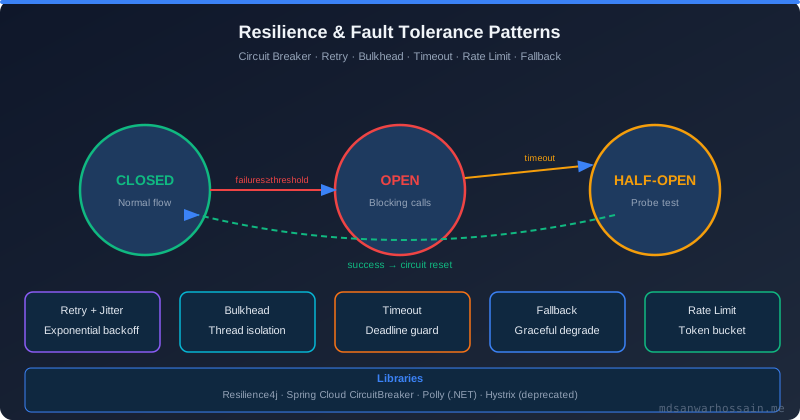
What it is: Services that make synchronous calls to downstream dependencies without protecting against dependency failures. When the downstream service becomes slow or unavailable, the calling service's threads pile up waiting for responses. Thread pool exhaustion causes the calling service to stop serving its own clients, cascading the failure upward through the call chain. This is the cascading failure pattern that takes down entire microservices meshes when one leaf service has a bad deployment.
Real failure scenario: A retail platform's product recommendation service called a third-party ML scoring API with a default 30-second HTTP timeout. The ML provider had a routing issue that caused requests to hang (not fail fast — just hang). Within 4 minutes, all 200 Tomcat threads in the recommendation service were blocked on ML API calls. The recommendation service stopped responding to the product page service. The product page service started queuing requests waiting for recommendations. In 8 minutes, the product page service was also exhausted. The homepage was down because of a third-party ML provider issue — a dependency that should have been optional.
Fix: Implement Resilience4j circuit breakers on every synchronous downstream call. Configure sensible timeouts (not the default 30 seconds — most service-to-service calls should timeout in 1–3 seconds). Use fallback responses for non-critical dependencies: if the recommendation service is open-circuited, return popular items from cache instead of failing the product page. Circuit breaker state transitions (CLOSED → OPEN → HALF_OPEN) should be exported as metrics and alert on OPEN state transitions in your monitoring system.
// Resilience4j circuit breaker configuration — Spring Boot application.yml
resilience4j:
  circuitbreaker:
    instances:
      mlScoringService:
        slidingWindowSize: 20           # evaluate based on last 20 calls
        failureRateThreshold: 50        # open circuit if 50%+ calls fail
        waitDurationInOpenState: 30s    # wait 30s before trying HALF_OPEN
        permittedNumberOfCallsInHalfOpenState: 3
        slowCallDurationThreshold: 2s   # treat 2s+ calls as "slow" failures
        slowCallRateThreshold: 80       # open if 80%+ calls are slow
  timelimiter:
    instances:
      mlScoringService:
        timeoutDuration: 1500ms         # hard 1.5s timeout per call

// Java usage with Spring annotation
@Service
public class RecommendationService {
    @CircuitBreaker(name = "mlScoringService", fallbackMethod = "popularItemsFallback")
    @TimeLimiter(name = "mlScoringService")
    public CompletableFuture<List<Product>> getRecommendations(String userId) {
        return CompletableFuture.supplyAsync(() -> mlClient.score(userId));
    }

    private CompletableFuture<List<Product>> popularItemsFallback(String userId, Exception ex) {
        return CompletableFuture.completedFuture(popularItemsCache.getTopItems(50));
    }
}
7. Inconsistent Data Contracts
What it is: Services that evolve their APIs without versioning, breaking consumers silently. A field renamed in the response JSON. An enum value added to a list that consumers deserialize as a fixed-size enum (Jackson's default). A required field made optional, or an optional field made required. Contract changes deployed without coordinating with consumers — causing runtime deserialization failures in production hours after deployment when requests hit the new behavior.
Real failure scenario: An OrderService changed the status field from a string to an enum and added a new PARTIALLY_SHIPPED value. The ShippingService was deserializing status with a strict enum mapper and had no handler for unknown values. After the OrderService deployment, 15% of shipping queries started throwing UnrecognizedFieldException — the 15% of orders that were in PARTIALLY_SHIPPED state. The ShippingService team didn't know about the change. Three hours of production degradation before the root cause was traced to a schema change in OrderService deployed that morning.
Fix: Adopt contract-first API development with OpenAPI specifications. Implement consumer-driven contract testing (Pact framework) — consumers define the contract they need, providers validate they satisfy all consumer contracts in CI before every deployment. Configure JSON deserialization to be lenient by default: @JsonIgnoreProperties(ignoreUnknown = true) on all DTOs, and READ_UNKNOWN_ENUM_VALUES_AS_NULL in Jackson configuration. Version APIs explicitly (/v1/, /v2/) and maintain backward compatibility within a major version for a defined deprecation period.
8. Over-Engineering with Microservices Too Early
What it is: Starting a new product with 15 microservices when you have 3 engineers, 0 paying customers, and unknown domain boundaries. The services are tiny (the infamous NanoService), each handling one function, with all the operational overhead of microservices (service mesh, distributed tracing, separate CI/CD pipelines, independent monitoring) but none of the benefits (there's only one team, so "independent deployability" provides no organizational value).
Real failure scenario: A startup split their MVP into 12 services on day one, following microservices blog posts uncritically. Three engineers spent 60% of their time on infrastructure (setting up Kubernetes, configuring service mesh, debugging inter-service authentication) instead of building product features. The product's domain model was still evolving — they refactored service boundaries 4 times in 6 months as they learned what users actually needed. Each boundary refactor required moving database tables, updating Kubernetes configs, rewriting service-to-service auth, and re-tracing distributed calls. The monolith competitor shipped 3x the features in the same period.
Fix: Start as a modular monolith. Separate the domain into distinct modules (packages with clear boundaries and no circular dependencies) but deploy as one service. When a specific module has independent scaling needs, a different deployment cadence, or a separate team, extract it as a service at that point. The domain model is stable enough that service boundaries are less likely to need refactoring. The "modular monolith first, extract when needed" strategy — favored by DHH, Martin Fowler, and Sam Newman — almost always outperforms premature decomposition for new products.
9. No Service Discovery / Registry
What it is: Services hardcoding the IP addresses or DNS names of their dependencies in configuration files. When instances are autoscaled, replaced during rolling deployments, or moved to different hosts during node failures, the hardcoded addresses become stale. Requests fail with connection refused or timeout until engineers manually update configuration and redeploy — defeating the purpose of cloud-native infrastructure.
Real failure scenario: A team running on-premise VMs used static IP addresses in application.properties for all service-to-service calls. When a planned VM migration moved the PaymentService to a new host with a different IP, the OrderService couldn't reach it. The migration was a 20-minute operation that caused a 4-hour payment outage because configuration updates had to be pushed to 8 services, each requiring a separate deployment. The team had no service registry, no health-check-based routing, and no way to update service endpoints without a redeployment cycle.
Fix: Use service discovery from day one. On Kubernetes, this is built in — services are addressable by DNS name (service-name.namespace.svc.cluster.local) and kube-proxy routes to healthy pods automatically. For non-Kubernetes environments, Consul, Eureka, or AWS Cloud Map provide service registration and DNS-based discovery. A service mesh (Istio, Linkerd) adds health-check-based load balancing and automatic retry on top of service discovery, further reducing the blast radius of individual instance failures.
10. Ignoring Operational Complexity
What it is: Adopting microservices for the architectural benefits without investing in the operational infrastructure those benefits require: distributed tracing, centralized logging, service health dashboards, alerting per service, chaos engineering, and incident runbooks per service. Without this infrastructure, debugging a production incident across 20 services becomes a multi-hour archaeology project correlating logs from 20 different log streams, guessing which service originated the error chain.
Real failure scenario: A team ran 30 microservices with logging to separate CloudWatch log groups and no distributed tracing. A customer reported intermittent checkout failures. Diagnosing the issue required manually correlating 30 log streams using rough timestamp matching. The team spent 6 hours before discovering that a memory leak in the discount service was causing occasional GC pauses that caused HTTP timeouts in the cart service, which propagated as 500s to the checkout service. With distributed tracing (Jaeger or Zipkin with OpenTelemetry), the trace would have shown the exact timing of the GC pause in the discount service within seconds of starting the investigation.
Fix: The operational investment is non-negotiable for production microservices. Minimum viable observability: OpenTelemetry distributed tracing with trace IDs propagated through all service calls; centralized log aggregation (ELK/EFK or Datadog) with trace IDs indexed; per-service RED metrics (Request rate, Error rate, Duration) dashboards; SLO-based alerting per service. Run regular game days simulating service failures to validate that your runbooks and observability actually work for diagnosing incidents. The cost of this infrastructure is far lower than the cost of a 6-hour incident investigation.
For application-side patterns that improve observability within a single service — particularly around how concurrent task execution maps to distributed traces — the Java Structured Concurrency post covers how StructuredTaskScope's parent-child thread model enables automatic OpenTelemetry context propagation to forked subtasks.
Key Takeaways
- Distributed monolith is the most common trap — if services can't be deployed independently, you have a monolith with distributed system failure modes; fix service boundaries before adding more services.
- Database per service is non-negotiable — shared databases create implicit coupling that makes schema changes and scaling impossible to do independently.
- Break synchronous chains with async messaging — every synchronous hop multiplies latency and degrades availability; Kafka/SNS events decouple service lifecycles.
- Circuit breakers on every synchronous downstream call — without them, a single slow dependency cascades into full system failure; Resilience4j with fallbacks is 30 lines of config.
- Start with a modular monolith — extract services only when you have clear scaling needs, team boundaries, or deployment cadence differences; premature decomposition costs more than it saves.
- Operational investment is mandatory — distributed tracing, centralized logging, and per-service RED metrics are prerequisites, not nice-to-haves; budget for them before deploying microservices to production.
- Consumer-driven contract testing prevents schema breakage — Pact in CI catches contract violations before deployment, not after a 3-hour production incident.
Conclusion
Microservices are not a silver bullet. They are a deliberate trade-off: accepting the complexity of distributed systems in exchange for independent deployability, team autonomy, and targeted scaling. That trade-off only pays off when you invest in the architectural discipline and operational infrastructure the model demands. The ten anti-patterns in this article are where that discipline breaks down — and where most microservices stories that end with "we're migrating back to a monolith" originate.
The good news: every anti-pattern has a well-known fix. Bounded contexts eliminate distributed monoliths. Event-driven integration breaks synchronous chains. Database per service removes shared-schema coupling. Circuit breakers prevent cascading failures. And starting as a modular monolith sidesteps premature decomposition entirely. Adopt microservices intentionally, invest in the operational stack, and the architecture delivers everything it promised.
Leave a Comment
Related Posts

Software Engineer · Java · Spring Boot · Microservices