RabbitMQ vs Kafka: When to Use Which Message Broker in Java Microservices
The RabbitMQ vs Kafka debate is one of the most frequently misunderstood architectural decisions in microservices. They are not competing alternatives — they solve fundamentally different problems. Understanding the architectural philosophy behind each is more valuable than memorising a feature checklist.
TL;DR
"RabbitMQ vs Kafka: when to use which message broker in Java microservices. Deep comparison of AMQP routing, throughput, ordering guarantees, consumer."
Table of Contents
- Core Architectural Philosophy: Message Queue vs Event Log
- RabbitMQ's AMQP Routing Model: Exchanges, Queues and Bindings
- Kafka's Partition and Consumer Group Model
- Throughput, Latency, and Ordering Guarantees Compared
- Delivery Guarantees and Idempotency
- Operational Complexity and Management
- Spring Boot Integration Patterns for Both Brokers
- Decision Framework: Which Broker for Which Use Case
Core Architectural Philosophy: Message Queue vs Event Log
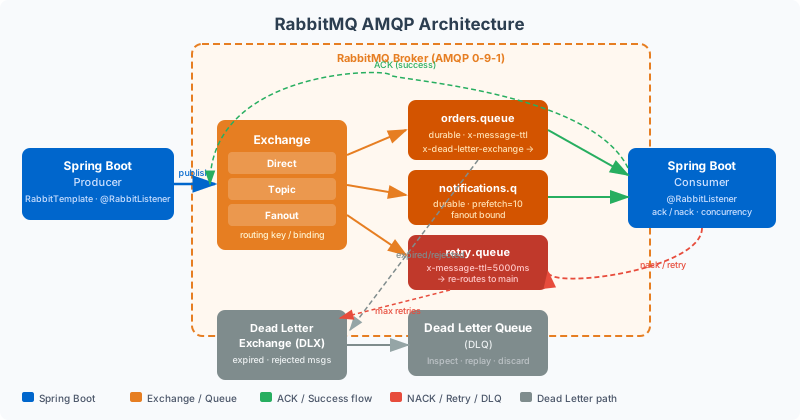
RabbitMQ and Kafka are built on fundamentally different architectural models that determine which problems each solves well. RabbitMQ is a message broker implementing the Advanced Message Queuing Protocol (AMQP). It follows a push-based model: the broker actively delivers messages to consumers, tracks delivery state, and considers a message "done" once it is acknowledged. Messages are deleted after consumption. RabbitMQ excels at task distribution, work queues, and complex routing scenarios where the broker needs intelligence about message destinations.
Kafka is a distributed event log. It follows a pull-based model: consumers pull messages at their own pace, messages are retained on disk for a configurable period regardless of consumption, and multiple independent consumer groups can read the same event stream without interfering with each other. Kafka's append-only log model makes it naturally suited for event sourcing, audit trails, stream processing, and scenarios where multiple downstream services need to react to the same events independently.
The most important conceptual difference is message persistence semantics. In RabbitMQ, a queue is a temporary holding area — messages are there to be processed and then gone. In Kafka, a topic is a permanent log — events are stored and replayable. If you need to replay the last 7 days of payment events to rebuild a projection, Kafka makes this trivial. With RabbitMQ, the message is gone after consumption unless you explicitly persist it elsewhere. This retention difference alone determines the right choice for most use cases.
Both systems are mature, production-battle-tested, and have excellent Spring Boot integration. The wrong choice is not picking the "wrong" broker — it is using either one in scenarios that fight against its design. Using Kafka as a simple task queue forces you to manage partition counts, consumer group rebalancing, and offset commits for a use case that RabbitMQ handles with a single queue declaration. Using RabbitMQ for event streaming requires storing event state in an external system and loses the inherent replayability that makes event-driven architectures so powerful.
RabbitMQ's AMQP Routing Model: Exchanges, Queues and Bindings
RabbitMQ's routing model is its defining feature. Producers do not send messages directly to queues — they publish to exchanges, and exchanges route messages to queues based on bindings and routing rules. This indirection gives RabbitMQ extraordinary routing flexibility that Kafka's topic model cannot match.
There are four exchange types. A direct exchange routes messages to queues where the binding key exactly matches the routing key — useful for point-to-point task dispatch. A topic exchange uses wildcard pattern matching (* for one word, # for zero or more words) — a message with routing key order.europe.payment matches bindings order.#, *.europe.*, and order.europe.payment simultaneously. A fanout exchange broadcasts every message to all bound queues regardless of routing key — useful for pub/sub notifications to multiple services. A headers exchange routes based on message headers rather than routing keys — useful when routing logic is complex and attribute-driven.
This routing model enables patterns that are difficult to replicate with Kafka. Consider an e-commerce platform where order events must be routed to different queues based on region (EU, APAC, NA) and order type (standard, express, wholesale). With RabbitMQ, a single topic exchange with appropriate bindings handles this in broker configuration — no application code changes required to add a new region. With Kafka, you would need separate topics per region-type combination, or a consumer that partitions events manually, or a stream processor (Kafka Streams / Flink) that routes between topics.
// Spring Boot RabbitMQ - Topic Exchange configuration
@Configuration
public class OrderMessagingConfig {

    public static final String ORDER_EXCHANGE = "order.topic.exchange";
    public static final String EU_QUEUE = "order.eu.queue";
    public static final String APAC_QUEUE = "order.apac.queue";
    public static final String ALL_ORDERS_QUEUE = "order.all.queue";

    @Bean
    public TopicExchange orderExchange() {
        return new TopicExchange(ORDER_EXCHANGE, true, false);
    }

    @Bean
    public Queue euOrderQueue() {
        return QueueBuilder.durable(EU_QUEUE).build();
    }

    @Bean
    public Queue allOrderQueue() {
        return QueueBuilder.durable(ALL_ORDERS_QUEUE).build();
    }

    @Bean
    public Binding euOrderBinding(Queue euOrderQueue, TopicExchange orderExchange) {
        return BindingBuilder.bind(euOrderQueue)
                .to(orderExchange)
                .with("order.eu.#"); // matches order.eu.payment, order.eu.refund, etc.
    }

    @Bean
    public Binding allOrdersBinding(Queue allOrderQueue, TopicExchange orderExchange) {
        return BindingBuilder.bind(allOrderQueue)
                .to(orderExchange)
                .with("order.#"); // receives every order event
    }
}
RabbitMQ also supports priority queues, allowing high-priority messages (VIP customer orders, payment escalations) to jump the queue ahead of standard messages. Kafka has no native concept of message priority — all messages in a partition are processed in append order. For use cases where message importance determines processing order, RabbitMQ is the natural choice.
Kafka's Partition and Consumer Group Model
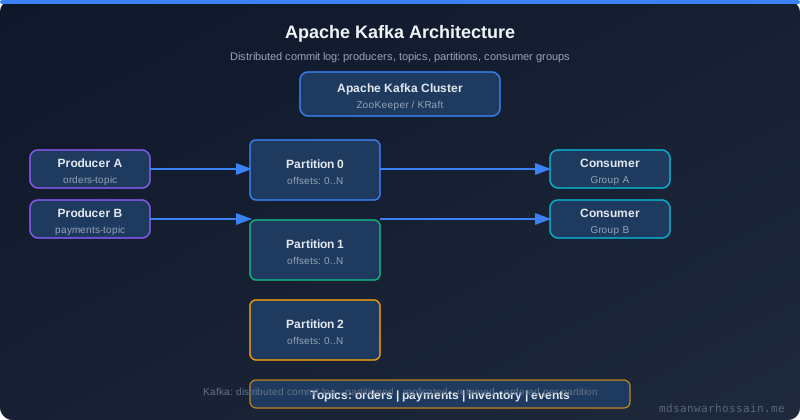
Kafka's partition model is the foundation of its scalability and ordering guarantees. A topic is divided into N partitions, each an independent append-only log stored on disk. Producers assign messages to partitions — typically by key hash, so all events for a given entity (e.g., all order events for orderId=12345) land in the same partition, preserving per-entity ordering. Within a partition, messages are totally ordered by offset. Across partitions, there is no ordering guarantee.
Consumer groups allow multiple independent subscribers to consume the same topic. Within a consumer group, each partition is consumed by exactly one consumer — this is how Kafka scales consumption: add consumers (up to the partition count) to scale throughput. Across consumer groups, every group sees every message independently. A billing service and an analytics service can both consume the same order-created topic in separate consumer groups without any interaction — each group maintains its own offset position.
This multi-consumer model is Kafka's killer feature for event-driven microservices. When a new downstream service needs to react to existing events, you add a new consumer group with no changes to the producer or broker configuration. Contrast with RabbitMQ: to add a new subscriber to a fanout exchange, you declare a new queue and binding — manageable, but the queue must exist before messages are published, or they are missed. Kafka retains events for its configured retention period (7 days by default, configurable to forever), so a new consumer group can replay historical events immediately upon creation.
Kafka's throughput ceiling is orders of magnitude higher than RabbitMQ's. Kafka is designed for sequential disk writes to a single commit log per partition — the exact access pattern that makes spinning disks and SSDs fastest. Production Kafka clusters routinely sustain millions of messages per second per broker. RabbitMQ's throughput depends heavily on message persistence configuration and acknowledgement mode, but typically peaks at tens of thousands to low hundreds of thousands of messages per second per node for persistent, acknowledged messages. For high-volume telemetry, log aggregation, and clickstream data, Kafka's throughput advantage is decisive.
Throughput, Latency, and Ordering Guarantees Compared
| Dimension | RabbitMQ | Kafka | Winner |
|---|---|---|---|
| Peak throughput | 10K–100K msg/s | 1M+ msg/s per broker | Kafka |
| End-to-end latency | <1ms (push delivery) | 1–10ms (pull + batching) | RabbitMQ |
| Global ordering | Per-queue FIFO | Per-partition only | RabbitMQ (single queue) |
| Message retention | Until consumed + TTL | Configurable (days/forever) | Kafka |
| Replay capability | Not supported natively | Full offset reset/replay | Kafka |
| Routing intelligence | Exchange/binding rules | Topic/key only | RabbitMQ |
| Multiple independent consumers | Requires fanout + separate queues | Native consumer groups | Kafka |
| Priority queuing | Native support | Not supported | RabbitMQ |
| Operational simplicity | Simpler (no ZooKeeper/KRaft) | More complex cluster mgmt | RabbitMQ |
Delivery Guarantees and Idempotency
Both RabbitMQ and Kafka support at-least-once delivery — the guarantee that messages will be delivered at least once, but potentially more than once under failure conditions. Exactly-once delivery is achievable in both systems but requires additional configuration and application-level idempotency.
In RabbitMQ, delivery acknowledgement works at the per-message level. The consumer sends an ack after processing, and the broker removes the message. If the consumer crashes before acking, the broker redelivers to another consumer. Publisher confirms (channel.confirmSelect()) ensure the broker has persisted the message before the producer considers it sent. The combination of publisher confirms and consumer acknowledgements gives at-least-once delivery. For exactly-once, you must implement idempotency in the consumer — typically by storing a processed message ID in a database and checking before processing each redelivered message.
Kafka's exactly-once semantics (EOS), introduced in Kafka 0.11, uses a transactional producer that atomically writes to multiple partitions and an idempotent producer that deduplicates retried sends using a sequence number. For Java applications, enable EOS with isolation.level=read_committed on consumers and transactional.id on producers. Spring Kafka's KafkaTransactionManager integrates with Spring's @Transactional to coordinate database and Kafka writes in the same transaction when using the ChainedKafkaTransactionManager pattern.
# Spring Kafka - exactly-once producer configuration
spring:
  kafka:
    producer:
      bootstrap-servers: ${KAFKA_BOOTSTRAP_SERVERS}
      key-serializer: org.apache.kafka.common.serialization.StringSerializer
      value-serializer: org.springframework.kafka.support.serializer.JsonSerializer
      properties:
        enable.idempotence: true
        transactional.id: order-service-tx  # unique per application instance
        acks: all
        retries: 2147483647
        max.in.flight.requests.per.connection: 5
    consumer:
      group-id: order-service-consumer
      auto-offset-reset: earliest
      isolation-level: read_committed    # only read committed transactions
      enable-auto-commit: false          # manual commit for EOS
Operational Complexity and Management
RabbitMQ is operationally simpler than Kafka for small-to-medium deployments. A single RabbitMQ node can be deployed in minutes with a Docker image and provides the management UI at http://host:15672 with real-time queue depths, message rates, and consumer status. For high availability, RabbitMQ uses quorum queues — Raft-based replicated queues that provide strong consistency without the classic mirrored queue's split-brain risks. A 3-node RabbitMQ cluster with quorum queues is relatively straightforward to operate.
Kafka clusters are more operationally demanding. The shift from ZooKeeper to KRaft (Kafka 3.3+, GA in 3.6) eliminated the external dependency and simplified deployment, but Kafka still requires careful partition planning, broker sizing, and replication factor configuration. Consumer group rebalancing during deployments causes pause-of-processing that requires careful linger.ms and session.timeout.ms tuning to minimise. For teams without a dedicated platform engineering function, Amazon MSK (Managed Streaming for Apache Kafka) or Confluent Cloud remove operational burden at the cost of vendor lock-in.
Spring Boot Integration Patterns for Both Brokers
Spring Boot provides first-class abstractions for both RabbitMQ (via Spring AMQP / spring-boot-starter-amqp) and Kafka (via Spring Kafka / spring-boot-starter-kafka). Both use annotation-driven listeners and template-based sending that feel identical from the application layer.
// RabbitMQ listener - Spring AMQP
@Component
public class OrderEventConsumer {

    @RabbitListener(queues = OrderMessagingConfig.EU_QUEUE,
                    concurrency = "3-10") // min 3, scale to 10 concurrent consumers
    public void handleEuOrder(OrderCreatedEvent event,
                              Channel channel,
                              @Header(AmqpHeaders.DELIVERY_TAG) long tag) throws IOException {
        try {
            processOrder(event);
            channel.basicAck(tag, false); // manual ack
        } catch (RecoverableException e) {
            channel.basicNack(tag, false, true); // requeue for retry
        } catch (PoisonPillException e) {
            channel.basicNack(tag, false, false); // reject to DLQ
        }
    }
}

// Kafka listener - Spring Kafka
@Component
public class OrderEventKafkaConsumer {

    @KafkaListener(topics = "order-created",
                   groupId = "billing-service",
                   concurrency = "6") // one thread per partition (up to 6)
    public void handleOrder(
            @Payload OrderCreatedEvent event,
            @Header(KafkaHeaders.RECEIVED_PARTITION) int partition,
            @Header(KafkaHeaders.OFFSET) long offset,
            Acknowledgment ack) {
        try {
            processBilling(event);
            ack.acknowledge(); // commit offset after successful processing
        } catch (Exception e) {
            // Don't ack — message will be redelivered
            throw e;
        }
    }
}
Decision Framework: Which Broker for Which Use Case
The decision between RabbitMQ and Kafka reduces to answering four questions: Do you need message replay? Do you have multiple independent consumer types? Is throughput above 100K msg/s required? Do you need complex routing logic based on message attributes?
Choose RabbitMQ when: your use case is a task queue where messages are processed-and-done (email sending, PDF generation, payment processing, notification dispatch); you need complex content-based routing through exchanges and bindings; you need priority queuing to fast-track important messages; latency below 1ms is required; you are operating with limited infrastructure complexity budget; or you need per-message TTL and expiry semantics.
Choose Kafka when: multiple independent microservices must react to the same event stream; you need event replay for new service onboarding, debugging, or projection rebuild; throughput exceeds 100K msg/s; you are building event sourcing or CQRS with an event store; you need stream processing with Kafka Streams or ksqlDB; or you need a durable audit log of all domain events. Most large enterprises that have both brokers use Kafka for domain events and inter-service integration, and RabbitMQ for internal task queues within a service boundary.