RAG with Hybrid Search in Production: Dense + Sparse Vector Fusion That Actually Works
Retrieval-Augmented Generation promised to ground language models in real knowledge — but in practice, retrieval quality is the bottleneck that almost no production team anticipated. Pure semantic search misses exact clause references. Pure keyword search misses conceptual intent. The answer is hybrid search: fusing dense embeddings and sparse BM25 scores through Reciprocal Rank Fusion (RRF), followed by a cross-encoder reranker that delivers the precision and recall your LLM actually needs to generate accurate answers.
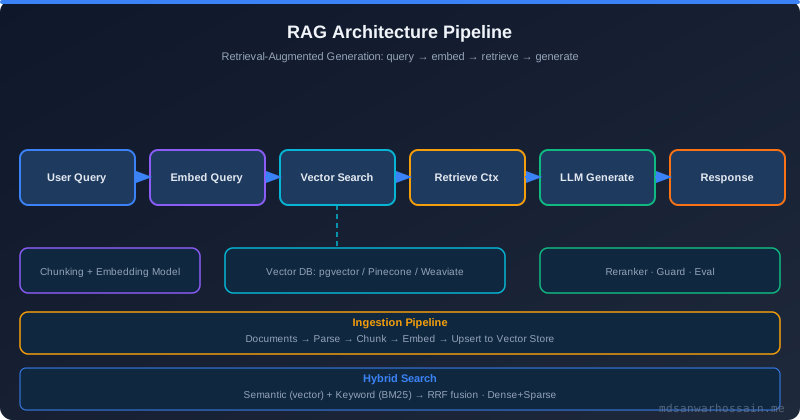
Table of Contents
- The Production Gap: Why Single-Mode Retrieval Fails
- Understanding Hybrid Search Architecture
- Reciprocal Rank Fusion (RRF) Explained
- Implementing Hybrid RAG with LangChain + Weaviate
- Reranking: The Final Quality Layer
- Failure Scenarios & Production Fixes
- Trade-offs: When NOT to Use Hybrid Search
- Optimization Techniques
- Key Takeaways
- Conclusion
1. The Production Gap: Why Single-Mode Retrieval Fails
A legal tech company deployed a RAG system for contract analysis. Their initial setup used a straightforward approach: embed all contract clauses with text-embedding-ada-002, store in a vector database, and retrieve the top-5 most semantically similar chunks for each user query. In testing, this produced impressive results — the LLM could explain general contract concepts fluently.
Production told a different story. When lawyers queried for specific clause references like "Section 12.3(b) indemnification obligations", the dense retrieval returned thematically related clauses about liability — but not the exact Section 12.3(b) the lawyer needed. Cosine similarity between the query embedding and the exact target clause was only 0.61, because the section identifier 12.3(b) carries almost no weight in a semantic embedding space trained on general language. Meanwhile, querying for "breach of obligation" with BM25 returned clauses containing that exact phrase but completely missed semantically equivalent passages using the phrase "failure to perform".
The core failure modes are:
- Dense vectors miss exact keyword matches: Numeric identifiers, proper nouns, section references like
Section 12.3(b), contract IDs, and legal citation codes are essentially invisible to cosine similarity. They are low-frequency tokens that carry enormous domain-specific meaning but generate averaged-out embeddings that lose the identifier signal entirely. - Sparse vectors miss semantic intent: BM25 scores documents based on term frequency and inverse document frequency. A clause using "failure to perform" scores zero for a query containing "breach of obligation" — despite the two phrases being legally synonymous. Domain-specific paraphrasing, abbreviations, and contextual language all defeat pure keyword search.
- The 80/20 failure trap: Either mode handles roughly 70-80% of queries well. The remaining 20-30% — precisely the complex, high-stakes queries that legal professionals most need AI assistance with — are the ones each mode fails at independently.
2. Understanding Hybrid Search Architecture
Hybrid search runs dense and sparse retrieval in parallel, then fuses their ranked result lists into a single unified ranking before passing the top-k documents to the LLM context window. The architecture is straightforward conceptually but has several critical implementation details that determine whether you get a meaningful lift or just added latency.
The data flow through a production hybrid retrieval pipeline looks like this:
User Query
  ├── BM25 Engine (sparse)      ── top-50 docs by term frequency
  └── Embedding Engine (dense)  ── top-50 docs by cosine similarity
         ↓                              ↓
         └──── Parallel Retrieval ──────┘
                      ↓
              RRF Fusion (k=60)
                      ↓
               Reranker (cross-encoder)
                      ↓
            Top-5 chunks → LLM context
                      ↓
                Final Answer
The legal tech team switched to this architecture. Answer quality jumped from 61% to 87% within two weeks of deployment — exceeding their 85% target. The entire change was in the retrieval layer. The LLM, prompts, and chunking strategy remained identical.
3. Reciprocal Rank Fusion (RRF) Explained
Reciprocal Rank Fusion is a rank aggregation method that combines multiple ranked lists by summing reciprocal rank scores across lists. Its key insight: the absolute similarity score from each retrieval mode is not directly comparable (BM25 scores are unbounded; cosine similarity is bounded between -1 and 1), but ranks are always comparable. RRF normalises everything to rank positions.
The formula for a document d fused from n ranked lists is:
RRF_score(d) = Σ  1 / (k + rank_i(d))
               i=1..n

Where:
  k   = smoothing constant (default 60, prevents top ranks dominating)
  rank_i(d) = position of document d in ranked list i (1-indexed)
  n   = number of ranked lists being fused
A document ranked #1 in both the BM25 list and the embedding list receives a score of 1/(60+1) + 1/(60+1) ≈ 0.033. A document ranked #1 in one list but absent from the other receives 1/(60+1) ≈ 0.016. The smoothing constant k=60 (from the original 2009 Cormack et al. paper) significantly dampens the advantage of rank-1 over rank-2, which prevents a single highly confident but incorrect retrieval from dominating the fused result.
def reciprocal_rank_fusion(results_list: list[list[dict]], k: int = 60) -> list[dict]:
    """Fuse multiple ranked result lists using RRF."""
    scores = {}
    for results in results_list:
        for rank, doc in enumerate(results):
            doc_id = doc['id']
            if doc_id not in scores:
                scores[doc_id] = {'score': 0, 'doc': doc}
            scores[doc_id]['score'] += 1 / (k + rank + 1)
    return sorted(scores.values(), key=lambda x: x['score'], reverse=True)
This implementation is deliberately simple — and that is a feature, not a limitation. RRF requires no training, no calibration of score normalisation across retrieval modes, and no hyperparameter tuning beyond the constant k. It is robust to outlier scores from individual retrievers, and it degrades gracefully when one retriever returns fewer results than expected.
4. Implementing Hybrid RAG with LangChain + Weaviate
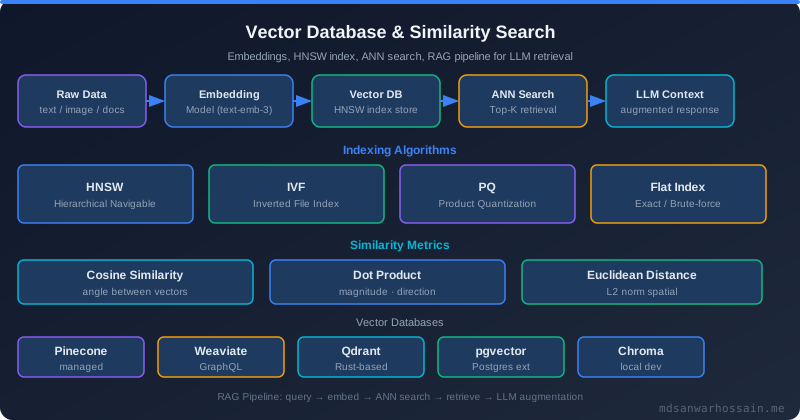
Weaviate is a vector database with first-class hybrid search support. It runs BM25 and HNSW-indexed vector search in parallel internally and accepts an alpha parameter to control the blend: alpha=0.0 is pure BM25, alpha=1.0 is pure vector search, and alpha=0.5 gives equal weight to both. Setting up hybrid search in Weaviate with LangChain looks like this:
import weaviate
from langchain_weaviate import WeaviateVectorStore
from langchain_openai import OpenAIEmbeddings

client = weaviate.connect_to_local()
embeddings = OpenAIEmbeddings(model="text-embedding-3-small")

vectorstore = WeaviateVectorStore(
    client=client,
    index_name="ContractClause",
    text_key="content",
    embedding=embeddings,
)

# Hybrid search: alpha=0.5 blends BM25 and vector equally
# Increase alpha toward 1.0 for more semantic, toward 0.0 for more keyword
retriever = vectorstore.as_retriever(
    search_type="hybrid",
    search_kwargs={
        "k": 20,        # retrieve top-20 before reranking
        "alpha": 0.5,   # 50% dense / 50% sparse blend
    }
)
For teams using a Spring Boot backend to serve the RAG API, here is a minimal service that delegates retrieval to a Python microservice and constructs the LLM prompt:
@Service
@RequiredArgsConstructor
public class HybridRagService {
    private final WebClient ragPythonClient;  // points to Python retrieval service
    private final OpenAiChatClient chatClient;

    public String answer(String userQuery) {
        // Call Python hybrid retrieval service
        List<RetrievedChunk> chunks = ragPythonClient.get()
            .uri(uriBuilder -> uriBuilder
                .path("/retrieve")
                .queryParam("q", userQuery)
                .queryParam("alpha", "0.5")
                .queryParam("top_k", "5")
                .build())
            .retrieve()
            .bodyToFlux(RetrievedChunk.class)
            .collectList()
            .block();

        String context = chunks.stream()
            .map(RetrievedChunk::content)
            .collect(Collectors.joining("\n\n---\n\n"));

        String prompt = """
            You are a legal contract analysis assistant.
            Answer the question using ONLY the provided context.
            If the answer is not in the context, say "Not found in documents."

            Context:
            %s

            Question: %s
            """.formatted(context, userQuery);

        return chatClient.call(prompt);
    }
}
The alpha parameter is a tunable knob. For the legal tech use case, empirical testing showed alpha=0.4 (slightly favouring keyword precision) yielded the best results on their test set of 300 gold-standard query/answer pairs. Run A/B tests on your specific domain before hardcoding this value.
5. Reranking: The Final Quality Layer
Hybrid search gets you a fused ranked list of ~20 candidate documents. A reranker — typically a cross-encoder model — takes each (query, document) pair, runs a full attention pass over both simultaneously, and produces a much more accurate relevance score than any bi-encoder similarity metric. Cross-encoders cannot efficiently retrieve at scale (they require N forward passes for N documents), but they excel at reranking a small candidate set.
Cohere Rerank is the most pragmatic production choice: a managed API that accepts your query and candidate documents, runs a cross-encoder internally, and returns a sorted list in milliseconds. Here is the full pipeline from hybrid retrieval through reranking:
import cohere
from langchain_core.documents import Document

co = cohere.Client(api_key="YOUR_COHERE_API_KEY")

def hybrid_retrieve_and_rerank(
    query: str,
    vectorstore,
    top_k_retrieve: int = 20,
    top_k_final: int = 5,
    alpha: float = 0.5,
) -> list[Document]:
    # Step 1: Hybrid retrieval (BM25 + dense, fused with RRF internally)
    candidates = vectorstore.similarity_search(
        query, k=top_k_retrieve, alpha=alpha
    )

    # Step 2: Rerank with Cohere cross-encoder
    rerank_response = co.rerank(
        model="rerank-english-v3.0",
        query=query,
        documents=[doc.page_content for doc in candidates],
        top_n=top_k_final,
    )

    # Step 3: Return reranked top-k in order
    return [
        candidates[result.index]
        for result in rerank_response.results
    ]
When reranking costs too much. The Cohere Rerank API adds approximately 100-200ms of latency per call. If your latency budget is under 500ms end-to-end, this may consume too large a share. In that case, consider: (1) using a locally hosted cross-encoder like cross-encoder/ms-marco-MiniLM-L-6-v2 to eliminate network round-trip overhead; (2) reducing the candidate pool to top-10 before reranking; or (3) skipping reranking entirely and relying purely on RRF fusion, which provides the majority of the quality lift at zero additional latency cost.
6. Failure Scenarios & Production Fixes
Hybrid RAG pipelines fail in ways that pure-retrieval and pure-generation systems do not. Understanding these failure modes before they hit production is the difference between a system that degrades gracefully and one that silently produces wrong answers at scale.
Index drift is the most insidious failure because it is invisible at the infrastructure level. Monitoring systems report healthy latency and throughput. But if you upgraded your embedding model from text-embedding-ada-002 to text-embedding-3-large without re-embedding stored documents, your query embeddings live in a different vector space than your document embeddings. Cosine similarities drop to near-random, semantic retrieval collapses, and the system silently degrades to BM25-only effective quality. Track embedding model version in your document metadata and alert on version mismatches.
7. Trade-offs: When NOT to Use Hybrid Search
Hybrid search is not universally the right choice. Evaluate these trade-offs honestly before adding the complexity of a dual-retrieval pipeline to every RAG application you build:
Small corpus (<10k documents): When your entire document set fits comfortably in memory and BM25 can scan it in milliseconds, adding a vector database and embedding pipeline is engineering overhead with marginal benefit. BM25 alone is fine. The quality lift from hybrid search is most pronounced at scale (100k+ chunks) where dense retrieval's semantic discrimination matters most.
High latency budget pressure: Running two retrieval paths instead of one adds 40-80ms of parallel overhead (assuming well-tuned infrastructure). If your total latency budget is 200ms, this is a significant fraction. Profile your specific stack before assuming the latency cost is acceptable.
Simple FAQ bot with narrow vocabulary: A customer support bot that answers questions about a single product line with a consistent vocabulary has little to gain from hybrid search. All queries use the same domain-specific terms. A well-tuned dense retriever with domain-adapted embeddings is simpler, faster, and equally accurate for this use case.
Single-domain, near-identical phrasing corpus: If your document corpus is homogeneous in vocabulary — all documents use the same terminology, no abbreviations, no cross-domain paraphrasing — dense-only retrieval will handle it well. The marginal value of BM25 diminishes when semantic and lexical similarity are already highly correlated.
"The question is not whether hybrid search is better than dense-only or sparse-only — it almost always is. The question is whether the improvement is worth the additional operational complexity for your specific workload."
— Production RAG engineering principle
8. Optimization Techniques
Once hybrid search is working correctly, these optimizations eliminate the most common production bottlenecks:
Async parallel retrieval. Dense and sparse retrieval are independent operations — run them concurrently. In Python, use asyncio.gather to fire both retrieval calls simultaneously and await both results before RRF fusion. This eliminates the serial overhead of sequential retrieval, cutting total retrieval latency roughly in half when both paths have similar duration:
import asyncio

async def parallel_hybrid_retrieve(query: str, k: int = 20) -> list[dict]:
    # Fire dense and sparse retrieval simultaneously
    dense_results, sparse_results = await asyncio.gather(
        dense_retriever.aretrieve(query, k=k),
        bm25_retriever.aretrieve(query, k=k),
    )
    # Fuse with RRF
    return reciprocal_rank_fusion([dense_results, sparse_results])
Embedding caching for repeated queries. Legal and enterprise RAG systems frequently receive semantically identical queries from different users: "What is the termination clause?" asked 50 times per day generates 50 identical embedding API calls. Cache query embeddings in Redis with a TTL of 1 hour. Use the query string as the cache key (after lowercasing and stripping punctuation). This can reduce embedding API costs by 30-60% in production and eliminates the 50-150ms OpenAI embedding latency for cache-hit queries.
Chunk overlap strategy for boundary context. A 512-token chunk ending mid-sentence drops the contextual bridge that ties it to the following chunk. Use a 20% overlap (approximately 100 tokens) between adjacent chunks so that the ending context of one chunk also appears at the beginning of the next. This ensures that semantically coherent spans are never split without representation. The legal tech team found that increasing overlap from 0% to 20% improved boundary-clause retrieval accuracy by 11 percentage points on their test set — at the cost of a 25% increase in total vector index size, which was a worthwhile trade-off.
Key Takeaways
- Single-mode retrieval has a 20-30% quality ceiling — dense search misses exact identifiers; sparse search misses semantic paraphrases. Hybrid search is the structural fix, not a tuning knob.
- Reciprocal Rank Fusion is the right fusion algorithm for production — it requires no training, no score normalisation, and is robust to retriever failures. Start with
k=60and adjust only if empirical testing demands it. - The
alphaparameter in Weaviate (and equivalent controls elsewhere) must be tuned per domain — legal and technical corpora benefit from lower alpha (more BM25 weight); semantic/conversational corpora benefit from higher alpha. - Reranking adds the highest per-token quality lift in the pipeline — a cross-encoder reranker over a 20-document hybrid candidate set consistently outperforms top-5 hybrid retrieval without reranking, at the cost of 100-200ms additional latency.
- Index drift is the silent killer of production RAG quality — version your embedding model in document metadata, monitor for model/index mismatches, and automate re-embedding pipelines for corpus-wide upgrades.
Conclusion
Hybrid search with Reciprocal Rank Fusion is the production-proven retrieval architecture for RAG systems operating on diverse, mixed-vocabulary corpora. It requires no model fine-tuning, no labelled training data, and no exotic infrastructure — just a vector database with BM25 support (Weaviate, Qdrant, or Elasticsearch), a lightweight RRF implementation, and optionally a cross-encoder reranker for the final quality layer. The legal tech team's 26-point quality improvement from 61% to 87% is reproducible across domains: technical documentation systems, internal knowledge bases, and multi-lingual enterprise search all show consistent lift when the retrieval layer stops forcing a false choice between lexical and semantic relevance.
If you are building on top of a foundational RAG system and want to understand the core architecture decisions that inform hybrid retrieval — chunking strategy, embedding model selection, metadata filtering, and context window management — our complete guide to RAG architecture covers the full retrieval pipeline design from document ingestion through generation. Hybrid search is the retrieval upgrade — that guide is the foundation it builds on.
Read Full Blog Here
Explore the complete guide including Weaviate hybrid configuration, RRF implementation, reranking pipeline code, and production monitoring strategies for hybrid RAG.
Read the Full PostLeave a Comment
Related Posts

Software Engineer · Java · Spring Boot · Microservices