Spring Boot WebFlux vs MVC: When Reactive Actually Helps and When It Hurts in Production
The reactive programming hype cycle peaked around 2019, and the fallout is visible in production systems everywhere: services rewritten in Spring WebFlux that are harder to debug, test, and extend than the Spring MVC code they replaced — with no measurable throughput improvement. But reactive isn't wrong. It's misapplied. This deep-dive cuts through the noise: how Spring MVC and WebFlux thread models actually differ, what problem reactive programming is genuinely solving, and the precise conditions under which each framework is the right tool for production Java services in 2026.
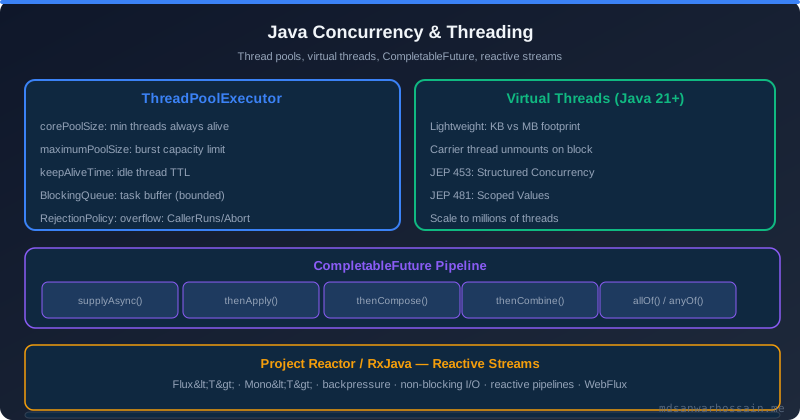
Table of Contents
- The Reactive Hype Trap
- Thread Models: Thread-per-Request vs Event Loop
- Mono and Flux: The Reactive Contract
- When to Choose WebFlux
- When Spring MVC Still Wins
- Backpressure: The Real Differentiator
- The Blocking in Reactive Pipeline Anti-Pattern
- Testing Reactive Code
- Migration Anti-Patterns
- The Virtual Threads Factor
- Key Takeaways
1. The Reactive Hype Trap
The pitch for reactive programming was compelling: eliminate thread-per-request overhead, handle 10x more concurrent connections with the same hardware, never run out of threads under load. Teams rewrote REST APIs in Spring WebFlux expecting transformational throughput gains. Many were disappointed — not because reactive is wrong, but because the thread-per-request model they were trying to escape is only a bottleneck under specific conditions that most CRUD APIs never experience.
Spring MVC's thread-per-request model has one real limitation: if you have 200 Tomcat threads and 201 concurrent long-lived connections (WebSockets, SSE streams, slow client uploads), the 201st request queues. Under normal HTTP request-response latencies (10–100ms), a thread pool of 200 handles thousands of requests per second comfortably. The problem only appears at extreme concurrency (thousands of simultaneous connections) or extreme latency (seconds-long blocking I/O per request). If your service doesn't hit those conditions, reactive programming adds complexity with no benefit.
The services that genuinely benefit from WebFlux are: API gateways proxying to dozens of upstream services, real-time notification servers maintaining thousands of open SSE streams, and file upload/download services handling large payloads from slow clients. The services that don't benefit — and pay the cost — are standard database-backed REST APIs with moderate traffic and synchronous business logic.
2. Thread Models: Thread-per-Request vs Event Loop
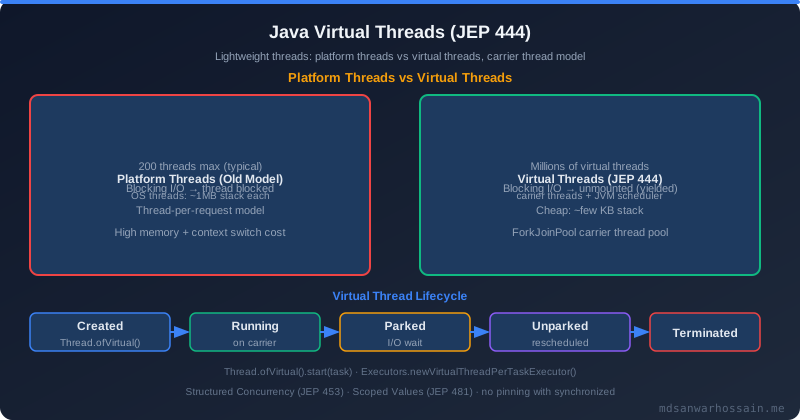
Spring MVC runs on Servlet containers (Tomcat, Jetty, Undertow) using the thread-per-request model. Each incoming HTTP request is assigned a platform thread from a pool (default 200 in Tomcat). That thread handles the entire lifecycle of the request: reading the request body, running your controller logic, making synchronous database calls, and writing the response. If a database query takes 50ms, the thread is parked for 50ms — consuming stack memory (~1MB) but doing no CPU work. Multiply by 200 threads × 50ms blocking: the throughput ceiling is 4,000 requests/second per thread pool, assuming perfectly uniform 50ms latency.
Spring WebFlux runs on Netty (by default) using an event loop model. Netty maintains a small pool of event loop threads — typically one per CPU core (8 on an 8-core instance). All I/O operations are non-blocking: when your reactive database driver issues a query, the event loop thread registers a callback and immediately moves on to process other requests. When the database responds, the callback is scheduled on an available event loop thread. No thread sits idle waiting for I/O. In theory, 8 event loop threads can serve thousands of concurrent connections.
The catch: event loop threads must never block. A single blocking call (a synchronous JDBC query, a Thread.sleep(), a synchronized block) on an event loop thread freezes that thread for all concurrent requests, not just the current one. With only 8 event loop threads, one blocking call can degrade throughput by 12.5% immediately. With Spring MVC, a blocking call only affects that one request's thread.
3. Mono and Flux: The Reactive Contract
Mono<T> represents a stream of 0 or 1 items. Flux<T> represents a stream of 0 to N items. Both are lazy: no work happens until something subscribes. This laziness is the source of both the power and the confusion. A Mono.fromCallable(() -> repository.findById(id)) doesn't execute the database call at construction time — it builds a recipe. The actual execution begins when the WebFlux framework subscribes to the returned Mono at request dispatch time.
// Spring WebFlux controller — reactive all the way down
@RestController
@RequestMapping("/users")
public class UserController {

    private final ReactiveUserRepository userRepository;
    private final ReactiveEmailService emailService;

    // Returns Mono: 0 or 1 user — non-blocking throughout
    @GetMapping("/{id}")
    public Mono<ResponseEntity<UserDto>> getUser(@PathVariable String id) {
        return userRepository.findById(id)
            .map(user -> ResponseEntity.ok(UserDto.from(user)))
            .defaultIfEmpty(ResponseEntity.notFound().build());
    }

    // Flux: stream all users with SSE — true backpressure-aware streaming
    @GetMapping(value = "/stream", produces = MediaType.TEXT_EVENT_STREAM_VALUE)
    public Flux<UserDto> streamUsers() {
        return userRepository.findAll()
            .map(UserDto::from)
            .delayElements(Duration.ofMillis(100)); // throttle for demo
    }

    // Fan-out: create user AND send welcome email in parallel
    @PostMapping
    public Mono<UserDto> createUser(@RequestBody UserRequest request) {
        return userRepository.save(User.from(request))
            .flatMap(saved ->
                emailService.sendWelcome(saved.getEmail())
                    .thenReturn(UserDto.from(saved))
            );
    }
}
The flatMap operator is the reactive equivalent of chaining asynchronous operations. It takes the result of the upstream operation, applies a function that returns another Publisher (Mono or Flux), and subscribes to that inner publisher. The event loop thread is never blocked between the outer and inner operations — the framework handles scheduling transparently. zipWith and zip execute two reactive pipelines concurrently and combine their results, analogous to CompletableFuture.allOf but with backpressure semantics.
4. When to Choose WebFlux
High-concurrency I/O-bound services: API gateways that proxy requests to 10+ upstream microservices, each with 50–200ms latency. WebFlux can maintain thousands of concurrent upstream connections on a handful of event loop threads. A traditional thread-per-request gateway would require a thread pool sized to the product of concurrent requests × average upstream latency to avoid queuing. At 1,000 concurrent requests × 100ms average latency, you need 100 threads. At 10,000 concurrent requests, you need 1,000 threads — 1GB of stack memory just for threads. WebFlux handles 10,000 concurrent requests with 8–16 event loop threads.
Server-Sent Events and WebSocket servers: Maintaining 50,000 persistent connections for real-time push notifications is WebFlux's native territory. Each SSE connection is a long-lived Flux subscription. On a thread-per-request model, 50,000 connections require 50,000 threads — completely infeasible. On an event loop, they are 50,000 registered channels waiting for events, consuming only file descriptor and buffer memory.
Reactive data stores end-to-end: If you're using R2DBC (reactive SQL), MongoDB reactive driver, Redis Reactive, or Apache Cassandra reactive driver, WebFlux lets you maintain a fully non-blocking pipeline from the HTTP socket through the database driver. A single blocking call anywhere in the chain breaks this guarantee, so the value is only realized when your entire stack is reactive — including your ORM, cache client, and any downstream HTTP clients (WebClient, not RestTemplate).
5. When Spring MVC Still Wins
Complex synchronous business logic: If your service applies 20 business rules, validates against multiple criteria, processes financial calculations, or executes multi-step workflows with rich domain models, that logic is fundamentally synchronous. Wrapping it in Mono.fromCallable() doesn't make it non-blocking — it still executes synchronously on whichever thread picks it up. The reactive wrapper adds operator overhead and callback nesting (reactor trains) without any I/O benefit. Spring MVC's straight-line code is dramatically easier to read, test, and debug.
Team familiarity and hiring: Reactive programming has a steep learning curve. Operators like flatMap, switchIfEmpty, concatMap, mergeWith, onErrorResume, and expand require mental model shifts that take months to internalize. Error messages from reactive pipelines — often involving nested operator stacks 30 levels deep — are notoriously difficult to diagnose. If your team doesn't have reactive expertise, the productivity cost during the learning period often exceeds any throughput gain.
JDBC-dependent services: Standard JDBC (which most relational database connectivity still uses) is fundamentally blocking. dataSource.getConnection() blocks. statement.executeQuery() blocks. Calling these inside a reactive pipeline requires offloading to a separate thread pool with Mono.fromCallable(...).subscribeOn(Schedulers.boundedElastic()). At that point you've traded Tomcat's thread pool management for Reactor's boundedElastic thread pool management — and added reactive complexity on top. The throughput is equivalent or worse, with far higher code complexity.
6. Backpressure: The Real Differentiator
Backpressure is the mechanism by which a consumer tells a producer to slow down when it can't keep up. It's the feature that genuinely has no equivalent in Spring MVC and is the strongest argument for WebFlux in streaming scenarios. Without backpressure, a fast producer pushing data to a slow consumer causes unbounded buffer growth and eventual OutOfMemoryError.
Reactor's Flux implements the Reactive Streams specification's Publisher contract, which includes explicit demand signaling: the subscriber calls request(n) to pull exactly n items, and the publisher emits at most n items before waiting for another request. For a Flux reading from a database cursor and writing to an HTTP response stream, this means: the HTTP client controls the rate at which database rows are read into memory by only requesting more rows when it has consumed the previous batch. Memory consumption stays bounded regardless of table size.
In Spring MVC, streaming a large result set requires explicit pagination, cursor management, or Spring's ResponseBodyEmitter — all of which require application-level coordination. WebFlux's Flux handles this at the framework level through backpressure semantics. For services that stream large data sets to clients with varying consumption rates, this is a genuine advantage that justifies the reactive complexity.
7. The Blocking in Reactive Pipeline Anti-Pattern
The most dangerous WebFlux mistake is blocking inside a reactive pipeline without offloading to an appropriate scheduler. This is catastrophic because a single blocked event loop thread can delay all concurrent requests on that thread by the full blocking duration.
// WRONG: Blocking call directly in reactive pipeline — freezes event loop!
@GetMapping("/users/{id}")
public Mono<User> getUser(@PathVariable String id) {
    return Mono.just(id)
        .map(uid -> jdbcUserRepository.findById(uid)); // BLOCKS event loop thread!
}

// CORRECT: Offload blocking I/O to boundedElastic thread pool
@GetMapping("/users/{id}")
public Mono<User> getUser(@PathVariable String id) {
    return Mono.fromCallable(() -> jdbcUserRepository.findById(id))
        .subscribeOn(Schedulers.boundedElastic()); // runs on separate I/O thread pool
}

// BEST: Use fully reactive R2DBC driver — no blocking at all
@GetMapping("/users/{id}")
public Mono<User> getUser(@PathVariable String id) {
    return r2dbcUserRepository.findById(id); // returns Mono, non-blocking throughout
}
Schedulers.boundedElastic() is Reactor's dedicated thread pool for blocking I/O operations. It expands elastically up to a configurable cap (default: 10× CPU cores) and queues tasks when exhausted. Using it for JDBC calls is the correct pattern if you can't switch to R2DBC — but recognize that you're now managing two thread pools (Netty event loop + boundedElastic), and the throughput gains of the event loop model are partially offset by the blocking I/O thread pool contention.
Detect blocking violations with Reactor's BlockHound library in development and staging: BlockHound.install() instruments all blocking calls and throws BlockingOperationError if a blocking method is called on a non-blocking thread. Enable it in your CI pipeline and never let a blocking violation reach production.
8. Testing Reactive Code
Testing reactive pipelines requires different tooling than standard JUnit assertions. StepVerifier from reactor-test is the standard approach — it subscribes to a Flux or Mono and verifies the sequence of emitted items, completion, and errors in a step-by-step declarative style. Without it, you'd need to call .block() in tests, which couples your test execution model to the reactive thread scheduler and prevents testing timing-sensitive operators.
// Testing with StepVerifier
@Test
void shouldReturnUserWhenFound() {
    User expected = new User("u1", "Alice");
    when(userRepository.findById("u1")).thenReturn(Mono.just(expected));

    Mono<ResponseEntity<UserDto>> result = userController.getUser("u1");

    StepVerifier.create(result)
        .assertNext(response -> {
            assertThat(response.getStatusCode()).isEqualTo(HttpStatus.OK);
            assertThat(response.getBody().name()).isEqualTo("Alice");
        })
        .verifyComplete(); // asserts Mono completes without error
}

@Test
void shouldReturnNotFoundWhenUserMissing() {
    when(userRepository.findById("missing")).thenReturn(Mono.empty());

    StepVerifier.create(userController.getUser("missing"))
        .assertNext(response ->
            assertThat(response.getStatusCode()).isEqualTo(HttpStatus.NOT_FOUND))
        .verifyComplete();
}

@Test
void shouldStreamUsersWithBackpressure() {
    List<User> users = List.of(new User("1", "A"), new User("2", "B"), new User("3", "C"));
    when(userRepository.findAll()).thenReturn(Flux.fromIterable(users));

    StepVerifier.create(userController.streamUsers(), 2) // request only 2 initially
        .expectNextCount(2)
        .thenRequest(1)  // then request 1 more — tests backpressure handling
        .expectNextCount(1)
        .verifyComplete();
}
For integration tests, WebTestClient (the reactive equivalent of MockMvc) provides a fluent API for testing WebFlux controllers end-to-end within the application context, or against a running server. It supports testing SSE streams, multipart uploads, and response streaming — capabilities that MockMvc handles awkwardly or not at all.
9. Migration Anti-Patterns
Wrapping everything in Mono.just() and claiming it's reactive: A common "migration" is replacing return user; with return Mono.just(user); while all the actual logic remains synchronous. This produces reactive-looking code that has all the complexity of WebFlux (operator chains, scheduler awareness, reactive testing) with none of the throughput benefits. If your logic is synchronous, Spring MVC is genuinely the right choice.
Keeping Spring Data JPA (Hibernate): Spring Data JPA uses Hibernate, which is fundamentally blocking and not compatible with WebFlux's non-blocking contract. Teams that migrate to WebFlux while keeping JPA are forced to use subscribeOn(Schedulers.boundedElastic()) for every database call — they get the complexity of reactive code with the throughput profile of blocking I/O.
Mixing Spring MVC and WebFlux in the same application: Spring Boot auto-configures either Spring MVC or WebFlux, not both. Mixing them in a single application context causes subtle configuration conflicts and is unsupported. If you need to migrate incrementally, run separate services for reactive endpoints rather than mixing within one application.
10. The Virtual Threads Factor
Java 21 virtual threads change the WebFlux vs MVC calculus significantly. A virtual thread costs ~2KB of stack memory versus ~1MB for a platform thread, and the JVM mounts/unmounts them from carrier threads automatically during blocking operations. With Spring Boot 3.2+ and Tomcat configured to use virtual threads, the thread-per-request model can handle tens of thousands of concurrent requests without the memory overhead that historically motivated reactive programming.
For most applications, virtual threads with Spring MVC achieve WebFlux-level concurrency with none of the reactive complexity. The cases where WebFlux still has an edge: true streaming with backpressure, reactive-native integrations (reactive Kafka, reactive Redis Pub/Sub), and ecosystems where Project Reactor's operator library provides value beyond concurrency (complex data transformation pipelines). The Java Structured Concurrency post explores how virtual threads and structured task scopes combine for the most ergonomic high-concurrency model in modern Java.
Key Takeaways
- WebFlux solves a concurrency-at-scale problem — it shines when maintaining thousands of simultaneous long-lived connections or proxying to many slow upstreams.
- Spring MVC is correct for most CRUD services — thread-per-request with virtual threads handles typical microservice workloads with far simpler code.
- Never block on event loop threads — one blocking JDBC call without
subscribeOn(Schedulers.boundedElastic())degrades all concurrent requests on that thread. - Backpressure is WebFlux's unique advantage — bounded-memory streaming of large data sets without application-level pagination logic.
- Full reactive stack required for real gains — WebFlux + JDBC is worse than WebFlux + R2DBC; the entire I/O path must be non-blocking.
- Java 21 virtual threads largely close the gap — Spring MVC + virtual threads achieves WebFlux-level concurrency for most workloads with zero reactive complexity.
- Use BlockHound in CI — catch blocking violations in non-blocking threads before they reach production and cause event loop starvation.
Conclusion
The reactive vs. imperative debate is not a religious war — it's an engineering trade-off. WebFlux is genuinely superior for high-concurrency I/O-bound workloads, real-time streaming, and API gateway patterns. Spring MVC is genuinely superior for complex synchronous business logic, JDBC-based persistence, and teams prioritizing developer productivity and debuggability. With Java 21 virtual threads available, the scalability argument for reactive has weakened considerably for standard request-response services.
Make the choice based on your actual concurrency profile and infrastructure. Profile before you migrate. If your service handles 500 requests/second with a 50ms average response time and no streaming requirements, Spring MVC with virtual threads will serve you better than a WebFlux rewrite — and your team will thank you every time they need to debug a production incident.
Leave a Comment
Related Posts

Software Engineer · Java · Spring Boot · Microservices