Spring Security Method-Level Security: @PreAuthorize, RBAC & Multi-Tenancy Patterns
URL-level security in Spring Security — locking down /api/admin/** to admins — is the entry-level skill. The difference between junior and senior Spring engineers is method-level security: @PreAuthorize, @PostAuthorize, @PreFilter, @PostFilter, role hierarchies, and custom SpEL beans. This guide covers all of them, plus multi-tenant patterns and performance considerations.
TL;DR
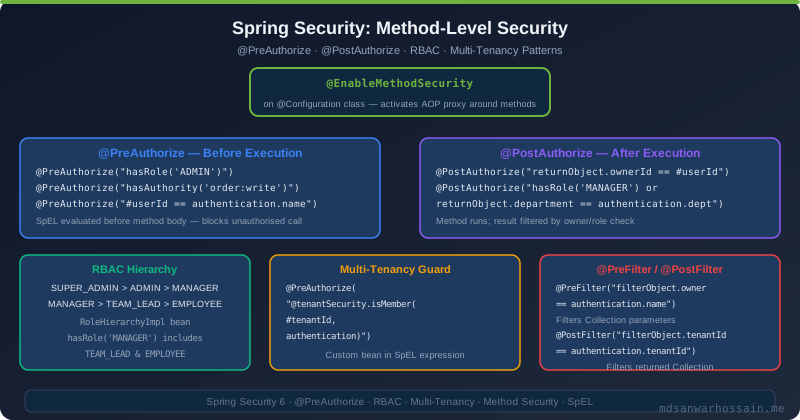
"Master Spring Security method-level security: @PreAuthorize, @PostAuthorize, SpEL expressions, role hierarchy, RBAC design, and multi-tenancy patterns for."
Table of Contents
- Enabling Method-Level Security
- @PreAuthorize: The Workhorse of Method Security
- @PostAuthorize: Filter by Return Value
- @PreFilter and @PostFilter: Filtering Collections
- RBAC Design: Role Hierarchy
- Custom SpEL Beans: Beyond Built-in Expressions
- Multi-Tenancy Authorization Patterns
- Testing Method Security
- Common @PreAuthorize Pitfalls
- Annotating Service vs Controller Layer
- Conclusion
Enabling Method-Level Security
Method security is disabled by default. Enable it with a single annotation on your @Configuration class:
@Configuration
@EnableWebSecurity
@EnableMethodSecurity(
    prePostEnabled = true,   // @PreAuthorize, @PostAuthorize, @PreFilter, @PostFilter
    securedEnabled = true,   // @Secured (legacy, avoid in new code)
    jsr250Enabled = true     // @RolesAllowed (JSR-250, optional)
)
public class SecurityConfig {
    // ...
}

// Spring Security 6 note:
// @EnableMethodSecurity replaces the deprecated @EnableGlobalMethodSecurity
// prePostEnabled = true is the default when using @EnableMethodSecurity
Method security uses Spring AOP under the hood — a proxy wraps your bean and intercepts calls. The security check runs before or after the method depending on the annotation used.
@PreAuthorize: The Workhorse of Method Security
@PreAuthorize evaluates a Spring Expression Language (SpEL) expression before the method body executes. If the expression returns false, a AccessDeniedException is thrown.
Basic Role and Authority Checks
@Service
public class OrderService {

    // Simple role check
    @PreAuthorize("hasRole('ADMIN')")
    public List<Order> findAll() { /* ... */ }

    // Multiple roles — OR logic
    @PreAuthorize("hasAnyRole('ADMIN', 'MANAGER')")
    public Page<Order> findAllPaged(Pageable pageable) { /* ... */ }

    // Authority check (fine-grained permission string)
    @PreAuthorize("hasAuthority('order:write')")
    public Order create(CreateOrderDto dto) { /* ... */ }

    // Multiple authorities — AND logic with &&
    @PreAuthorize("hasAuthority('order:read') and hasAuthority('order:export')")
    public byte[] exportCsv() { /* ... */ }

    // Authenticated vs anonymous
    @PreAuthorize("isAuthenticated()")
    public Order findById(String id) { /* ... */ }

    @PreAuthorize("isAnonymous()")
    public String publicEndpoint() { /* ... */ }
}
SpEL Parameter Binding
The most powerful feature of @PreAuthorize is binding to method parameters via #paramName syntax, enabling ownership and contextual checks:
@Service
public class OrderService {

    // Check that the authenticated user owns the resource
    @PreAuthorize("#userId == authentication.name")
    public List<Order> findByUser(String userId) { /* ... */ }

    // Check ownership via a method parameter object's field
    @PreAuthorize("#dto.ownerId == authentication.name")
    public Order update(UpdateOrderDto dto) { /* ... */ }

    // Combine role check with ownership
    @PreAuthorize("hasRole('ADMIN') or #userId == authentication.name")
    public void deleteUserOrders(String userId) { /* ... */ }

    // Parameter binding works with nested paths too
    @PreAuthorize("#order.customer.id == authentication.name")
    public void processOrder(Order order) { /* ... */ }
}Important: Parameter binding with #paramName requires that your code is compiled with the -parameters flag, or that you use Spring Boot (which sets this by default). Without it, parameter names are lost at runtime and you must use #a0, #a1 etc. (positional arguments).
@PostAuthorize: Filter by Return Value
@PostAuthorize runs after the method completes and can access the return value via returnObject. Use it when you cannot determine authorization until the method has run — typically for ownership checks where the resource is loaded from the database:
@Service
public class DocumentService {

    // Method runs first, then Spring checks if caller owns the returned document
    @PostAuthorize("returnObject.ownerId == authentication.name or hasRole('ADMIN')")
    public Document findById(String id) {
        return documentRepo.findById(id)
            .orElseThrow(() -> new DocumentNotFoundException(id));
    }

    // Works with Optional — note the null safety
    @PostAuthorize("returnObject.isEmpty() or returnObject.get().ownerId == authentication.name")
    public Optional<Document> findByExternalId(String externalId) {
        return documentRepo.findByExternalId(externalId);
    }

    // Tenant isolation — department check from the returned object
    @PostAuthorize("hasRole('ADMIN') or returnObject.department == authentication.principal.department")
    public Report getReport(String reportId) {
        return reportRepo.findById(reportId).orElseThrow();
    }
}
Performance note: @PostAuthorize executes the method and then throws if authorization fails. For expensive operations, prefer @PreAuthorize with a custom security bean that does a lightweight DB check (exists by id + owner) rather than loading the full object.
@PreFilter and @PostFilter: Filtering Collections
@Service
public class DocumentService {

    // @PreFilter — filter the INPUT collection before the method executes
    // 'filterObject' refers to each element of the collection parameter
    @PreFilter("filterObject.ownerId == authentication.name")
    public List<Document> bulkUpdate(List<Document> documents) {
        // Only documents owned by the caller reach this method
        return documentRepo.saveAll(documents);
    }

    // @PostFilter — filter the RETURNED collection
    // 'filterObject' refers to each element of the returned collection
    @PostFilter("filterObject.tenantId == authentication.principal.tenantId")
    public List<Document> findAll() {
        return documentRepo.findAll(); // Full list; Spring filters it post-execution
    }

    // Combine @PreAuthorize and @PostFilter
    @PreAuthorize("isAuthenticated()")
    @PostFilter("filterObject.ownerId == authentication.name or hasRole('ADMIN')")
    public List<Document> search(String query) {
        return documentRepo.findByQuery(query);
    }
}
Performance caution: @PostFilter iterates through the entire returned list to check each element's SpEL expression. For large result sets this is expensive. Prefer pushing the ownership/tenant filter into the database query itself, and use @PostFilter only as a secondary safety net.
RBAC Design: Role Hierarchy
By default, Spring Security roles are flat. A user with ROLE_ADMIN does not automatically have ROLE_USER permissions. RoleHierarchyImpl fixes this by declaring role inheritance:
@Bean
public RoleHierarchy roleHierarchy() {
    return RoleHierarchyImpl.fromHierarchy("""
        ROLE_SUPER_ADMIN > ROLE_ADMIN
        ROLE_ADMIN > ROLE_MANAGER
        ROLE_MANAGER > ROLE_TEAM_LEAD
        ROLE_TEAM_LEAD > ROLE_EMPLOYEE
        ROLE_EMPLOYEE > ROLE_VIEWER
        """);
}

// With this hierarchy:
// A user with ROLE_ADMIN automatically has ROLE_MANAGER, ROLE_TEAM_LEAD,
// ROLE_EMPLOYEE, and ROLE_VIEWER permissions.

// @PreAuthorize("hasRole('EMPLOYEE')") passes for ADMIN users too.

// Must also configure it in the method security expression handler:
@Bean
public MethodSecurityExpressionHandler methodSecurityExpressionHandler(RoleHierarchy roleHierarchy) {
    DefaultMethodSecurityExpressionHandler handler = new DefaultMethodSecurityExpressionHandler();
    handler.setRoleHierarchy(roleHierarchy);
    return handler;
}
Without configuring the MethodSecurityExpressionHandler, the role hierarchy bean exists but is never consulted during SpEL evaluation — a common production bug where hasRole('EMPLOYEE') works for direct role holders but fails for admin users who should inherit it. The hierarchy is expressed as a multi-line string where > means "implies" — ROLE_ADMIN > ROLE_MANAGER means any user with ADMIN also has MANAGER permissions. Avoid deeply nested hierarchies (more than 4 levels) as they make auditing and debugging authorization failures significantly harder; a flat permission-based model with explicit hasAuthority() checks scales better for complex enterprise applications.
Custom SpEL Beans: Beyond Built-in Expressions
For complex authorization logic that cannot be expressed cleanly in SpEL strings, create a security bean and call it from SpEL using the @beanName.method() syntax:
// OrderSecurityService.java — custom security bean
@Service("orderSecurity")  // bean name used in SpEL
public class OrderSecurityService {

    private final OrderRepository orderRepo;
    private final TenantService tenantService;

    // Is the authenticated user the owner of this order?
    public boolean isOwner(String orderId, Authentication auth) {
        String userId = auth.getName();
        return orderRepo.existsByIdAndUserId(orderId, userId);
    }

    // Is the user in the same department as the order?
    public boolean isSameDepartment(String orderId, Authentication auth) {
        UserDetails user = (UserDetails) auth.getPrincipal();
        String userDept = ((CustomUserDetails) user).getDepartment();
        return orderRepo.findById(orderId)
            .map(order -> order.getDepartment().equals(userDept))
            .orElse(false);
    }

    // Multi-tenant membership check
    public boolean isTenantMember(String tenantId, Authentication auth) {
        String userId = auth.getName();
        return tenantService.isMember(tenantId, userId);
    }
}

// Usage in controllers/services:
@Service
public class OrderService {

    @PreAuthorize("@orderSecurity.isOwner(#orderId, authentication)")
    public Order getOrder(String orderId) { /* ... */ }

    @PreAuthorize("hasRole('ADMIN') or @orderSecurity.isSameDepartment(#orderId, authentication)")
    public void approveOrder(String orderId) { /* ... */ }

    @PreAuthorize("@orderSecurity.isTenantMember(#tenantId, authentication)")
    public List<Order> getTenantOrders(String tenantId) { /* ... */ }
}
Custom SpEL beans are the recommended pattern for authorization logic that involves database lookups or complex business rules. Keeping authorization logic in a dedicated bean makes it testable, traceable (standard logging and metrics apply), and reusable across multiple service methods. The @Service("orderSecurity") bean name must match the @orderSecurity prefix in SpEL expressions exactly. If the bean cannot be found at runtime, Spring throws a SpelEvaluationException rather than denying access, so test your SpEL expressions in integration tests to catch typos and naming mismatches before production.
Multi-Tenancy Authorization Patterns
Multi-tenant SaaS applications need to ensure that users can only access data belonging to their tenant. There are three main patterns:
Pattern 1: SpEL with JWT tenant claim
// JWT contains: { "sub": "user-123", "tenant_id": "acme-corp" }

// In a JwtAuthenticationConverter, promote tenant_id to a principal attribute:
@Component
public class CustomJwtConverter implements Converter<Jwt, AbstractAuthenticationToken> {
    @Override
    public AbstractAuthenticationToken convert(Jwt jwt) {
        String tenantId = jwt.getClaim("tenant_id");
        String userId = jwt.getSubject();
        // Build a custom UserDetails or use attributes map
        Collection<GrantedAuthority> authorities = extractAuthorities(jwt);
        CustomJwtAuthenticationToken auth = new CustomJwtAuthenticationToken(jwt, authorities);
        auth.setTenantId(tenantId);
        return auth;
    }
}

// Then in SpEL (authentication is the CustomJwtAuthenticationToken):
@PreAuthorize("#tenantId == authentication.tenantId")
public List<Order> getTenantOrders(String tenantId) { /* ... */ }

@PreAuthorize("@orderSecurity.isTenantMember(#orderId, authentication.tenantId)")
public Order getOrder(String orderId) { /* ... */ }
Pattern 2: Tenant filter at the data access layer
// TenantAwareRepository.java — automatically filters by tenant in every query
@Repository
public interface OrderRepository extends JpaRepository<Order, String> {

    // Every method scoped to a tenant — no method-level check needed for basic queries
    List<Order> findAllByTenantId(String tenantId);
    Optional<Order> findByIdAndTenantId(String id, String tenantId);
}

// OrderService.java — get tenant from security context
@Service
public class OrderService {

    @PreAuthorize("isAuthenticated()")  // only ensure authenticated; tenant is enforced by repo
    public List<Order> getOrders() {
        String tenantId = SecurityContextHolder.getContext()
            .getAuthentication().getDetails() instanceof TenantDetails td
            ? td.getTenantId()
            : null;
        return orderRepo.findAllByTenantId(tenantId);
    }
}
Pattern 3: Hibernate multi-tenancy with @TenantId (Hibernate 6)
// Order.java — Hibernate 6 @TenantId
@Entity
@Table(name = "orders")
public class Order {
    @Id
    private String id;

    @TenantId  // Hibernate automatically adds WHERE tenant_id = ? to every query
    private String tenantId;

    // other fields...
}

// When Hibernate 6 @TenantId is in use, tenant isolation is enforced at the ORM level.
// Method-level @PreAuthorize is still used for role/ownership checks on top of this.
Testing Method Security
@SpringBootTest
@AutoConfigureMockMvc
class OrderServiceSecurityTest {

    @Autowired
    private OrderService orderService;

    @Test
    @WithMockUser(roles = "USER")
    void findAll_withUserRole_throwsAccessDenied() {
        assertThrows(AccessDeniedException.class, () -> orderService.findAll());
    }

    @Test
    @WithMockUser(roles = "ADMIN")
    void findAll_withAdminRole_succeeds() {
        assertDoesNotThrow(() -> orderService.findAll());
    }

    @Test
    @WithMockUser(username = "alice", roles = "USER")
    void getOrder_ownedByAlice_succeedsForAlice() {
        // assuming the order's ownerId is "alice"
        assertDoesNotThrow(() -> orderService.getOrder("order-alice-1"));
    }

    @Test
    @WithMockUser(username = "bob", roles = "USER")
    void getOrder_ownedByAlice_failsForBob() {
        assertThrows(AccessDeniedException.class, () -> orderService.getOrder("order-alice-1"));
    }

    // Custom principal with tenant
    @Test
    void getOrder_wrongTenant_throwsAccessDenied() {
        Authentication auth = new UsernamePasswordAuthenticationToken(
            "user", "pass",
            List.of(new SimpleGrantedAuthority("ROLE_USER"))
        );
        // attach wrong tenant
        SecurityContextHolder.getContext().setAuthentication(auth);
        assertThrows(AccessDeniedException.class, () -> orderService.getTenantOrders("other-tenant"));
    }
}
Testing method security requires loading the full Spring application context to engage the AOP proxy — pure unit tests that instantiate the service directly will bypass all @PreAuthorize checks. Use @WithMockUser to inject a synthetic SecurityContext for each test scenario. Test both the happy path (access granted) and the denial path (access denied) for every significant authorization rule — many teams only test the positive case and miss denial regressions. For ownership tests that check #id == authentication.name, ensure the mock user's name matches the data in your test fixtures exactly, including case sensitivity. Use @BeforeEach to clear the SecurityContextHolder after tests that manually set the context, or stale security contexts can contaminate subsequent tests.
Common @PreAuthorize Pitfalls
| Pitfall | Cause | Fix |
|---|---|---|
| Self-invocation bypasses security | Calling a secured method from within the same bean skips the AOP proxy | Move the secured method to a different bean, or inject the proxy via @Autowired into self |
| #param binding fails | Parameter names compiled away | Ensure -parameters compiler flag (Spring Boot default) or use @Param |
| hasRole vs hasAuthority confusion | hasRole prepends ROLE_; hasAuthority is exact | Use hasRole('ADMIN') when GrantedAuthority is ROLE_ADMIN |
| RoleHierarchy not in SpEL handler | RoleHierarchy bean defined but not wired to MethodSecurityExpressionHandler | Override methodSecurityExpressionHandler() bean with hierarchy set |
| @PostFilter on large collections | Filters in Java after full DB result is loaded | Add tenant/owner filter to the JPA query; use @PostFilter as a safety net only |
| @PreAuthorize on private methods | AOP proxy cannot intercept private methods | Apply to public methods only; move security logic to a public service method |
Annotating Service vs Controller Layer
A common architectural question is whether to place @PreAuthorize on the controller or the service. The recommendation is service layer:
- Controller-only security means that if the service method is called from a scheduled task, a message consumer, or another service, it is unprotected.
- Service-layer security is enforced everywhere the method is called — regardless of the entry point.
- Put authentication checks (e.g.,
isAuthenticated()) at the controller level, and authorization checks (hasRole, ownership) at the service level.
// Controller — authentication only
@RestController
public class OrderController {
    @PreAuthorize("isAuthenticated()")  // must be logged in
    @GetMapping("/api/v1/orders/{id}")
    public Order getOrder(@PathVariable String id) {
        return orderService.getOrder(id);  // authorization enforced here
    }
}

// Service — authorization and ownership
@Service
public class OrderService {
    @PreAuthorize("hasRole('ADMIN') or @orderSecurity.isOwner(#id, authentication)")
    public Order getOrder(String id) { /* ... */ }
}
Conclusion
Spring Security method-level security with @PreAuthorize is the pattern that separates production-grade Spring Boot APIs from toy applications. It enforces authorization at the business logic layer — not just at URL patterns — ensuring that security follows the code regardless of how a method is invoked. The combination of SpEL expressions, role hierarchy, custom security beans, and multi-tenant patterns gives you a complete authorization framework that scales from simple role checks to complex multi-tenant SaaS authorization models.
To configure the identity provider that issues the JWTs that power these authorization checks, see the companion post on Spring Security 6 OAuth2 Resource Server with Keycloak and Auth0. For the custom JWT approach with self-managed tokens, see the JWT token lifecycle guide.
Leave a Comment
Related Posts

Software Engineer · Java · Spring Boot · Spring Security