Trending Software Engineering Technologies in 2026: What Every Developer Needs to Know
The technology landscape is shifting faster than ever. The engineers who thrive in 2026 are not the ones who chase every new framework—they are the ones who understand which trends have durable structural importance and invest their learning time accordingly.
TL;DR
"Trending software engineering technologies in 2026: Agentic AI, WebAssembly, eBPF, Rust, edge computing, and the skills shaping modern software careers."
Every year, new frameworks, languages, and paradigms compete for developer attention. Most fade quickly. A few reshape the industry permanently. In 2026, we are living through a convergence of several such permanent shifts: AI is becoming a first-class engineering tool, not just a product feature; systems programming is being reshaped by memory-safe languages; observability is evolving from reactive monitoring to proactive intelligence; and the boundary between edge and cloud is blurring in ways that change architecture fundamentals.
As a software engineer specializing in Java, Angular, React, and modern architecture, I have been tracking these trends carefully—not to jump on hype cycles, but to identify where investing learning and architectural energy will provide durable competitive advantage. This guide covers the technologies that are genuinely reshaping software engineering in 2026 and explains why they matter practically, not theoretically.
Table of Contents
- 1. Agentic AI: From Copilot to Autonomous Engineering Workflow
- 2. Platform Engineering and Internal Developer Platforms
- 3. WebAssembly (WASM) Beyond the Browser
- 4. Rust in Systems and Backend Engineering
- 5. eBPF: Programmable Observability and Networking at the Kernel Level
- 6. OpenTelemetry as the Universal Observability Standard
- 7. Edge-Native Architecture and Distributed Compute
- 8. AI-Enhanced Observability and AIOps
- 9. Multi-Agent AI Collaboration Frameworks
- Tools & Technologies Summary
- Best Practices for Navigating Technology Trends
- Future Outlook
- Conclusion
1. Agentic AI: From Copilot to Autonomous Engineering Workflow
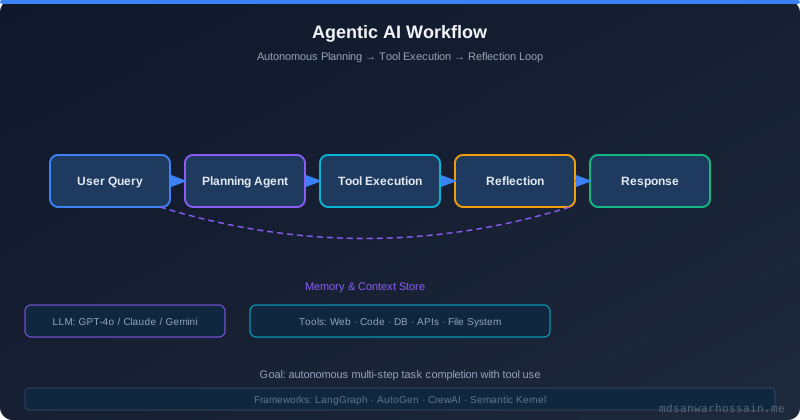
The evolution from AI autocomplete (GitHub Copilot v1) to agentic AI (multi-step autonomous engineering) is arguably the biggest transformation in developer productivity in a generation. Agentic AI tools can now understand a natural-language task description, explore a codebase, write code across multiple files, run tests, fix failures, and submit a pull request—all autonomously. Tools like Devin, SWE-agent, and advanced uses of OpenAI Codex are making this practical for real engineering teams.
The practical impact is most visible in bounded, well-defined tasks: migrating a library across a large codebase, adding a standard API endpoint following existing patterns, or generating comprehensive test suites for legacy code. The engineering discipline shift is significant: developers increasingly define acceptance criteria and architectural constraints clearly, then delegate mechanical execution to AI agents. This is not replacing engineering judgment—it is removing the mechanical work that consumes it.
Why it matters in 2026: Teams that integrate agentic AI effectively into development workflows report 20–40% productivity improvements in empirical studies. Those who ignore it face competitive disadvantages in delivery speed that compound over time.
2. Platform Engineering and Internal Developer Platforms
Platform engineering has moved from a Spotify-and-Netflix-only concept to mainstream adoption. The Gartner prediction that 80% of engineering organizations will have a platform engineering function by 2026 is proving accurate. The driver is simple: as microservices proliferates and cloud infrastructure complexity grows, the cognitive overhead of building, deploying, and operating software without standardized platforms becomes a delivery constraint.
Internal Developer Platforms (IDPs) built with tools like Backstage, Crossplane, and ArgoCD give product engineers self-service access to infrastructure, deployment pipelines, and compliance guardrails. Developers focus on product code; platforms handle the operational scaffolding. The organizations investing in this are seeing measurable improvements in developer experience scores, service onboarding time, and security baseline consistency.
Why it matters in 2026: Developer experience is now recognized as a competitive metric, not just a quality-of-life concern. Organizations that reduce cognitive overhead enable faster product iteration and better engineering talent retention.
3. WebAssembly (WASM) Beyond the Browser
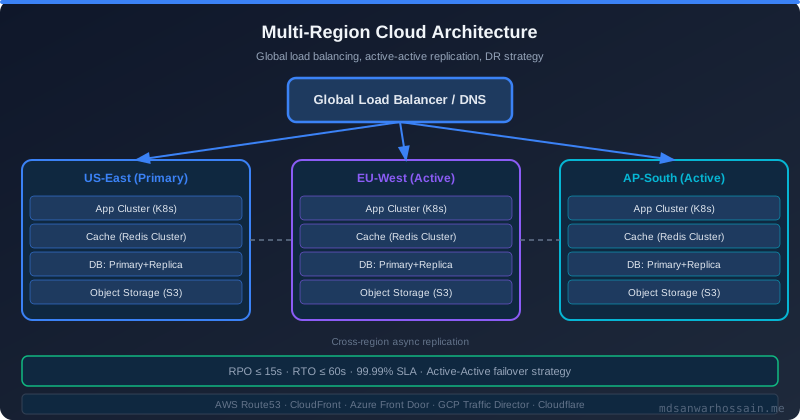
WebAssembly started as a browser performance technology, but its 2026 trajectory is server-side and edge-native. WASM provides near-native execution speed with strong security isolation, making it ideal for plugin systems, serverless functions, and edge compute workloads. The WASM Component Model is enabling language-agnostic module composition—compile a component in Rust, another in Go, and another in Python, then compose them into a single application with zero-cost cross-language calls.
In practice, WASM is transforming how companies build extensible platforms. Shopify's Functions product, Fastly's Compute@Edge, and Cloudflare Workers all use WASM as their execution model. For backend engineers, this means understanding WASM as an execution target for lightweight, highly-isolated functions alongside traditional containers.
Why it matters in 2026: As edge computing becomes architecturally mainstream, WASM's combination of portability, isolation, and performance makes it the natural execution model for edge workloads—a skill gap worth addressing proactively.
4. Rust in Systems and Backend Engineering
Rust has moved firmly from systems programming curiosity to production-grade industry technology. Linux kernel modules, AWS infrastructure components, Google's Android codebase, and Mozilla's Servo project all use Rust. The language's compile-time memory safety guarantees eliminate entire classes of vulnerabilities—buffer overflows, use-after-free, and data races—that remain endemic in C and C++ codebases.
For Java and JVM engineers, Rust is not a replacement for high-level application development—JVM platforms remain excellent there. But for performance-critical tooling, CLI utilities, network proxies, database components, and any code that needs to run close to the metal without a GC pause, Rust is increasingly the default choice. The learning investment is real, but the safety and performance dividends compound significantly in production systems.
Why it matters in 2026: Security regulations and performance demands are pushing organizations toward memory-safe languages. Engineers with Rust proficiency have access to a growing category of high-impact infrastructure work.
5. eBPF: Programmable Observability and Networking at the Kernel Level
Extended Berkeley Packet Filter (eBPF) allows safely running custom programs inside the Linux kernel without modifying kernel source code or loading kernel modules. This enables unprecedented observability, networking, and security capabilities with minimal overhead. Tools like Cilium (Kubernetes networking with eBPF), Falco (runtime security), Pixie (continuous profiling and observability), and Tetragon (security observability) are all built on eBPF.
For backend engineers and SREs, eBPF means observability that does not require application code changes—you can trace system calls, network packets, file operations, and process behavior across your entire infrastructure without instrumenting individual services. For security teams, it enables real-time detection of anomalous system behavior at a level that was previously only available to kernel developers.
Why it matters in 2026: eBPF-based tools are displacing traditional monitoring agents across cloud-native environments, and understanding their capabilities and limitations is increasingly important for platform and observability engineering roles.
6. OpenTelemetry as the Universal Observability Standard
OpenTelemetry (OTel) has become the de-facto standard for distributed tracing, metrics, and logging across cloud-native environments. Virtually every major observability vendor now supports OTel as a first-class ingestion format. The practical implication: teams can instrument their services once using OTel's standard SDK and route telemetry to any backend without vendor lock-in.
In 2026, OTel adoption has expanded beyond traces into semantic conventions for database calls, HTTP requests, messaging systems, and AI inference operations. The AI semantic conventions—tracking token usage, model IDs, prompt lengths, and inference latency—are particularly valuable for teams operating LLM features in production. Standardized telemetry enables cross-team comparison and platform-level cost optimization that siloed vendor solutions cannot provide.
Why it matters in 2026: Engineers who understand OTel instrumentation deeply can build observability capabilities that work across any cloud environment and any observability vendor—a portable, high-value skill.
7. Edge-Native Architecture and Distributed Compute
Edge computing is maturing from CDN caching to genuine distributed compute: applications that run logic close to users at geographically distributed edge nodes, dramatically reducing latency for global user bases. Platforms like Cloudflare Workers, AWS Lambda@Edge, and Vercel Edge Functions make sub-50ms global response times achievable for dynamic applications. The architectural shift is real: increasingly, the question is not "monolith or microservices" but "cloud-hosted or edge-distributed."
For full-stack engineers, edge-native development changes familiar patterns. Cold starts, cold memory, and limited runtime capabilities require different optimization strategies than traditional serverless or container-based deployments. But for latency-sensitive applications—personalization, authentication decisions, A/B testing, real-time data pipelines—the user experience improvements justify the architectural complexity.
Why it matters in 2026: As user expectations for global application performance intensify and edge platforms mature, edge-native architecture will become a standard tool in the modern engineer's toolkit—not a specialty.
8. AI-Enhanced Observability and AIOps
Traditional monitoring dashboards require humans to know what to look for. AIOps and AI-enhanced observability tools change this by automatically detecting anomalies, correlating signals across systems, and suggesting probable root causes during incidents. Tools like Dynatrace Davis AI, New Relic's AI engine, and open-source alternatives like Chaos Genius use ML models trained on historical telemetry to surface insights that would take human analysts hours to find manually.
The practical value in 2026 is most visible in two contexts: alert noise reduction (ML-based grouping that collapses 200 noisy alerts into 3 actionable incidents) and root cause analysis acceleration (correlating deployment events, dependency changes, and metric anomalies to identify probable incident causes within minutes). Neither replaces human judgment in incident resolution, but both dramatically reduce mean time to diagnosis.
9. Multi-Agent AI Collaboration Frameworks
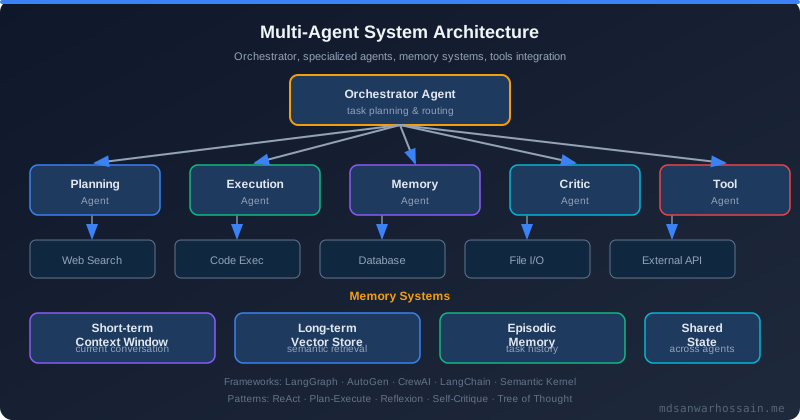
The next frontier beyond single autonomous AI agents is multi-agent collaboration: specialized agents working together on complex problems, each contributing domain expertise. Frameworks like LangGraph, AutoGen, and CrewAI enable architects to define agent roles (planner, coder, reviewer, tester), communication protocols, and shared memory—then orchestrate complex workflows where agents collaborate and validate each other's outputs.
Early enterprise use cases include: multi-agent code review (separate agents for security analysis, performance analysis, and standards compliance reviewing the same code in parallel), research synthesis (agents retrieving, reading, and synthesizing information from multiple sources simultaneously), and automated incident analysis (an agent that reads alert context, retrieves relevant runbooks, and drafts a diagnosis while another executes diagnostic queries in parallel).
Tools & Technologies Summary
- AI/Agentic: GitHub Copilot Enterprise, Cursor, Devin, SWE-agent, LangGraph, AutoGen, CrewAI
- Platform Engineering: Backstage, Crossplane, ArgoCD, Port, Kyverno, OPA
- Edge/WASM: Cloudflare Workers, WASMTIME, Fastly Compute@Edge, WASMCloud
- Systems/Performance: Rust, eBPF, Cilium, Falco, Pixie, Tetragon
- Observability: OpenTelemetry, Dynatrace, New Relic AI, Grafana, Prometheus
- Security: Sigstore/Cosign, Syft, Trivy, SLSA toolchain, Snyk
Best Practices for Navigating Technology Trends
Invest in fundamentals first
Trending technologies change rapidly; strong fundamentals compound. Deep expertise in distributed systems concepts, security principles, observability practices, and software design patterns will serve you across multiple technology generations. Use trends to identify where to apply fundamentals, not to replace them.
Evaluate trends by production value, not hype volume
The most-tweeted technology is rarely the most impactful. Evaluate trends by asking: which companies are using this in production at scale? What measurable improvements are they reporting? What are the known limitations and failure modes? Production evidence beats conference demos consistently.
Build a deliberate learning portfolio
Trying to learn everything leads to shallow competence in nothing. Build a portfolio: one technology for deep mastery (spend 3–6 months), one for informed awareness (read papers, watch talks, build toy projects), and one for horizon monitoring (follow community updates without hands-on investment). Rotate based on career goals and organizational needs.
Future Outlook
The trajectory for the next 2–3 years points clearly toward: AI agents that can autonomously manage substantial portions of the software development lifecycle; memory-safe systems languages becoming regulatory requirements for critical infrastructure; edge computing reaching parity with cloud for most developer experience metrics; and observability evolving from reactive incident response to proactive system optimization driven by continuous AI analysis.
Conclusion
The most important technology trend of 2026 is not any single tool or framework—it is the acceleration of the pace of change itself. The engineering mindset that wins is one that prioritizes learning agility, strong fundamentals, and deliberate adoption of technologies with demonstrated production value. Whether you are investing in Agentic AI proficiency, platform engineering skills, or systems-level understanding of eBPF and Rust, the key is intentionality: know why you are learning it, what problems it solves, and how it fits into the broader architecture of modern software engineering.
As a software engineer with experience in Java, Angular, React, and modern cloud-native architecture, I find this moment genuinely exciting. The tools are getting better, the patterns are maturing, and the opportunity to build significantly better software—faster and more safely—has never been greater. The challenge is staying focused on what matters most rather than being distracted by what is merely new.
Leave a Comment
Related Posts

Software Engineer · Java · Spring Boot · Microservices