Vibe Coding for Backend Engineers: AI-First Java Development with Cursor, GitHub Copilot & Spring Boot in 2026
Vibe coding is transforming how backend engineers write Java and Spring Boot services — but it requires discipline, guardrails, and architecture ownership to avoid catastrophic shortcuts. This comprehensive guide covers the entire AI-first development workflow: from writing effective intent prompts to securing AI-generated code, running AI-assisted TDD, and measuring real productivity gains without losing engineering judgment.
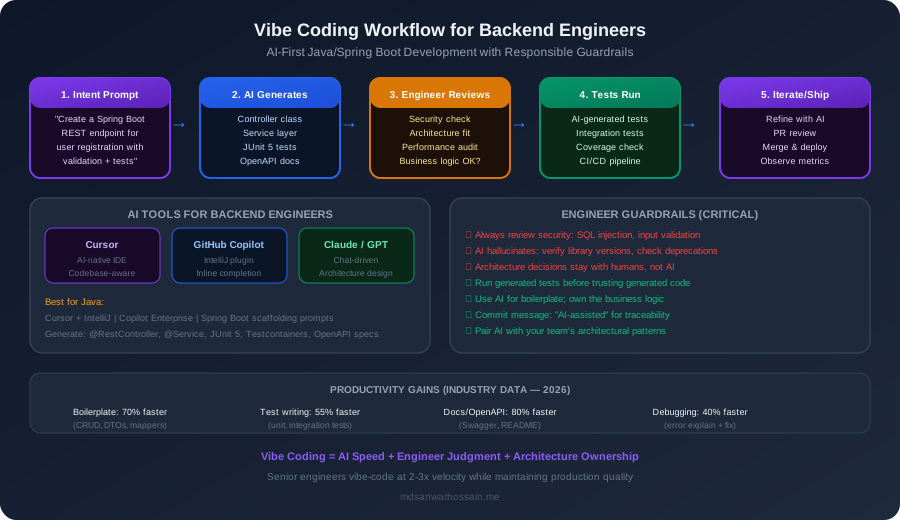
TL;DR — Vibe Coding in One Sentence
"Vibe coding means describing your intent in natural language and letting AI generate the implementation — but it only works safely when engineers own the architecture, validate security, and treat AI output as a junior developer's pull request that always needs review."
Table of Contents
- What Is Vibe Coding?
- Tools for Backend Vibe Coding
- Writing Effective Intent Prompts for Java
- AI-First TDD Workflow
- Spring Boot Vibe Coding Patterns
- Architecture Guardrails: What Engineers Must Own
- Security Review of AI-Generated Code
- Real Productivity Metrics
- Team Workflow: Vibe Coding at Scale
- Anti-Patterns & When Vibe Coding Fails
- Conclusion & Vibe Coding Checklist
1. What Is Vibe Coding?
The term vibe coding was coined by AI researcher Andrej Karpathy in early 2025 to describe a new mode of software development: instead of writing every line of code manually, the engineer describes what they want in natural language — their intent, their "vibe" — and lets an AI model generate the implementation. The engineer then reads, reviews, tests, and refines the output.
For backend engineers in particular, this represents a genuine paradigm shift. Rather than starting a new Spring Boot feature by typing boilerplate — controller, service, repository, DTOs, tests — you describe the feature to Cursor or GitHub Copilot in a chat panel and watch it scaffold the entire stack. The question is no longer whether this is faster (it is, often dramatically so) but how to do it safely and responsibly.
The Intent-First Paradigm
Traditional coding is implementation-first: you think in classes, methods, and data structures. Vibe coding is intent-first: you think in outcomes, contracts, and business rules — then delegate implementation to AI. This is not about being lazy; it is about operating at a higher abstraction level. The best vibe coders spend more time thinking about what the system should do and less time typing how to do it.
It is also fundamentally different from simple autocomplete (which GitHub Copilot pioneered as ghost-text completion). Vibe coding involves multi-turn, context-aware dialogue with the AI: you give it architectural context, business constraints, existing code patterns in your codebase, and then iterate on the generated output through conversation rather than manual editing.
Vibe Coding vs AI-Assisted Coding vs Traditional Coding
| Dimension | Traditional Coding | AI-Assisted Coding | Vibe Coding |
|---|---|---|---|
| Primary input | Keystrokes | Keystrokes + completions | Natural language intent |
| Interaction model | Type everything | Accept/reject suggestions | Conversational dialogue |
| Abstraction level | Implementation | Implementation | Intent & outcomes |
| Code ownership | Full engineer authorship | Mostly engineer | Engineer reviews AI output |
| Boilerplate speed | Slow | Medium | Very fast (3–10×) |
| Security risk | Engineer's own bugs | Occasional AI bugs | Higher without review discipline |
| Best for | Novel algorithms, core business logic | Routine features | Scaffolding, CRUD, tests, docs |
2. Tools for Backend Vibe Coding
The three dominant tools for vibe coding in 2026 are Cursor, GitHub Copilot Enterprise, and Codeium. Each has distinct strengths for Java/Spring Boot backend work, and choosing the wrong one for your team's workflow and IDE preferences costs real productivity.
Tool Comparison: Cursor vs GitHub Copilot Enterprise vs Codeium for Java/Spring Boot
| Feature | Cursor | GitHub Copilot Enterprise | Codeium |
|---|---|---|---|
| Base IDE | VS Code fork (standalone) | VS Code, JetBrains, Neovim | VS Code, JetBrains, Neovim |
| IntelliJ / IDEA support | ❌ Not native | ✅ Full plugin | ✅ Full plugin |
| Codebase-aware chat | ✅ Excellent (@codebase) | ✅ Good (Copilot Chat) | ✅ Good (Cascade) |
| Multi-file edits | ✅ Composer (best-in-class) | ⚠️ Limited (Edits mode) | ✅ Cascade multi-file |
| Java/Spring Boot quality | Excellent (GPT-4o / Claude 3.7) | Excellent (GPT-4o / Claude) | Good (custom model) |
| Privacy / Enterprise | ✅ Privacy mode (no training) | ✅ Enterprise policy controls | ✅ Self-hosted option |
| Pricing (2026) | $20/mo (Pro), $40/mo (Business) | $39/user/mo (Enterprise) | Free tier + $12/mo (Pro) |
| Best for | Heavy vibe coding sessions | Teams already on GitHub | Cost-sensitive teams |
When to Use Which Tool
- Cursor: Choose Cursor when your team is willing to switch from IntelliJ to VS Code and wants the most powerful multi-file vibe coding experience. Cursor's Composer feature — where you describe a feature and it edits multiple files simultaneously — is the gold standard for large-scale scaffolding. Java engineers at startups who don't need IntelliJ's deep refactoring tools get the most out of Cursor.
- GitHub Copilot Enterprise: Choose Copilot Enterprise when your team is invested in the GitHub ecosystem, needs policy-controlled code suggestions (blocklisting training data), and wants IntelliJ integration. Copilot's codebase context via
@workspaceand deep GitHub integration for PR reviews makes it the enterprise default. - Codeium: Choose Codeium when budget is the primary constraint or your team needs a self-hosted deployment for compliance. Codeium's free tier is surprisingly capable for routine CRUD generation and its Cascade feature handles multi-file edits well. Java quality lags slightly behind Cursor and Copilot for complex patterns.
3. Writing Effective Intent Prompts for Java
The quality of AI-generated Java code is almost entirely determined by the quality of your intent prompt. Vague prompts produce vague code; precise, structured prompts produce production-ready scaffolding. The 4-part intent prompt structure is the foundation of effective vibe coding.
The 4-Part Intent Prompt Structure
- Context: Describe the existing codebase conventions, framework version, and architectural style (e.g., "This is a Spring Boot 3.3 hexagonal architecture project using Java 21, JPA with PostgreSQL, and MapStruct for DTO mapping").
- Task: State precisely what you want the AI to generate (e.g., "Create a REST endpoint POST /api/v1/orders that accepts an OrderRequest DTO and persists an Order entity").
- Constraints: List technical constraints and non-negotiables (e.g., "Use constructor injection, not field injection. Validate all inputs with jakarta.validation. Return a ProblemDetail on errors. Include OpenAPI @Operation annotations").
- Format: Specify output format preferences (e.g., "Generate the Controller, Service interface, Service implementation, and Repository as separate code blocks. Include unit test stubs").
Example Intent Prompt: REST Endpoint
// Intent Prompt Example — Spring Boot REST endpoint

Context: Spring Boot 3.3, Java 21, hexagonal architecture.
Existing packages: com.acme.order.adapter.in.web (controllers),
com.acme.order.application.port.in (use case interfaces),
com.acme.order.application.service (service impls),
com.acme.order.adapter.out.persistence (JPA repositories + entities).
We use MapStruct for DTO-to-domain mapping, constructor injection always,
jakarta.validation for request validation, and RFC 7807 ProblemDetail for error responses.

Task: Generate the full stack for a POST /api/v1/orders endpoint
that creates a new Order from an OrderRequest DTO.

Constraints:
- Use @Validated on controller, @NotNull/@NotBlank/@Size on DTO fields
- Service layer should call an OrderRepository port (interface), NOT JPA directly
- Return 201 Created with OrderResponse body on success
- Include @Operation and @ApiResponse OpenAPI annotations
- Constructor injection only (no @Autowired field injection)
- Throw OrderValidationException on business rule violations

Format: Separate code blocks for OrderRequest, OrderResponse,
CreateOrderUseCase (interface), CreateOrderService, OrderController.
Include Javadoc for public methods only.
Example Intent Prompt: Service Layer with Business Logic
// Intent Prompt Example — Service layer with domain logic

Context: Same project as above. The Order domain object has:
- orderId (UUID), customerId (UUID), items (List<OrderItem>),
  status (OrderStatus enum: PENDING, CONFIRMED, SHIPPED, DELIVERED, CANCELLED),
  totalAmount (BigDecimal), createdAt (Instant).

Task: Implement CreateOrderService.createOrder(CreateOrderCommand command):
1. Validate that the customer exists (call CustomerPort.findById)
2. Check inventory for each item (call InventoryPort.checkAvailability)
3. Calculate totalAmount with a 10% discount if order total > $500
4. Persist the order via OrderPersistencePort.save
5. Publish an OrderCreatedEvent via DomainEventPublisher

Constraints:
- All external calls (Customer, Inventory) must be via port interfaces
- Use @Transactional on the service method
- Throw CustomerNotFoundException and InsufficientInventoryException as needed
- BigDecimal arithmetic only (no double/float)
- Event published AFTER successful persistence (use @TransactionalEventListener)

Format: Full implementation with inline comments on non-obvious decisions.
Notice how both prompts follow the 4-part structure. The AI has enough context to generate code that fits your actual codebase — not generic Spring Boot boilerplate that you'd spend an hour adapting. The constraints section is the most important: it prevents the AI's most common mistakes (field injection, missing validation, wrong error handling patterns).
4. AI-First TDD Workflow
Vibe coding pairs exceptionally well with Test-Driven Development — arguably better than traditional coding does. When you write the test specification first and have AI generate the implementation, you get the discipline of TDD without the slowdown of manually writing both tests and implementation. Here's the full AI-first TDD loop.
Step 1: Write the Test Specification with AI
Start by prompting AI to generate a comprehensive test class from your intent, before writing any implementation:
// AI-First TDD: Test-first intent prompt
// Prompt: "Generate a JUnit 5 + Mockito test class for CreateOrderService.
// Test all business scenarios: successful order creation, customer not found,
// insufficient inventory, discount applied when total > $500, discount NOT
// applied when total <= $500, event published after save, event NOT published
// if save throws. Use @ExtendWith(MockitoExtension.class), BDD-style
// given/when/then comments, assertj assertions."

@ExtendWith(MockitoExtension.class)
class CreateOrderServiceTest {

    @Mock private CustomerPort customerPort;
    @Mock private InventoryPort inventoryPort;
    @Mock private OrderPersistencePort orderPersistencePort;
    @Mock private DomainEventPublisher eventPublisher;

    @InjectMocks private CreateOrderService service;

    @Test
    @DisplayName("should create order with 10% discount when total exceeds $500")
    void shouldApplyDiscountForLargeOrders() {
        // given
        var command = CreateOrderCommand.builder()
            .customerId(UUID.randomUUID())
            .items(List.of(new OrderItemCommand("SKU-001", 3, new BigDecimal("200.00"))))
            .build();
        given(customerPort.findById(command.customerId()))
            .willReturn(Optional.of(CustomerFixture.aValidCustomer()));
        given(inventoryPort.checkAvailability(any(), anyInt()))
            .willReturn(InventoryStatus.AVAILABLE);
        given(orderPersistencePort.save(any()))
            .willAnswer(inv -> inv.getArgument(0));

        // when
        var result = service.createOrder(command);

        // then
        assertThat(result.totalAmount())
            .isEqualByComparingTo(new BigDecimal("540.00")); // 600 - 10%
        then(eventPublisher).should().publish(any(OrderCreatedEvent.class));
    }

    @Test
    @DisplayName("should throw CustomerNotFoundException when customer does not exist")
    void shouldThrowWhenCustomerNotFound() {
        // given
        var command = CreateOrderCommand.builder()
            .customerId(UUID.randomUUID()).items(List.of()).build();
        given(customerPort.findById(any())).willReturn(Optional.empty());

        // when / then
        assertThatThrownBy(() -> service.createOrder(command))
            .isInstanceOf(CustomerNotFoundException.class);
        then(orderPersistencePort).shouldHaveNoInteractions();
        then(eventPublisher).shouldHaveNoInteractions();
    }
}
Step 2: Generate Implementation to Make Tests Pass
With tests written, prompt AI with: "Implement CreateOrderService to make these tests pass. Do not modify the test class." The existing tests serve as an executable specification that constrains the AI and prevents it from hallucinating incompatible implementations.
Step 3: AI Edge Case Generation
After the happy-path and main error scenarios pass, prompt AI: "Review CreateOrderService and suggest 5 edge cases I haven't tested yet. Generate test methods for each." AI frequently catches null amounts, empty item lists, concurrent inventory depletion, boundary values at exactly $500.00, and idempotency edge cases that engineers miss.
Step 4: Mutation Testing with AI Analysis
Run PIT mutation testing (mvn test-compile org.pitest:pitest-maven:mutationCoverage) and paste the surviving mutants report into your AI chat. Prompt: "These mutants survived mutation testing in CreateOrderService. Generate test cases to kill each surviving mutant." This produces surgically targeted tests that improve mutation score from typically 60–70% to over 85% with minimal effort.
Testcontainers Integration Test Generation
AI is particularly effective at generating Testcontainers integration tests. A prompt like: "Generate a @SpringBootTest integration test for OrderRepository using Testcontainers PostgreSQL. Test save, findById, findAllByCustomerId, and that the createdAt is auto-populated." produces a complete, working integration test with @Testcontainers, @Container, and @DynamicPropertySource setup in about 30 seconds — a test that would take an experienced engineer 15–20 minutes to write from scratch.
5. Spring Boot Vibe Coding Patterns
Certain Spring Boot patterns are so well-established in AI training data that vibe coding generates them at near-production quality with minimal prompt effort. Knowing which patterns to delegate and which to write yourself is a key skill.
@RestController + @Service + @Repository Stack Generation
The most common vibe coding task in Spring Boot is scaffolding a full CRUD stack for a new resource. A 3-sentence prompt generates a controller with all five HTTP methods, a service with validation, a JPA repository with custom queries, DTOs, a MapStruct mapper, and exception handlers — typically in 45–90 seconds. The generated code is good enough to serve as a starting point for 90% of standard resources.
OpenAPI Spec from Natural Language
Instead of writing OpenAPI YAML manually, describe your API in natural language and have AI generate the spec first, then implement from the spec. Example: "Generate an OpenAPI 3.1 spec for a payment processing API with endpoints: POST /payments (create payment), GET /payments/{id} (get payment status), POST /payments/{id}/refund (initiate refund). Include realistic request/response schemas with validation constraints and error responses using RFC 7807 ProblemDetail."
Database Migration Generation
AI generates Flyway and Liquibase migration scripts reliably from JPA entity definitions. Prompt: "Generate a Flyway V3 migration script for this Order entity. Include indexes on customer_id and status columns. Add a partial index on status WHERE status = 'PENDING'. Use timestamptz for all timestamp columns." Always review generated migrations carefully — AI occasionally misses NOT NULL constraints or generates PostgreSQL-specific syntax that breaks on other databases.
Spring Security Configuration Generation
Spring Security configuration is notoriously verbose and error-prone to write manually. AI handles it well for common patterns: JWT resource server configuration, method-level security with @PreAuthorize, OAuth2 login flows, and CORS configuration. Use the prompt: "Generate a Spring Security 6.2 SecurityFilterChain that: disables sessions (stateless), validates JWT bearer tokens from our Keycloak realm, requires ROLE_USER for all /api/** paths except /api/v1/public/**, enables method security, and configures CORS for origins https://app.acme.com."
6. Architecture Guardrails: What Engineers Must Own
The most dangerous misconception in vibe coding is that AI can make architecture decisions. It cannot — and attempting to delegate architecture to AI is the fastest path to technical debt and production incidents. There are specific categories of decisions that must remain entirely with the engineer.
Hexagonal Architecture Enforcement
When you adopt hexagonal (ports and adapters) architecture, AI will repeatedly try to violate it by injecting JPA repositories directly into services, importing Spring Web annotations into domain classes, and mixing infrastructure concerns into use cases. You must enforce boundaries through: (1) clear package structure in your prompts, (2) ArchUnit tests that fail the build on boundary violations, and (3) systematic review of every import statement in AI-generated code.
Architecture Decision: Always Engineer-Owned
- Data model design — table structure, normalization level, indexing strategy
- Service boundary definition — what belongs in one service vs two
- Consistency model — eventual vs strong consistency for any given write path
- Technology selection — which message broker, cache, or database to use
- API contract and versioning strategy
- Transaction boundaries and saga choreography vs orchestration choice
Never Let AI Choose the Data Model
This is the single most important guardrail. AI will design a data model that "seems reasonable" based on patterns in its training data — but it has no knowledge of your query patterns, your growth trajectory, your read/write ratios, or your compliance requirements. A wrong data model costs months to fix in production. Design the data model yourself, document the reasoning, then have AI generate the JPA entities and migrations from your schema.
Performance-Critical Path Review
AI-generated code frequently introduces N+1 query problems, missing fetch join hints, and inefficient stream operations on large collections. Any code on a hot path — order processing, payment flows, search, real-time features — must be profiled with Java Flight Recorder before it ships. Do not trust AI performance suggestions without measurement; AI optimizes for correctness and readability, not for your specific load profile.
7. Security Review of AI-Generated Code
AI-generated code has a well-documented set of recurring security vulnerabilities. These are not random bugs — they are systematic patterns that appear because AI models optimize for producing code that "looks right" rather than code that is hardened against adversarial inputs. Every engineer vibe coding must internalize this security review checklist.
Common Security Vulnerabilities in AI-Generated Java Code
1. SQL Injection via String Concatenation
AI occasionally generates JPQL or native queries with string concatenation instead of parameterized queries, especially when the prompt mentions dynamic filtering or search. Always verify:
// ❌ AI sometimes generates this (SQL injection risk)
String query = "SELECT * FROM orders WHERE status = '" + status + "'";

// ✅ Always use parameterized queries
@Query("SELECT o FROM Order o WHERE o.status = :status")
List<Order> findByStatus(@Param("status") OrderStatus status);
2. Missing Input Validation
AI often generates DTO classes without validation annotations, or adds @NotNull but forgets @Size limits on String fields, enabling denial-of-service attacks through oversized payloads. Review every DTO field for completeness: null checks, size bounds, pattern constraints for formatted strings (emails, phone numbers, UUIDs).
3. Hardcoded Credentials and Secrets
AI sometimes generates application.properties or YAML configuration with hardcoded database passwords, API keys, and JWT secrets — particularly in test configurations. Use git-secrets or GitHub's secret scanning to catch these before they reach source control. All secrets must come from environment variables or a secret manager (AWS Secrets Manager, HashiCorp Vault).
4. Insecure Deserialization
When generating Kafka consumer code or Redis caching, AI may use Java's native serialization or misconfigured Jackson ObjectMapper that trusts type information in incoming messages. Always use @JsonTypeInfo with a whitelist or avoid polymorphic deserialization entirely. For Kafka, use specific Avro or JSON schemas rather than generic Object deserializers.
Security Review Checklist for AI-Generated Code
- ✅ All database queries use parameterized form (no string concatenation)
- ✅ All DTO fields have appropriate validation annotations with size limits
- ✅ No hardcoded credentials, tokens, or connection strings in source code
- ✅ Authorization checks present on all endpoints (not just authentication)
- ✅ Sensitive data (passwords, PII) is never logged
- ✅ HTTP responses do not include stack traces or internal path information
- ✅ File upload endpoints validate MIME type and enforce file size limits
- ✅ Deserialization uses explicit type mapping, not polymorphic defaults
- ✅ CORS configuration whitelists specific origins (no wildcard in production)
- ✅ Run OWASP Dependency-Check on any new library AI adds to pom.xml
8. Real Productivity Metrics
The productivity claims for vibe coding range from breathless marketing to legitimate engineering efficiency gains. Here are the most reliable industry measurements from the 2025–2026 period, along with the critical context that most productivity posts omit.
What Is NOT Faster with Vibe Coding
The productivity numbers above are real — but they apply to specific task categories, not to software engineering as a whole. These activities are not meaningfully faster with vibe coding, and some are slower:
- Architecture design: Thinking through service decomposition, data modeling, and consistency requirements takes the same amount of time. AI cannot replace this thinking.
- Novel algorithm implementation: For genuinely novel problems, AI provides starting points that often require complete rewrites. The iteration overhead sometimes makes it slower than just writing the algorithm directly.
- Code review: Reviewing AI-generated code requires the same depth of review as human-written code — arguably more, given known security and architecture risks. Review time does not decrease.
- Production incident diagnosis: Deep debugging of production issues requires domain knowledge, production log access, and systems thinking that AI cannot replicate from code alone.
- Security hardening: Adding proper security requires understanding your threat model, which is organization-specific. AI gives you a checklist; threat modeling gives you judgment.
The Acceleration Ceiling
Industry surveys (GitHub Octoverse 2025, Stack Overflow Developer Survey 2025) consistently show that developers using AI tools report 30–55% overall productivity improvement — but this aggregate masks a bimodal distribution. Developers who use AI for boilerplate and tests gain 50–70% in those areas; developers who try to use AI for architecture and business logic sometimes slow down because they spend time correcting AI mistakes rather than making progress.
9. Team Workflow: Vibe Coding at Scale
Individual productivity gains from vibe coding can disappear — or create new problems — when not managed at the team level. These practices help engineering teams capture the benefits while maintaining code quality, security, and knowledge retention.
Branch Conventions for AI-Generated Code
Some teams adopt a branch naming convention that signals the origin of the code: feature/ai-ORDER-1234-order-crud-scaffold or a commit prefix [AI-GEN]. This serves multiple purposes: it signals to reviewers to look more carefully at security and architecture, it provides traceability for audit requirements, and it helps teams track how much of their codebase is AI-generated over time.
PR Review Practices
Pull requests containing predominantly AI-generated code should include a brief note describing the prompt used and confirming that the security checklist was completed. Reviewers should apply the same rigor as reviewing junior developer code: check for architectural boundary violations, security vulnerabilities, missing error handling, and inadequate test coverage. The speed of code generation does not reduce the required thoroughness of review.
Knowledge Transfer Concerns
One of the least-discussed risks of team-scale vibe coding is knowledge atrophy. When engineers vibe-code Spring Security configurations or complex JPA queries without deeply understanding them, the team loses the institutional knowledge to debug those systems when they break in production at 3 AM. Mitigate this with: (1) mandatory architecture decision records (ADRs) for all AI-generated infrastructure code, (2) periodic "explain this code" sessions where team members must walk through AI-generated components they didn't write, and (3) rotation policies that ensure every engineer has written at least some non-AI implementations in each critical area.
Pair Vibe Coding
Traditional pair programming has a vibe coding analog: one engineer drives the AI conversation (writes prompts, reviews output, guides the direction) while the other critiques and suggests improvements in real time. This catches architectural issues before they become commits, transfers knowledge of the prompt patterns between engineers, and maintains the shared understanding of the codebase that traditional pair programming was designed to achieve.
10. Anti-Patterns & When Vibe Coding Fails
Vibe coding fails in predictable ways. Understanding these failure modes is the difference between a productive AI-first engineer and one who introduces compounding technical debt with every feature.
Anti-Pattern 1: Over-Trusting AI for Architecture
Asking AI "how should I design this service?" and accepting its first answer without question. AI produces architecturally coherent-sounding designs that optimize for the general case, not your system's specific constraints. Architecture requires context AI does not have: your existing system topology, your team's capabilities, your scaling requirements, your organizational structure (Conway's Law applies to AI-designed systems too).
Anti-Pattern 2: Skipping Security Review "Because AI Knows Best"
The most dangerous anti-pattern. Engineers who assume AI writes secure code because it "knows" security best practices. AI knows about security in the abstract; it does not know your threat model, your data classification requirements, your regulatory environment, or the ways your users will attempt to misuse your API. The security review checklist is non-negotiable.
Anti-Pattern 3: Letting AI Write Business Rules
Business rules — pricing logic, eligibility criteria, workflow state machines — encode your company's competitive differentiation and legal obligations. When you describe a business rule to AI and accept its implementation without deeply understanding and validating every condition, you create silent correctness bugs. A discount applied when it shouldn't be, or an order accepted when inventory rules say it shouldn't — these are bugs that may not surface in testing but cause real financial and legal consequences in production.
Anti-Pattern 4: Cargo-Culting AI Patterns Without Understanding
Copying AI-generated patterns into multiple places in the codebase without understanding why the pattern is structured that way. This creates a codebase full of subtle inconsistencies — different error handling patterns, different transaction strategies, different caching approaches — because the engineer modified each AI-generated piece without a mental model of the overall design. Always understand before you commit.
Anti-Pattern 5: Library Version Hallucinations
AI models confidently cite library APIs, annotation names, and configuration properties that do not exist or existed in an older version. Spring Boot 3.x broke many Spring Boot 2.x patterns; Java 21 deprecated or removed APIs from Java 11. Always verify every import and method call against the actual library version in your pom.xml. Use your IDE's dependency resolution, not AI's memory, to confirm API availability.
11. Conclusion & Vibe Coding Checklist
Vibe coding is not a trend that will pass — it is a fundamental shift in how software engineers work. The engineers who thrive in the next decade will be those who master AI-first development workflows while maintaining the architectural judgment, security discipline, and business domain understanding that AI cannot replicate.
For Java and Spring Boot backend engineers, the opportunity is enormous: the framework's well-established patterns and Java's dominance in AI training data mean that AI generates particularly high-quality Spring Boot scaffolding. The 70% boilerplate acceleration and 55% test generation speedup are real, measurable, and reproducible with the right prompting practices.
But the guardrails matter just as much as the acceleration. Architecture ownership, security review, business rule validation, and knowledge retention are not optional overhead — they are the difference between a team that ships faster with AI and a team that accumulates AI-generated technical debt that eventually consumes all the productivity gains.
Responsible Vibe Coding Checklist (10 Items)
- ✅ Design the architecture yourself. Use AI to implement it, never to design it.
- ✅ Design the data model yourself. Have AI generate entities and migrations from your schema — never the reverse.
- ✅ Use the 4-part prompt structure (context + task + constraints + format) for every significant generation task.
- ✅ Write intent prompts with constraints that enforce your team's coding standards, preventing AI's most common violations.
- ✅ Follow AI-first TDD: write tests first, generate implementation second, then use AI for edge case and mutation test generation.
- ✅ Review every AI-generated file against the security checklist before committing — no exceptions for "simple" CRUD code.
- ✅ Validate all business logic manually against your domain expert's specification. Never accept AI business rule implementations without this review.
- ✅ Verify all library APIs against your actual dependency versions. Do not trust AI to know your exact library version's API surface.
- ✅ Document AI-assisted work in commit messages or PR descriptions — include the prompt approach used for significant scaffolding.
- ✅ Invest in team knowledge retention. Rotate responsibilities, write ADRs for AI-generated infrastructure code, and ensure every engineer can explain and debug the AI-generated components they own.
Vibe coding, done responsibly, makes backend engineers genuinely more powerful — not by replacing their judgment but by dramatically reducing the time spent on implementation mechanics. The engineers who embrace it thoughtfully, with guardrails, will outproduce those who either avoid it out of skepticism or adopt it without discipline.