AI Memory Management: Short-Term vs Long-Term Context in LLM Applications
LLMs are stateless by design. Memory is the engineering layer you add on top. Getting memory architecture right is the difference between an AI assistant that feels persistent and useful and one that forgets everything the moment a conversation ends.
Table of Contents
Introduction
A large language model has no memory of previous conversations by default. Each API call is independent — the model processes only the tokens in the current context window, then discards them. For single-turn question answering, this is fine. For AI assistants, coding agents, customer support systems, and autonomous workflows that span multiple sessions, memory is essential infrastructure.
The challenge is that memory in LLM applications is not a simple key-value store. Effective AI memory must be selective (retaining what matters, discarding noise), structured (matching memory to the type of recall needed), and governed (respecting data privacy, retention limits, and access controls). This post walks through the full memory architecture for production LLM systems: the types of memory, how each is implemented, and the operational patterns that keep them reliable at scale.
Problem Statement: The Stateless AI Problem
Without memory, AI assistants suffer from well-known failure modes. A customer support agent asks users to re-explain their issue every time they start a new conversation. A coding agent loses track of decisions made earlier in a long refactoring session. A multi-step research agent cannot connect findings from different retrieval calls. Each failure erodes user trust and limits the practical utility of the system.
Adding memory naively — for example, stuffing the entire conversation history into the context window — creates its own problems: token cost increases proportionally with history length, older context degrades model attention (models process recent tokens more effectively), and sensitive data may be inadvertently retained and re-exposed in future prompts.
The Four Types of AI Memory
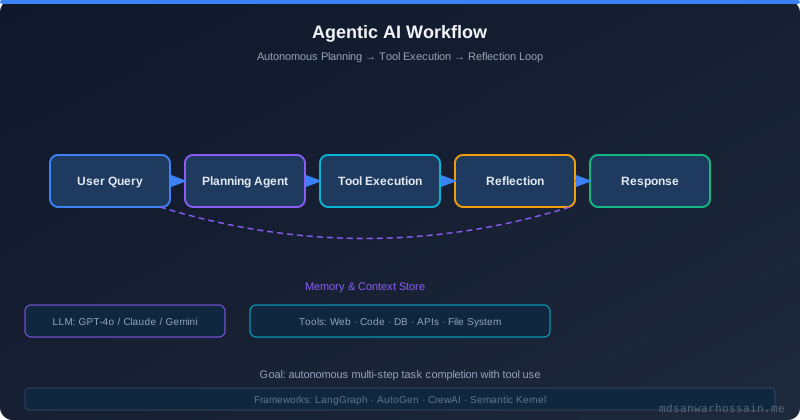
Effective AI memory systems mirror cognitive memory types. Each type serves a distinct purpose and maps to a specific implementation pattern.
1. Short-Term (In-Context) Memory
This is the content within the current context window: the messages exchanged so far in the active conversation. It is the most immediate form of memory. The LLM attends to everything in this window equally (with recency bias). Short-term memory is ideal for maintaining continuity within a single session. Its limitation is the context window size — GPT-4 Turbo and Claude 3.5 Sonnet support 128K–200K token windows, which handles multi-hour conversations but not week-long user histories.
Effective short-term memory management involves summarization: when conversation history exceeds a threshold (say, 40% of the context window budget), summarize older turns and replace them with the summary. This preserves the semantic content while freeing token capacity for new turns.
# Summarization-based context compression
def compress_history(messages: list[dict], max_tokens: int) -> list[dict]:
    current_tokens = count_tokens(messages)
    if current_tokens <= max_tokens:
        return messages

    # Summarize the oldest 50% of conversation turns
    to_summarize = messages[:-len(messages)//2]
    summary = llm.summarize(to_summarize)
    return [{"role": "system", "content": f"[Summary]: {summary}"}] + messages[-len(messages)//2:]
2. Long-Term (Episodic) Memory
Episodic memory stores specific past interactions: user preferences expressed in previous sessions, decisions made in earlier stages of a long project, or context from a conversation three weeks ago. This memory lives outside the context window and must be retrieved explicitly when relevant.
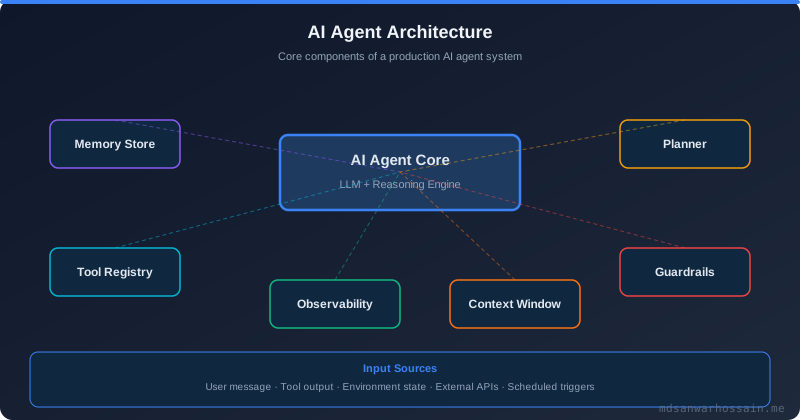
The standard implementation uses a vector store (Pinecone, Weaviate, Qdrant, pgvector). Each significant memory item is embedded and stored. On a new conversation turn, a similarity search retrieves the most relevant memories and injects them into the prompt context. This is semantically relevant retrieval — you are not fetching all past interactions, only the ones that are similar to the current query.
# Episodic memory retrieval using vector similarity
def recall_relevant_memories(query: str, user_id: str, top_k: int = 5) -> list[str]:
    query_embedding = embed(query)
    results = vector_store.search(
        vector=query_embedding,
        filter={"user_id": user_id},
        top_k=top_k
    )
    return [r.text for r in results]

# Storing a new memory
def store_memory(content: str, user_id: str, memory_type: str):
    embedding = embed(content)
    vector_store.upsert(
        id=generate_id(),
        vector=embedding,
        metadata={"user_id": user_id, "type": memory_type, "created_at": now()}
    )
3. Semantic (Factual) Memory
Semantic memory stores facts about the user, their domain, or their organization: the user is a backend engineer who prefers Kotlin over Java, their team uses Kubernetes on AWS, their company's coding standards require all exceptions to be logged at WARN level. This structured knowledge does not fit naturally into a conversation history format.
Implement semantic memory as structured facts — typed key-value pairs or JSON objects stored in a database with the user's profile. Before constructing a prompt, fetch relevant facts and inject them into the system message. Facts have explicit provenance (where was this stated?) and TTL (when does this expire?).
4. Procedural Memory
Procedural memory encodes how to do things: the sequence of steps an agent should follow for a specific workflow, tool usage patterns, or domain-specific reasoning rules. This is typically implemented as system prompt instructions, few-shot examples embedded in the prompt, or as tool descriptions. Unlike episodic and semantic memory, procedural memory is usually authored by engineers and curated over time rather than learned dynamically from user interactions.
Memory Architecture: Production Design
A production memory system for an AI assistant integrates all four types. The architecture is layered: the prompt builder assembles context from multiple sources just before each model call. It pulls from in-context conversation history (short-term), retrieves relevant episodic memories from the vector store, injects applicable semantic facts from the user profile store, and includes procedural instructions from the system prompt template.
The memory writer runs asynchronously after each conversation turn. It evaluates whether the turn contains information worth storing to long-term memory (a heuristic model or simple rule-based classifier), extracts it, embeds it, and writes it to the appropriate store. This decouples memory storage from the response latency path.
Retention Policies and Data Governance
Memory without governance is a security liability. Define explicit retention policies: episodic memories expire after 90 days unless explicitly renewed. Semantic facts are re-confirmed quarterly. Users can view, edit, and delete their stored memories through a transparent memory management UI. Sensitive data — financial details, health information, personally identifiable details — is either excluded from memory storage entirely or encrypted at rest with strict access controls.
Implement a memory audit log that records what was stored, when, and from which conversation turn. This is essential for GDPR compliance and for diagnosing cases where the AI made a decision based on stale or incorrect memory.
Memory in Multi-Agent Systems
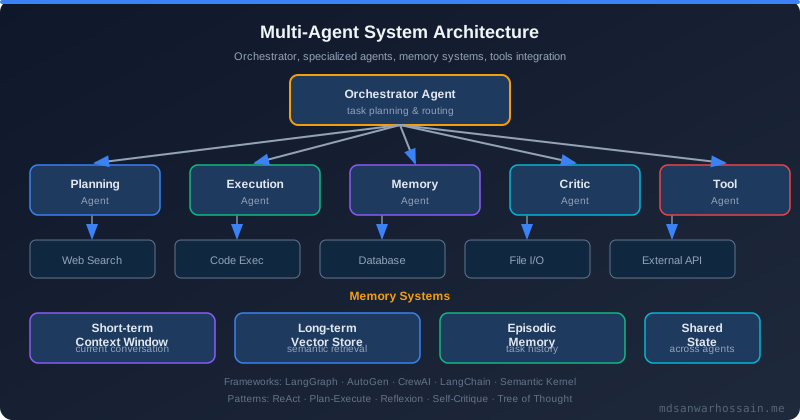
In multi-agent workflows, memory management becomes more complex. Different agents may share a workspace memory (facts relevant to a shared project) while maintaining separate agent-specific memories (tool call history, intermediate reasoning steps). Use explicit scoping: workspace memory is shared and governed by the orchestrator; agent memory is local to that agent's execution context. Prevent memory bleed between unrelated tasks by tagging memories with task and session identifiers and filtering on these during retrieval.
Performance and Scaling Considerations
Vector similarity search adds 10–50ms per recall operation for well-indexed stores at moderate scale. At high request rates (thousands of users), this cost is significant. Optimize with approximate nearest neighbor (ANN) indexes (HNSW in Qdrant/Weaviate), result caching for repeated queries, and pre-fetching relevant memories at session start rather than on each turn. Batch memory writes asynchronously to avoid adding latency to the primary response path.
Common Mistakes
Storing everything: Indiscriminate memory accumulation degrades retrieval quality. Not every turn contains memory-worthy content. Implement a relevance gate before storing — only store facts, preferences, and decisions, not small talk or transient exchanges.
No TTL on memories: Old memories become stale and misleading. A user preference expressed 18 months ago may no longer be valid. All memories should have expiry dates and a refresh mechanism.
Skipping memory attribution in prompts: When injecting recalled memories, tell the model where they came from and when they were recorded. This helps the model appropriately weight old or potentially outdated information.
Treating vector retrieval as exact: Semantic similarity is probabilistic. The most similar embedding is not always the most relevant fact. Add a re-ranking step and a relevance threshold filter to avoid injecting misleading memories.
Key Takeaways
- LLM memory has four types: short-term (context window), episodic (past interactions), semantic (factual knowledge), and procedural (how-to instructions).
- Long-term episodic memory is implemented with vector stores using semantic similarity retrieval.
- Retention policies and user transparency are required for production memory systems — especially for GDPR compliance.
- Memory writes should be asynchronous and selective — store meaningful facts, not noise.
- In multi-agent systems, scope memories by task and session to prevent bleed between unrelated workflows.
Conclusion
Memory transforms LLM applications from stateless question-answering tools into persistent, context-aware assistants and agents. The engineering required is non-trivial: you need vector stores, summarization pipelines, retention governance, and careful prompt assembly. But teams that invest in well-designed memory architecture build AI products that feel genuinely useful across sessions rather than frustratingly forgetful. Memory is not a feature — for production AI applications, it is foundational infrastructure.
Frequently Asked Questions
What is AI Memory Management and why does it matter?
A large language model has no memory of previous conversations by default. Each API call is independent — the model processes only the tokens in the current context window, then discards them. For single-turn question answering, this is fine. For AI assistants, coding agents, customer support systems, and autonomous workflows that span multiple sessions, memory is essential infrastructure. The challenge is that memory in LLM applications is not a simple key-value store. Effective AI memory must be selective (retaining what matters, discarding noise), structured (matching memory to the type of recall needed), and governed (respecting data privacy, retention limits, and access controls).
What is Problem Statement and how does it work?
Without memory, AI assistants suffer from well-known failure modes. A customer support agent asks users to re-explain their issue every time they start a new conversation. A coding agent loses track of decisions made earlier in a long refactoring session. A multi-step research agent cannot connect findings from different retrieval calls. Each failure erodes user trust and limits the practical utility of the system. Adding memory naively — for example, stuffing the entire conversation history into the context window — creates its own problems: token cost increases proportionally with history length, older context degrades model attention (models process recent tokens more effectively), and sensitive data may be inadvertently retained and re-exposed in future prompts.
What is The Four Types of AI Memory and how does it work?
Effective AI memory systems mirror cognitive memory types. Each type serves a distinct purpose and maps to a specific implementation pattern.
What is Short-Term (In-Context) Memory and how does it work?
This is the content within the current context window: the messages exchanged so far in the active conversation. It is the most immediate form of memory. The LLM attends to everything in this window equally (with recency bias). Short-term memory is ideal for maintaining continuity within a single session. Its limitation is the context window size — GPT-4 Turbo and Claude 3.5 Sonnet support 128K–200K token windows, which handles multi-hour conversations but not week-long user histories. Effective short-term memory management involves summarization: when conversation history exceeds a threshold (say, 40% of the context window budget), summarize older turns and replace them with the summary. This preserves the semantic content while freeing token capacity for new turns.
What is Long-Term (Episodic) Memory and how does it work?
Episodic memory stores specific past interactions: user preferences expressed in previous sessions, decisions made in earlier stages of a long project, or context from a conversation three weeks ago. This memory lives outside the context window and must be retrieved explicitly when relevant. The standard implementation uses a vector store (Pinecone, Weaviate, Qdrant, pgvector). Each significant memory item is embedded and stored. On a new conversation turn, a similarity search retrieves the most relevant memories and injects them into the prompt context. This is semantically relevant retrieval — you are not fetching all past interactions, only the ones that are similar to the current query.
Leave a Comment

Software Engineer · Java · Spring Boot · Microservices