Dependency Vulnerability Management: SBOM, Trivy, Snyk & CVE Governance for Java Developers in 2026
The 2021 Log4Shell vulnerability (CVE-2021-44228) reached 93% of enterprise cloud environments within 72 hours of disclosure. It was embedded in thousands of Java applications through transitive dependencies — many teams didn't even know they used Log4j. This guide gives you a complete dependency security workflow: from SBOM generation to automated patching, so you know exactly what you're shipping and can fix critical CVEs before attackers find them.
TL;DR — Know What You Ship
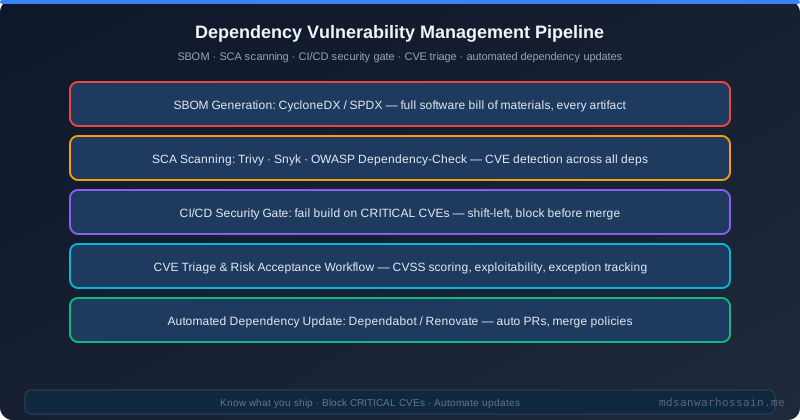
"You can't secure what you can't see. Generate an SBOM for every build, scan it for CVEs in CI/CD, block deployments on CRITICAL findings, triage by real exploitability (not just CVSS score), and automate dependency updates. 85% of Java apps ship with at least one HIGH severity vulnerability — most are fixable in under an hour."
Table of Contents
- The Scale of the Dependency Security Problem
- SBOM: Know What You Ship
- CycloneDX SBOM Generation with Maven & Gradle
- Trivy: Fast CVE Scanning for Containers & Dependencies
- Snyk for Java: Deep SCA with Fix PRs
- OWASP Dependency-Check: The CI/CD Standard
- CVE Triage: Exploitability Over CVSS Score
- Automating Updates: Renovate & Dependabot
- Integrating SCA into CI/CD Gates
- CVE Governance: Policy, SLAs & Risk Acceptance
- Production Dependency Security Checklist
- Conclusion
1. The Scale of the Dependency Security Problem
A typical Spring Boot application declares 30–50 direct dependencies. Those direct dependencies pull in 200–500 transitive dependencies. Each transitive dependency is a vulnerability vector you didn't choose, may not know exists, and almost certainly don't track. Sonatype's 2024 State of the Software Supply Chain report found 85% of Java applications in production contain at least one known HIGH or CRITICAL vulnerability in their dependency tree.
- Log4Shell (CVE-2021-44228): CVSS 10.0. Affected Log4j 2.0–2.14.1. Reached 93% of enterprise environments within 72 hours of public disclosure. Many teams discovered they used Log4j only through transitive dependencies (Elasticsearch, Spring Boot, Kafka — all included it). Had they maintained an SBOM, discovery would have taken minutes, not days.
- Spring4Shell (CVE-2022-22965): CVSS 9.8. A Spring Framework data binding vulnerability affecting millions of Spring Boot applications. Teams without dependency inventory couldn't quickly determine exposure.
- Transitive depth problem: The average direct-to-transitive ratio in Java projects is 1:8. A vulnerability in a library you've never heard of — pulled in through your ORM through your connection pool through your test framework — is still your responsibility in production.
2. SBOM: Know What You Ship
A Software Bill of Materials (SBOM) is a machine-readable inventory of every component in your software: the library name, version, license, package URL, hash, and relationships between components. The US Executive Order 14028 (2021) mandated SBOMs for all software sold to the federal government. Enterprise buyers increasingly require them from vendors.
SBOM Formats: CycloneDX vs SPDX
| Feature | CycloneDX | SPDX |
|---|---|---|
| Origin | OWASP | Linux Foundation |
| Formats | JSON, XML, Protobuf | JSON, YAML, RDF, tag-value |
| VEX support | ✅ Built-in | ✅ Via external docs |
| Tool ecosystem | Trivy, Snyk, Grype, Syft | Syft, FOSSA, Black Duck |
| Recommendation | Preferred for security scanning | Preferred for license compliance |
3. CycloneDX SBOM Generation with Maven & Gradle
Maven: cyclonedx-maven-plugin
<!-- pom.xml -->
<plugin>
    <groupId>org.cyclonedx</groupId>
    <artifactId>cyclonedx-maven-plugin</artifactId>
    <version>2.7.11</version>
    <executions>
        <execution>
            <phase>package</phase>
            <goals><goal>makeAggregateBom</goal></goals>
        </execution>
    </executions>
    <configuration>
        <projectType>library</projectType>
        <schemaVersion>1.4</schemaVersion>
        <includeBomSerialNumber>true</includeBomSerialNumber>
        <includeCompileScope>true</includeCompileScope>
        <includeRuntimeScope>true</includeRuntimeScope>
        <includeTestScope>false</includeTestScope>
        <outputFormat>json</outputFormat>
    </configuration>
</plugin>

<!-- Generate: mvn cyclonedx:makeAggregateBom -->
<!-- Output: target/bom.json -->
Gradle: CycloneDX Plugin
// build.gradle.kts
plugins {
    id("org.cyclonedx.bom") version "1.8.2"
}

cyclonedxBom {
    includeConfigs.set(listOf("runtimeClasspath"))
    schemaVersion.set("1.4")
    outputFormat.set("json")
}

// Generate: ./gradlew cyclonedxBom
// Output: build/reports/bom.json
4. Trivy: Fast CVE Scanning for Containers & Dependencies
Trivy is the most widely adopted open-source vulnerability scanner. It scans container images, filesystems, Git repositories, SBOMs, and Kubernetes clusters for CVEs, misconfigurations, and secret leaks. Its speed and CI/CD integration make it the default choice for Java teams.
# Scan container image
trivy image myapp:latest --severity CRITICAL,HIGH --exit-code 1

# Scan filesystem (JAR files, pom.xml, build.gradle)
trivy fs . --scanners vuln --severity CRITICAL,HIGH --exit-code 1

# Scan generated SBOM
trivy sbom target/bom.json --severity CRITICAL,HIGH

# Output as SARIF for GitHub Security tab integration
trivy image myapp:latest --format sarif --output trivy-results.sarif5. Snyk for Java: Deep SCA with Fix PRs
Snyk adds developer-centric SCA: it integrates with IDEs (VS Code, IntelliJ), creates automated fix PRs, and provides remediation advice with upgrade paths. It also scans container images, IaC, and code (SAST).
# Test for vulnerabilities (CI/CD — fails on high+)
snyk test --severity-threshold=high --all-projects

# Monitor project (continuous tracking in Snyk dashboard)
snyk monitor

# Auto-suggest fix (creates a patched version or upgrade path)
snyk fix

# GitHub Actions integration
- name: Run Snyk to check for vulnerabilities
  uses: snyk/actions/maven@master
  env:
    SNYK_TOKEN: ${{ secrets.SNYK_TOKEN }}
  with:
    args: --severity-threshold=high --fail-on=all
Trivy vs Snyk: Quick Comparison
| Feature | Trivy | Snyk |
|---|---|---|
| Pricing | Free (open-source) | Free tier (limited), paid plans |
| Fix PRs | ❌ Manual | ✅ Automated |
| Container scan | ✅ Excellent | ✅ Good |
| IDE integration | Limited | ✅ VS Code, IntelliJ |
| License compliance | Basic | ✅ Advanced |
6. OWASP Dependency-Check: The CI/CD Standard
OWASP Dependency-Check is the veteran of Java SCA tools. It matches your dependencies against the NVD (National Vulnerability Database) and CPE dictionary. While Trivy is faster, Dependency-Check is often required for compliance audits (SOC2, PCI-DSS) because of its NVD integration and detailed HTML reports.
<!-- Maven plugin -->
<plugin>
    <groupId>org.owasp</groupId>
    <artifactId>dependency-check-maven</artifactId>
    <version>10.0.2</version>
    <configuration>
        <failBuildOnCVSS>9</failBuildOnCVSS>  <!-- fail on CVSS >= 9 -->
        <nvdApiKey>${env.NVD_API_KEY}</nvdApiKey>
        <suppressionFiles>
            <suppressionFile>odc-suppressions.xml</suppressionFile>
        </suppressionFiles>
    </configuration>
    <executions>
        <execution>
            <goals><goal>check</goal></goals>
        </execution>
    </executions>
</plugin>
7. CVE Triage: Exploitability Over CVSS Score
CVSS scores measure the theoretical severity of a vulnerability. They do NOT measure your actual risk. A CVSS 9.8 Remote Code Execution vulnerability in a library only called from a batch job that never receives external input may be lower priority than a CVSS 7.5 vulnerability in your public API handler. Use exploitability context to triage.
EPSS: Exploit Prediction Scoring System
EPSS (maintained by FIRST.org) predicts the probability of a CVE being exploited in the wild within 30 days. A CVE with CVSS 9.8 but EPSS 0.001 (0.1%) poses far less immediate risk than one with CVSS 7.5 and EPSS 0.85 (85%). The CISA KEV (Known Exploited Vulnerabilities) catalog is the highest-priority list — if a CVE appears there, treat it as CRITICAL regardless of CVSS.
| CVE | CVSS | EPSS | Context | Priority |
|---|---|---|---|---|
| CVE-A (RCE in batch lib) | 9.8 | 0.001 | No network exposure | Medium — fix in sprint |
| CVE-B (SQLi in web lib) | 7.5 | 0.85 | Handles user input | CRITICAL — fix now |
| CVE-C (in CISA KEV) | 6.8 | 0.95 | Actively exploited | EMERGENCY — patch today |
8. Automating Updates: Renovate & Dependabot
Renovate Configuration
{
  "$schema": "https://docs.renovatebot.com/renovate-schema.json",
  "extends": ["config:recommended"],
  "schedule": ["before 9am on Monday"],
  "prConcurrentLimit": 5,
  "packageRules": [
    {
      "matchUpdateTypes": ["patch"],
      "automerge": true,
      "automergeType": "pr"
    },
    {
      "matchPackagePatterns": ["^org.springframework"],
      "groupName": "Spring Framework packages",
      "automerge": false
    },
    {
      "matchDepTypes": ["dependencies"],
      "matchUpdateTypes": ["major"],
      "labels": ["major-update", "needs-review"]
    }
  ]
}
Dependabot for Maven
# .github/dependabot.yml
version: 2
updates:
  - package-ecosystem: maven
    directory: /
    schedule:
      interval: weekly
      day: monday
    open-pull-requests-limit: 10
    groups:
      spring-boot:
        patterns:
          - "org.springframework.boot:*"
    ignore:
      - dependency-name: "*"
        update-types: ["version-update:semver-major"]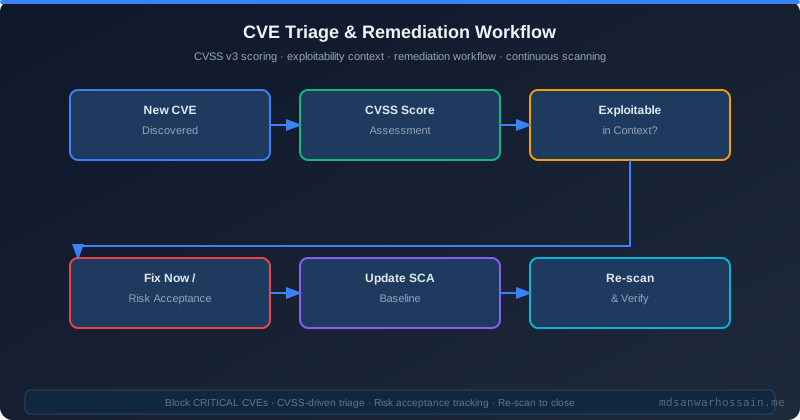
9. Integrating SCA into CI/CD Gates
# .github/workflows/security.yml
name: Security Scan
on: [push, pull_request]
jobs:
  dependency-scan:
    runs-on: ubuntu-latest
    steps:
      - uses: actions/checkout@v4
      - name: Set up Java
        uses: actions/setup-java@v4
        with: { java-version: '21', distribution: 'temurin' }
      - name: Build and generate SBOM
        run: mvn package cyclonedx:makeAggregateBom -DskipTests
      - name: Scan with Trivy
        uses: aquasecurity/trivy-action@master
        with:
          scan-type: sbom
          input: target/bom.json
          severity: CRITICAL,HIGH
          exit-code: 1
          ignore-unfixed: true
          format: sarif
          output: trivy-results.sarif
      - name: Upload results to GitHub Security
        uses: github/codeql-action/upload-sarif@v3
        if: always()
        with:
          sarif_file: trivy-results.sarif
10. CVE Governance: Policy, SLAs & Risk Acceptance
| Severity | SLA (Remediation) | Action |
|---|---|---|
| CRITICAL + CISA KEV | 24 hours | Emergency patch, security incident opened |
| CRITICAL | 72 hours | Hotfix branch, expedited review |
| HIGH | 7 days | Include in next sprint |
| MEDIUM | 30 days | Backlog with priority label |
| LOW | 90 days | Track in vulnerability register |
For CVEs that cannot be remediated within SLA (no fix available, breaking API change), implement a formal risk acceptance process: create a JIRA/GitHub issue with business justification, set a re-evaluation date, add a suppression entry in your SCA tool (with expiry), and get sign-off from a security lead. Undocumented risk acceptance is a compliance gap.
11. Production Dependency Security Checklist
- ✅ SBOM generated on every build — CycloneDX JSON attached as build artifact and stored in artifact registry
- ✅ Trivy scan in CI/CD — blocks PRs with CRITICAL CVEs that have available fixes
- ✅ Snyk monitoring enabled — continuous monitoring of production dependencies with fix PR automation
- ✅ OWASP Dependency-Check in release pipeline — HTML report archived for audit trail
- ✅ EPSS-enriched triage — do not treat CVSS 9.8 without network exposure as higher priority than CVSS 7.5 actively exploited
- ✅ CISA KEV subscription — alert on any new KEV entry matching your dependency inventory
- ✅ Renovate or Dependabot configured — patch versions auto-merged, minor/major as PRs
- ✅ CVE SLA policy documented — CRITICAL 72h, HIGH 7d, MEDIUM 30d
- ✅ Risk acceptance process — documented exceptions with expiry date, business justification, and security sign-off
- ✅ Quarterly SBOM review — compare current vs previous SBOM, identify new transitive dependencies
12. Conclusion
Dependency vulnerability management is not a one-time audit — it is a continuous process that must be embedded in your development lifecycle. The tools are mature, the integrations are straightforward, and the cost of a single breach from an unpatched transitive dependency far exceeds the engineering time to implement this workflow.
Start with three actions this week: add the cyclonedx-maven-plugin to generate SBOMs, add a Trivy step to your CI/CD pipeline that blocks on CRITICAL CVEs, and enable Dependabot or Renovate on your repository. These three changes, taking roughly four hours of engineering time, will give you more visibility into your dependency security posture than most production Java teams have today.
Frequently Asked Questions
What is TL;DR — Know What You Ship and how does it work?
"You can't secure what you can't see. Generate an SBOM for every build, scan it for CVEs in CI/CD, block deployments on CRITICAL findings, triage by real exploitability (not just CVSS score), and automate dependency updates. 85% of Java apps ship with at least one HIGH severity vulnerability — most are fixable in under an hour."
What are the security considerations for The Scale of the Dependency Security Problem?
A typical Spring Boot application declares 30–50 direct dependencies. Those direct dependencies pull in 200–500 transitive dependencies. Each transitive dependency is a vulnerability vector you didn't choose, may not know exists, and almost certainly don't track. Sonatype's 2024 State of the Software Supply Chain report found 85% of Java applications in production contain at least one known HIGH or CRITICAL vulnerability in their dependency tree. Log4Shell (CVE-2021-44228): CVSS 10.0. Affected Log4j 2.0–2.14.1. Reached 93% of enterprise environments within 72 hours of public disclosure. Many teams discovered they used Log4j only through transitive dependencies (Elasticsearch, Spring Boot, Kafka — all included it). Had they maintained an SBOM, discovery would have taken minutes, not days. Spring4Shell (CVE-2022-22965): CVSS 9.8. A Spring Framework data binding vulnerability affecting millions of Spring Boot applications.
What is SBOM and how does it work?
A Software Bill of Materials (SBOM) is a machine-readable inventory of every component in your software: the library name, version, license, package URL, hash, and relationships between components. The US Executive Order 14028 (2021) mandated SBOMs for all software sold to the federal government. Enterprise buyers increasingly require them from vendors.
What is Trivy and how does it work?
Trivy is the most widely adopted open-source vulnerability scanner. It scans container images, filesystems, Git repositories, SBOMs, and Kubernetes clusters for CVEs, misconfigurations, and secret leaks. Its speed and CI/CD integration make it the default choice for Java teams.
What is Snyk for Java and how does it work?
Snyk adds developer-centric SCA: it integrates with IDEs (VS Code, IntelliJ), creates automated fix PRs, and provides remediation advice with upgrade paths. It also scans container images, IaC, and code (SAST).
Leave a Comment
Frequently Asked Questions
What is TL;DR — Know What You Ship and how does it work?
"You can't secure what you can't see. Generate an SBOM for every build, scan it for CVEs in CI/CD, block deployments on CRITICAL findings, triage by real exploitability (not just CVSS score), and automate dependency updates. 85% of Java apps ship with at least one HIGH severity vulnerability — most are fixable in under an hour."
What are the security considerations for The Scale of the Dependency Security Problem?
A typical Spring Boot application declares 30–50 direct dependencies. Those direct dependencies pull in 200–500 transitive dependencies. Each transitive dependency is a vulnerability vector you didn't choose, may not know exists, and almost certainly don't track. Sonatype's 2024 State of the Software Supply Chain report found 85% of Java applications in production contain at least one known HIGH or CRITICAL vulnerability in their dependency tree. Log4Shell (CVE-2021-44228): CVSS 10.0. Affected Log4j 2.0–2.14.1. Reached 93% of enterprise environments within 72 hours of public disclosure. Many teams discovered they used Log4j only through transitive dependencies (Elasticsearch, Spring Boot, Kafka — all included it). Had they maintained an SBOM, discovery would have taken minutes, not days. Spring4Shell (CVE-2022-22965): CVSS 9.8. A Spring Framework data binding vulnerability affecting millions of Spring Boot applications.
What is SBOM and how does it work?
A Software Bill of Materials (SBOM) is a machine-readable inventory of every component in your software: the library name, version, license, package URL, hash, and relationships between components. The US Executive Order 14028 (2021) mandated SBOMs for all software sold to the federal government. Enterprise buyers increasingly require them from vendors.
What is Trivy and how does it work?
Trivy is the most widely adopted open-source vulnerability scanner. It scans container images, filesystems, Git repositories, SBOMs, and Kubernetes clusters for CVEs, misconfigurations, and secret leaks. Its speed and CI/CD integration make it the default choice for Java teams.
What is Snyk for Java and how does it work?
Snyk adds developer-centric SCA: it integrates with IDEs (VS Code, IntelliJ), creates automated fix PRs, and provides remediation advice with upgrade paths. It also scans container images, IaC, and code (SAST).