Multi-Agent Memory Consolidation in Production: Episodic Memory, Shared State & Forgetting Strategies
As multi-agent AI systems grow in complexity, memory becomes the silent bottleneck that destroys both reliability and performance. Agents that remember too much hallucinate from stale context; agents that remember too little lose the thread of long-running workflows. This deep dive covers the full memory lifecycle — from episodic capture to consolidation, importance scoring, and principled forgetting — so your production multi-agent systems stay coherent under real workload.
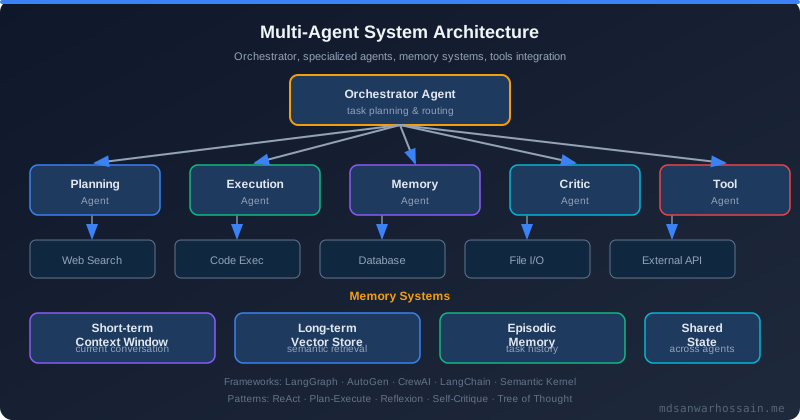
Table of Contents
- Introduction — The Hidden Memory Crisis
- Real-World Problem — Context Window Overflow in Shared State
- Deep Dive — Episodic, Semantic & Working Memory Taxonomy
- Solution Approach — The Memory Consolidation Pipeline
- Architecture & Code Examples — MemoryConsolidator in Python
- Failure Scenarios & Trade-offs
- When NOT to Use Memory Consolidation
- Optimization Techniques
- Key Takeaways
- Conclusion
1. Introduction — The Hidden Memory Crisis
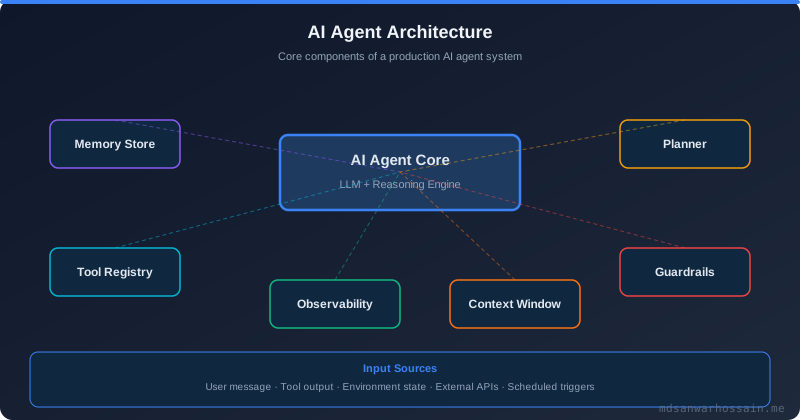
Picture a customer support platform running five specialized agents in parallel: an intent classifier, an order-status fetcher, a returns-policy advisor, a sentiment tracker, and a supervisor agent that orchestrates the others. The system launches confidently in production and performs brilliantly during the first week. By week three, customers start receiving contradictory answers. The order agent insists a shipment departed on a date that was corrected three turns ago. The policy advisor quotes a return window that was updated in the previous session. The supervisor agent starts every new session with thousands of tokens of residual context from sessions that ended hours earlier.
The root cause is not a model deficiency or a prompt engineering failure — it is an architectural one. The system has no memory lifecycle. Every interaction appends new episodic records to a shared Redis store without ever compacting, scoring, or pruning old ones. Over time each agent's effective context window fills with noise, the signal-to-noise ratio collapses, and hallucinations become the statistical norm rather than the exception.
Memory consolidation is the discipline that prevents this outcome. Borrowed from cognitive neuroscience — where the hippocampus transfers short-term episodic traces into long-term semantic storage during sleep — memory consolidation in multi-agent systems is the controlled process of summarizing, scoring, and selectively discarding agent memories so that what persists is the most useful distillation of past experience, not a raw append-only log.
2. Real-World Problem — Context Window Overflow in Shared State
The customer support system described above uses Redis as its shared episodic store. Each agent writes a structured JSON blob per turn: the user utterance, the agent's response, tool call results, confidence scores, and a timestamp. With five agents active across an average session of twelve turns, a single session produces sixty or more episodic entries. Across two hundred concurrent sessions that number reaches twelve thousand entries, each averaging 600 tokens when serialized.
Unbounded episodic logs are the most common root cause of multi-agent memory failure in production. An append-only shared store grows at O(agents × turns × sessions) and will overflow context windows within days of launch at moderate traffic.
The deeper problem is that the agents were built with single-session RAG assumptions: retrieve the most recent N entries, pass them as context, generate a response. When stale entries from previous sessions bleed into the retrieval window — because Redis keys were never expired and relevance scoring was never applied — the agents receive contradictory ground truths. The intent classifier tags a returning customer as "first contact." The order agent quotes a voided tracking number because an old episode ranked higher by recency than the correction issued two sessions later.
Compounding the problem, the five agents share a single Redis namespace. When the supervisor writes a summary of the session, it uses the same key pattern as individual agent writes. Reads during the next session pull both the supervisor summary and all raw agent traces, causing token budgets to be exhausted before the actual user query is even processed. Without a consolidation layer, the system is architecturally guaranteed to degrade as usage grows.
3. Deep Dive — Episodic, Semantic & Working Memory Taxonomy
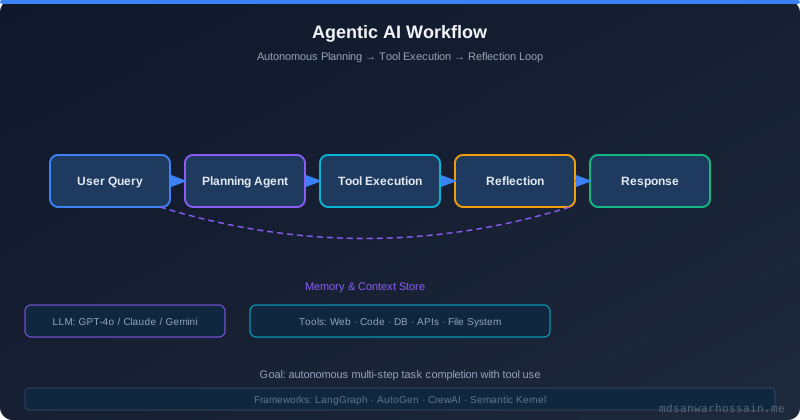
Before designing a consolidation strategy, you must understand what you are consolidating. Multi-agent memory falls into three distinct categories, each with different retention requirements, access patterns, and eviction semantics.
Episodic memory captures specific events: "At 14:32 on March 3rd, the user said X and the order agent responded Y." Episodic records are high-fidelity, temporally anchored, and inherently perishable. Their value decays rapidly — yesterday's order status is largely irrelevant today. Episodic memory in an agent system maps directly to conversation turns, tool call logs, and observation buffers. It is the raw material from which higher-level knowledge is distilled.
Semantic memory captures generalizations distilled from episodes: "This customer typically contacts support about delayed shipments, prefers self-service resolution, and escalates quickly if not acknowledged within two turns." Semantic memory is lower-fidelity, temporally unanchored, and highly durable. It is the output of the consolidation process — the compressed, actionable knowledge an agent should carry across sessions.
Working memory is the agent's in-context state during active inference: the current system prompt, recent conversation window, retrieved documents, and tool outputs. Working memory is ephemeral by design — it exists only for the duration of a single LLM call — but its composition directly controls output quality. Consolidation's primary job is ensuring that working memory is populated with the right semantic memories and the minimal necessary episodic context.
The consolidation pipeline exists at the boundary between episodic and semantic memory. Its job is to continuously transform high-volume, perishable episodic traces into low-volume, durable semantic summaries, while applying principled forgetting to what no longer serves the agent's goals.
This taxonomy is fundamentally different from single-agent RAG systems, where there is typically one retrieval index and one query context. In a multi-agent system, each agent has its own episodic buffer and contributes to a shared semantic store. The parallel memory fetch pattern — where multiple agents simultaneously query their respective memory stores — shares conceptual overlap with the fan-out patterns we explored in Java's Structured Concurrency post: bounded parallelism with lifecycle ownership. The difference is that in the AI domain, the "subtasks" are memory fetches rather than I/O calls, but the need for deadline-bound cancellation and structured results is identical.
4. Solution Approach — The Memory Consolidation Pipeline
The consolidation pipeline runs asynchronously alongside the live agent system, typically triggered at session end or on a rolling time window (every fifteen minutes of inactivity). It operates in three stages: summarization, importance scoring, and temporal decay.
Summarization collapses a batch of raw episodic entries into a compact semantic summary. This is an LLM call, usually to a cheaper, faster model than the one running agent inference. The summarizer receives a window of N episodes and produces a structured output: key facts extracted, decisions made, open issues unresolved, and recommended follow-up actions. The summary is written to the semantic store; the raw episodes are marked as consolidated and candidates for expiry.
Importance scoring assigns a numeric score to each memory entry — both consolidated summaries and residual raw episodes — based on signals like recency, frequency of reference, outcome impact (did this episode lead to a successful resolution?), and agent-assigned confidence. High-importance memories are retained longer; low-importance memories decay faster. Scores are stored as sorted set weights in Redis, enabling efficient rank-based eviction.
Temporal decay applies an exponential half-life to all memory entries. A raw episodic entry might have a half-life of two hours; a semantic summary might have a half-life of thirty days. Decay is implemented as a scheduled score reduction rather than hard expiry, so borderline memories are not abruptly deleted but gradually demoted below the retrieval threshold. This mirrors how biological forgetting works: gradual inaccessibility rather than instantaneous deletion.
5. Architecture & Code Examples — MemoryConsolidator in Python
Below is a production-ready MemoryConsolidator class that implements all three pipeline stages. It connects to Redis for storage and uses an LLM client (OpenAI-compatible) for summarization.
import json, math, time
from dataclasses import dataclass, field
from typing import Any
import redis
import openai

EPISODE_KEY   = "agent:episodes:{session_id}"
SEMANTIC_KEY  = "agent:semantic:{user_id}"
SCORE_KEY     = "agent:scores:{user_id}"

HALF_LIFE_EPISODE_HOURS  = 2.0
HALF_LIFE_SEMANTIC_DAYS  = 30.0

@dataclass
class MemoryEntry:
    memory_id: str
    content: str
    memory_type: str          # "episode" | "semantic"
    created_at: float = field(default_factory=time.time)
    score: float = 1.0


class MemoryConsolidator:
    def __init__(self, redis_client: redis.Redis, llm_client: openai.OpenAI):
        self.redis = redis_client
        self.llm   = llm_client

    # ── Stage 1: Summarise a batch of raw episodes ──────────────────────────
    def summarize_episodes(self, episodes: list[MemoryEntry]) -> str:
        text_block = "\n".join(
            f"[{e.memory_id}] {e.content}" for e in episodes
        )
        response = self.llm.chat.completions.create(
            model="gpt-4o-mini",
            messages=[
                {"role": "system", "content": (
                    "You are a memory consolidator for a multi-agent support system. "
                    "Extract key facts, decisions made, open issues, and recommended "
                    "follow-ups from the episode log. Be concise and factual."
                )},
                {"role": "user", "content": text_block},
            ],
            temperature=0.1,
            max_tokens=512,
        )
        return response.choices[0].message.content.strip()

    # ── Stage 2: Score importance (0.0 – 1.0) ───────────────────────────────
    def score_importance(
        self,
        entry: MemoryEntry,
        reference_count: int = 0,
        outcome_positive: bool = False,
    ) -> float:
        recency_score   = math.exp(-0.1 * (time.time() - entry.created_at) / 3600)
        frequency_score = min(1.0, reference_count / 5.0)
        outcome_bonus   = 0.2 if outcome_positive else 0.0
        # Weights: recency 40%, frequency 40%, outcome 20% — sum never exceeds 1.0
        return round(
            0.4 * recency_score + 0.4 * frequency_score + outcome_bonus, 4
        )

    # ── Stage 3: Apply temporal decay to stored scores ──────────────────────
    def apply_decay(self, user_id: str) -> int:
        score_key = SCORE_KEY.format(user_id=user_id)
        entries: dict[str, Any] = self.redis.hgetall(score_key)
        updated = 0
        for mem_id, raw in entries.items():
            data = json.loads(raw)
            hours_elapsed = (time.time() - data["created_at"]) / 3600
            if data["memory_type"] == "episode":
                half_life = HALF_LIFE_EPISODE_HOURS
            else:
                half_life = HALF_LIFE_SEMANTIC_DAYS * 24
            decay_factor  = math.pow(0.5, hours_elapsed / half_life)
            data["score"] = round(data["score"] * decay_factor, 6)
            self.redis.hset(score_key, mem_id, json.dumps(data))
            updated += 1
        return updated

    # ── Agent write-back helper ──────────────────────────────────────────────
    def write_episode(self, session_id: str, user_id: str, content: str) -> str:
        entry = MemoryEntry(
            memory_id   = f"ep_{session_id}_{int(time.time()*1000)}",
            content     = content,
            memory_type = "episode",
        )
        episode_key = EPISODE_KEY.format(session_id=session_id)
        score_key   = SCORE_KEY.format(user_id=user_id)
        # Store raw episode
        self.redis.rpush(episode_key, json.dumps(entry.__dict__))
        self.redis.expire(episode_key, int(HALF_LIFE_EPISODE_HOURS * 3600 * 4))
        # Store initial score metadata
        self.redis.hset(score_key, entry.memory_id, json.dumps(entry.__dict__))
        return entry.memory_id
The Redis sorted set for recency-based retrieval works alongside this class. When an agent fetches context, it queries the sorted set by score descending, retrieving only the top-K entries that fit within its token budget:
# Recency-scored retrieval using Redis ZREVRANGEBYSCORE
def fetch_top_memories(redis_client: redis.Redis, user_id: str, top_k: int = 10):
    score_key = SCORE_KEY.format(user_id=user_id)
    # Get all entries sorted by importance score descending
    all_scores = redis_client.hgetall(score_key)
    ranked = sorted(
        [(k, json.loads(v)) for k, v in all_scores.items()],
        key=lambda x: x[1]["score"],
        reverse=True
    )
    return [data["content"] for _, data in ranked[:top_k]]
If you are implementing the memory consolidation pipeline in a JVM-based orchestrator, Java's StructuredTaskScope (covered in our Java Structured Concurrency deep dive) is an excellent fit for the parallel fetch-score-prune pipeline with deadline-bound cancellation. You can model each agent's memory fetch as a subtask inside a ShutdownOnFailure scope, so that a slow Redis replica never stalls the entire consolidation run.
6. Failure Scenarios & Trade-offs
Consolidation latency introducing stale reads. The summarization LLM call is not instantaneous. When a consolidation job is in progress for a given user, agents serving a concurrent session may read from an inconsistent state — some raw episodes have been marked "consolidated pending" but the semantic summary has not yet been written. This stale-read window is typically under two seconds for gpt-4o-mini, but at scale it manifests as visible inconsistencies. Mitigation: use a Redis WATCH/MULTI/EXEC transaction to atomically swap raw episodes for the semantic summary in a single write operation.
Race conditions in concurrent agent writes. Five agents writing to the same Redis session key simultaneously without serialization will produce interleaved entries that can corrupt temporal ordering, making summarization unreliable. Mitigation: use a lightweight Redis distributed lock (Redlock pattern with a two-second TTL) on the session key during write-back, or route all writes through a single session manager service that serializes them.
The importance scorer itself can hallucinate when given low-context episodes (single-token tool calls, bare timestamps with no surrounding narrative). Always set a minimum content-length threshold — reject entries shorter than 20 tokens from scoring and assign them the baseline score of 0.1 rather than invoking the LLM scorer.
Consolidation amplifying errors. If the summarization LLM produces a factually incorrect summary — for instance, misattributing an order status correction to the wrong order ID — that error becomes embedded in semantic memory and persists for weeks. Raw episodes would have expired, so there is no audit trail to correct from. Mitigation: retain a cryptographic hash of the raw episode batch alongside each summary, and store the top-3 most important raw episodes as verbatim snippets in the semantic record for grounding.
7. When NOT to Use Memory Consolidation
Short-lived stateless agents. If your agents handle discrete, independent tasks with no cross-session continuity requirements — a code-review agent invoked per PR, a document-classification agent triggered per upload — the consolidation overhead far exceeds the benefit. These agents have no meaningful episodic history to consolidate; each invocation starts clean by design.
Cost-sensitive deployments. Every consolidation run invokes an LLM. At high session volume this adds up quickly. For a system processing ten thousand sessions per day with consolidation triggered at session end, you are making ten thousand additional LLM calls. If those calls average 800 input tokens and 300 output tokens with gpt-4o-mini pricing, the daily cost is non-trivial. Carefully model the cost-benefit ratio before committing to LLM-based consolidation at scale. Rule-based extractors (regex, entity recognizers) can replace the LLM summarizer for structured domains at a fraction of the cost.
Strict determinism requirements. Consolidation introduces non-determinism at two levels: the summarization LLM produces different outputs on repeated runs, and the decay schedule means the same episode will score differently depending on when consolidation runs. Systems with auditability requirements — legal, financial, healthcare — may need to retain raw episodes indefinitely in an immutable store rather than consolidating them, using consolidation only as an index overlay rather than a replacement.
8. Optimization Techniques
Async consolidation pipelines. Never run consolidation synchronously on the hot path. Use a background worker (Celery, RQ, or a lightweight asyncio task queue) to process consolidation jobs asynchronously. Publish a session.ended event to a queue; the consolidation worker consumes it independently. This decouples agent latency from consolidation latency entirely.
Delta encoding for memory patches. Instead of rewriting the entire semantic summary on each consolidation cycle, model updates as patches: structured diffs that add new facts, revise existing ones, or mark facts as superseded. Store patches in an append log separate from the canonical semantic snapshot. This dramatically reduces write amplification and makes it easy to reconstruct the memory state at any point in time for debugging or audit.
Bloom filters for deduplication. Agents in high-throughput systems frequently write semantically identical episodes — the same order status queried by three different agents in the same session. A Bloom filter on episode content hashes prevents storing near-duplicate entries before they ever reach the consolidation pipeline, reducing both storage volume and summarization complexity. Redis has a native Bloom filter module (RedisBloom) that integrates seamlessly.
Embedding-based similarity pruning using cosine distance can eliminate near-duplicate semantic summaries that differ only in phrasing. Compute embeddings for all semantic entries on a daily schedule and merge pairs with cosine similarity above 0.97, keeping the higher-scored entry. This typically reduces semantic store size by 20–35% in systems with multiple agents writing independent summaries about the same user.
Embedding-based similarity pruning. Beyond deduplication, embedding-based clustering can identify groups of related semantic memories that can be rolled up into a higher-order abstraction. This creates a memory hierarchy: individual episode summaries → topic-level summaries → persona-level summaries, each progressively more compressed and durable. Topic-level summaries are ideal for working memory injection because they are maximally information-dense for their token cost.
9. Key Takeaways
- Memory consolidation is not optional in production multi-agent systems — unbounded episodic logs mathematically guarantee degradation as session volume grows.
- Distinguish episodic memory (perishable, high-fidelity event logs) from semantic memory (durable, distilled knowledge) and apply different retention policies to each.
- The three-stage pipeline — summarization, importance scoring, temporal decay — addresses both the volume problem (too many entries) and the quality problem (stale or irrelevant entries).
- Race conditions between concurrent agents writing to shared state are a correctness hazard; serialize writes with distributed locks or route through a dedicated session manager service.
- Always retain verbatim evidence snippets alongside LLM-generated summaries; without them, consolidation errors are unrecoverable once raw episodes expire.
- Async pipelines, Bloom filter deduplication, and embedding-based similarity pruning together can reduce memory store size by 40–60% without sacrificing retrieval quality.
10. Conclusion
Multi-agent memory consolidation is the infrastructure layer that separates prototype multi-agent systems from production-grade ones. The customer support platform that started this article is not an unusual failure mode — it is the default failure mode when memory architecture is not designed upfront. Every production multi-agent system will eventually hit context overflow, stale reads, or hallucination from accumulated noise if its memory lifecycle is not managed.
The patterns in this article — episodic/semantic/working memory taxonomy, three-stage consolidation pipelines, importance scoring with temporal decay, async execution, and similarity-based pruning — give you a complete toolkit to build memory infrastructure that scales with your agent system rather than against it. Start with a simple synchronous consolidation job at session end, measure the impact on context quality, and then progressively add async workers, Bloom filters, and embedding-based pruning as your traffic demands.
Memory is not a feature you add to agents — it is the substrate that makes agents capable of sustained, coherent reasoning across time. Build it right from the start, and your agents will grow more capable with every session rather than more confused.
Leave a Comment
Related Posts

Software Engineer · Java · Spring Boot · Microservices