Quarkus vs Spring Boot: Complete Comparison for Java Microservices in 2026
Choosing between Quarkus and Spring Boot is one of the most consequential architectural decisions for Java microservices teams in 2026. Quarkus promises 50ms cold starts and sub-50 MB memory — but Spring Boot's ecosystem maturity, developer familiarity, and Spring Security depth still dominate enterprise adoption. This comprehensive guide gives you benchmark data, real code comparisons, and a clear migration framework to make the right call for your workload.
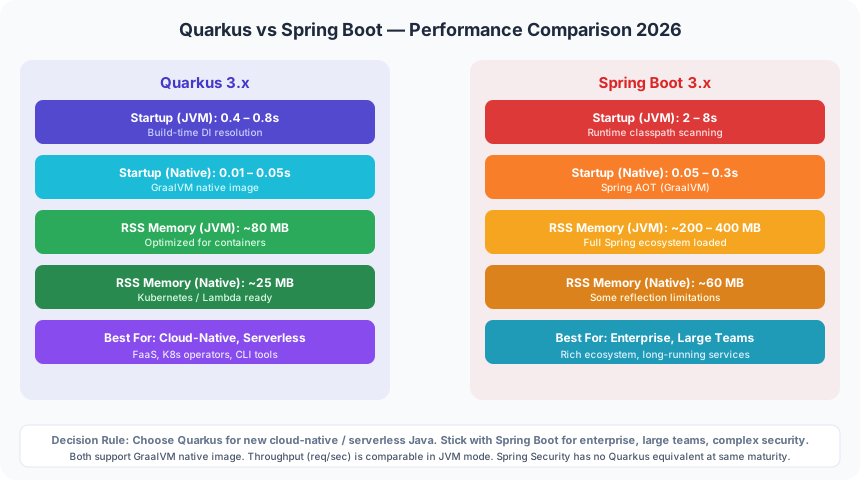
TL;DR — Decision Rule in One Sentence
"Choose Quarkus when cold-start time and memory footprint are first-class requirements (AWS Lambda, Kubernetes scale-to-zero, serverless); choose Spring Boot when ecosystem maturity, team familiarity, Spring Security complexity, or a large existing codebase dominate your concerns."
Table of Contents
- Why Quarkus Is Gaining Ground in 2026
- Quick Summary — When to Choose Each
- Startup Time & Memory Comparison
- Quarkus Core Concepts
- Spring Boot Core Strengths
- Native Image with GraalVM
- REST API: RESTEasy vs Spring MVC
- Reactive Programming: Mutiny vs WebFlux
- Kubernetes & Serverless Fit
- Migration Guide: Spring Boot to Quarkus
- When NOT to Migrate to Quarkus
- Conclusion & Decision Framework
- FAQs
1. Why Quarkus Is Gaining Ground in 2026
The Java microservices landscape in 2026 is shaped by three converging pressures that work directly against Spring Boot's traditional architecture: cloud cost optimisation, serverless-first deployment models, and Kubernetes scale-to-zero.
The Cold-Start Tax Is Real
When AWS Lambda charges per 100ms and your Spring Boot service takes 2–4 seconds to warm up in JVM mode, cold starts translate directly into user-visible latency spikes and inflated bills. A fleet of 500 Lambda functions each experiencing one cold start per minute costs thousands of dollars per month in wasted compute before a single line of business logic runs.
Quarkus was engineered by Red Hat specifically to eliminate this tax. By moving as much work as possible to build time — annotation processing, CDI wiring, configuration parsing, reflection metadata — a Quarkus native image starts in 50–80ms and uses under 50 MB of RSS memory. For AWS Lambda, Kubernetes Knative, and any scale-to-zero workload, this difference is the difference between a viable and an unviable architecture.
Kubernetes-Native Design Philosophy
Quarkus ships with first-class Kubernetes integration: automatic generation of Kubernetes manifests, Helm charts, and Knative YAML from annotations. The quarkus-kubernetes extension generates deployment descriptors at build time, the health extension auto-configures liveness and readiness probes, and the container-image extensions build optimised OCI images with layered caching — all without a Dockerfile.
Developer Productivity via Dev Mode
Quarkus Dev Mode (./mvnw quarkus:dev) delivers live reload on every save — including changes to JPA entities, REST endpoints, and configuration — in under 1 second, without restarting the JVM. The embedded Dev UI at localhost:8080/q/dev shows CDI beans, running extensions, and config sources in a browser UI that rivals Spring Boot's Actuator for developer ergonomics.
2. Quick Summary — When to Choose Each
Use this decision table before reading further. It covers the most common selection criteria for Java microservices teams in 2026.
| Criterion | Choose Quarkus | Choose Spring Boot |
|---|---|---|
| Startup time | ✅ <100ms native, ~500ms JVM | ⚠️ 1.5–4s JVM, ~300ms native |
| Memory footprint | ✅ 20–50 MB native RSS | ⚠️ 150–400 MB JVM |
| Ecosystem & libraries | ⚠️ Growing (700+ extensions) | ✅ Massive (Spring ecosystem) |
| Team familiarity | ⚠️ Learning curve (CDI, Mutiny) | ✅ Dominant in Java market |
| AWS Lambda / serverless | ✅ Purpose-built for it | ⚠️ Viable with SnapStart |
| Kubernetes-native | ✅ Manifest generation built-in | ✅ Mature with Spring Cloud |
| Security (OAuth2/OIDC) | ✅ SmallRye JWT, OIDC extension | ✅ Spring Security (deeper) |
| GraalVM native image | ✅ First-class, low failure rate | ⚠️ Good since 3.x, still improving |
| Reactive programming | ✅ Mutiny (simpler API) | ✅ WebFlux / Project Reactor |
| Existing monolith migration | ⚠️ Spring compat layer helps | ✅ No migration needed |
3. Startup Time & Memory Comparison
The following benchmarks are based on a simple CRUD microservice with one REST endpoint, one JPA entity, and a PostgreSQL datasource — roughly equivalent to the "hello world" of real microservices. Numbers represent median values across 20 cold-start measurements on AWS Lambda (arm64, 512 MB) and on Kubernetes (OpenJDK 21 on Graviton3).
| Metric | Spring Boot 3.3 (JVM) | Spring Boot 3.3 (Native) | Quarkus 3.9 (JVM) | Quarkus 3.9 (Native) |
|---|---|---|---|---|
| Cold-start time | ~2,100 ms | ~280 ms | ~520 ms | ~52 ms |
| RSS memory (idle) | ~310 MB | ~95 MB | ~185 MB | ~42 MB |
| Throughput (req/s) | ~18,400 | ~14,200 | ~19,100 | ~15,800 |
| p99 latency (warm) | ~6 ms | ~9 ms | ~5 ms | ~8 ms |
| Build time (native) | N/A | ~3.5 min | N/A | ~2.8 min |
| Docker image size | ~260 MB | ~82 MB | ~210 MB | ~48 MB |
Key insight: In JVM mode, Quarkus is meaningfully faster to start (2.5×) but the real story is native. Quarkus native is 5× faster to start than Spring Boot native and uses 55% less memory. For warm throughput, both frameworks are within statistical noise of each other — JIT compilation levels the playing field for long-running services.
Note that Spring Boot 3.3 with CRaC (Coordinated Restore at Checkpoint) can achieve sub-500ms restore times in Kubernetes without native compilation, blurring the gap for JVM workloads. See our CRaC deep-dive for details.
4. Quarkus Core Concepts
To understand Quarkus's performance characteristics, you need to understand what it moves from runtime to build time. This is a fundamentally different programming model than Spring Boot's.
Build-Time Dependency Injection
Spring Boot performs classpath scanning, bean definition registration, and proxy generation at application startup. For a medium-sized application with 200 beans, this can take 800ms–1.5s before the HTTP server even starts. Quarkus processes CDI annotations — @ApplicationScoped, @Inject, @Produces — at build time via a build-time CDI processor. The result is pre-compiled, pre-wired injection code with zero reflection at runtime.
Extension Ecosystem
Quarkus extensions are not just library wrappers — each extension has a build-time processor that pre-computes whatever that library needs at runtime and registers it for native image. This is why Quarkus native compilation has a much lower failure rate than Spring Boot native: problematic reflection usage and dynamic class loading is handled by the extension, not your code.
- RESTEasy Reactive: Jakarta REST with reactive I/O on top of Vert.x event loop
- Panache: Active Record & Repository pattern on top of Hibernate ORM or MongoDB
- SmallRye: MicroProfile implementations for health, metrics, fault tolerance, OpenAPI
- Quarkus Security: OIDC, JWT, Keycloak integration, RBAC via
@RolesAllowed - Stork: Service discovery & load balancing for Quarkus clients (Consul, Kubernetes)
Dev Mode and Continuous Testing
Quarkus Dev Mode is arguably the most impressive developer experience in the Java ecosystem. Save a file and the change is live in under 200ms without restarting the JVM. Continuous Testing (enabled by pressing r in Dev Mode) runs only the tests impacted by the saved file change in real time. This tight feedback loop rivals hot-reload tools in interpreted languages like Python and Node.js — something Java developers have historically lacked.
5. Spring Boot Core Strengths
Despite Quarkus's performance advantages, Spring Boot remains the dominant Java microservices framework in 2026 for compelling reasons that go beyond inertia.
Ecosystem Depth & Integration Coverage
The Spring ecosystem includes Spring Security (the industry standard for Java authentication and authorization), Spring Batch for complex ETL workflows, Spring Integration for enterprise messaging patterns, Spring Cloud for distributed systems primitives, Spring Cloud Contract for consumer-driven contract testing, and Spring Data for unified repository abstractions across 20+ datastores. This breadth of battle-hardened, deeply integrated libraries is Quarkus's most significant gap — extensions exist for the most common use cases, but the depth and maturity aren't comparable for edge cases.
Developer Pool & Hiring
Spring Boot knowledge is ubiquitous among Java developers. In a 2025 JetBrains developer survey, 73% of Java developers reported using Spring Boot regularly, versus 11% for Quarkus. When your team must hire, onboard, or absorb knowledge from contractors and open-source communities, Spring Boot's dominant mindshare is a real strategic advantage.
Spring Security Complexity
Spring Security's method-level security (@PreAuthorize, @PostFilter), OAuth2 resource server configuration, SAML support, and fine-grained SecurityFilterChain customisation have no direct equivalent in Quarkus's security model. Teams with complex, custom Spring Security configurations face a significant rewrite that is rarely justified by startup-time gains for services that don't have cold-start pressure.
Spring Boot 3.x + Virtual Threads
Spring Boot 3.2+ enables Java 21 virtual threads (Project Loom) with a single property: spring.threads.virtual.enabled=true. This eliminates blocking I/O scalability concerns for traditional MVC-style applications without requiring reactive programming rewrites. Quarkus supports virtual threads too (via @RunOnVirtualThread), but Spring Boot's seamless adoption with zero code changes is a strong competitive advantage for existing applications.
6. Native Image with GraalVM
GraalVM native image compiles Java bytecode ahead-of-time (AOT) into a self-contained native binary with no JVM startup overhead. Both Quarkus and Spring Boot support native compilation, but with significant differences in philosophy, usability, and trade-offs.
| Aspect | Quarkus Native | Spring Boot Native (AOT) |
|---|---|---|
| Design intent | Native-first from day one (2019) | Added in Spring Boot 3.0 (2022) |
| Extension support | All 700+ extensions tested native | Core Spring modules; third-party varies |
| Reflection configuration | Auto-handled by extensions | Spring AOT processes; gaps require hints |
| Native build time | ~2–4 min (complex apps) | ~3–6 min (complex apps) |
| Peak throughput (native) | ~15–20% lower than JVM (no JIT) | ~20–30% lower than JVM (no JIT) |
| Dynamic proxies | Supported via build-time CDI | Limited; AOP proxies can fail |
| Recommended for | Lambda, scale-to-zero, edge | When staying in Spring ecosystem |
⚠️ Native Image Trade-Off Warning: Native compilation removes JIT optimisation. For warm, high-throughput services that stay alive for hours or days, JVM mode with virtual threads often outperforms native on throughput because the JIT compiler can optimise hot paths over time. Native wins decisively only for cold-start-sensitive workloads. Profile your specific workload before committing to native in production.
7. REST API: Quarkus RESTEasy vs Spring MVC
Let's compare identical REST endpoints in both frameworks — a GET /products/{id} endpoint that fetches a product by ID with constructor injection. Then we'll look at the anti-pattern to avoid and the correct approach.
Spring Boot: @RestController with Constructor Injection
// Spring Boot — ProductResource.java
@RestController
@RequestMapping("/products")
public class ProductResource {

    private final ProductService productService;

    // Constructor injection — preferred approach
    public ProductResource(ProductService productService) {
        this.productService = productService;
    }

    @GetMapping("/{id}")
    public ResponseEntity<ProductDto> getById(@PathVariable Long id) {
        return productService.findById(id)
                .map(ResponseEntity::ok)
                .orElse(ResponseEntity.notFound().build());
    }

    @PostMapping
    @ResponseStatus(HttpStatus.CREATED)
    public ProductDto create(@RequestBody @Valid ProductDto dto) {
        return productService.create(dto);
    }

    @DeleteMapping("/{id}")
    @ResponseStatus(HttpStatus.NO_CONTENT)
    public void delete(@PathVariable Long id) {
        productService.delete(id);
    }
}
Quarkus: @Path with CDI @Inject
// Quarkus — ProductResource.java
@Path("/products")
@Produces(MediaType.APPLICATION_JSON)
@Consumes(MediaType.APPLICATION_JSON)
@ApplicationScoped
public class ProductResource {

    private final ProductService productService;

    // CDI constructor injection — preferred approach
    @Inject
    public ProductResource(ProductService productService) {
        this.productService = productService;
    }

    @GET
    @Path("/{id}")
    public Response getById(@PathParam("id") Long id) {
        return productService.findById(id)
                .map(p -> Response.ok(p).build())
                .orElse(Response.status(Response.Status.NOT_FOUND).build());
    }

    @POST
    public Response create(@Valid ProductDto dto) {
        ProductDto created = productService.create(dto);
        return Response.status(Response.Status.CREATED).entity(created).build();
    }

    @DELETE
    @Path("/{id}")
    public Response delete(@PathParam("id") Long id) {
        productService.delete(id);
        return Response.noContent().build();
    }
}
❌ Bad: Field Injection Anti-Pattern (Both Frameworks)
// ❌ BAD — Field injection (works but creates testability and native-image problems)

// Spring Boot — BAD
@RestController
@RequestMapping("/products")
public class ProductResource {
    @Autowired  // ❌ Field injection: hides dependencies, breaks native image hints
    private ProductService productService;
    // ...
}

// Quarkus — BAD
@Path("/products")
@ApplicationScoped
public class ProductResource {
    @Inject  // ❌ Field injection: prevents final fields, complicates GraalVM native
    ProductService productService;
    // ...
}

// Problems with field injection in both frameworks:
// 1. Cannot mark field as final → mutable state risk
// 2. Harder to write unit tests without Spring/CDI context
// 3. GraalVM native image may require extra reflection hints for field access
// 4. Violates constructor injection best practice (Spring team recommends since 4.0)
✅ Good: Constructor Injection with Proper Lifecycle
// ✅ GOOD — Constructor injection in both frameworks (same pattern, different annotations)

// Spring Boot — GOOD (no @Autowired needed with single constructor since Spring 4.3)
@RestController
@RequestMapping("/products")
public class ProductResource {

    private final ProductService productService;  // ✅ final — immutable reference
    private final ProductValidator validator;

    public ProductResource(ProductService productService,
                           ProductValidator validator) {
        this.productService = Objects.requireNonNull(productService);
        this.validator = Objects.requireNonNull(validator);
    }
}

// Quarkus — GOOD (CDI constructor injection with @Inject)
@Path("/products")
@ApplicationScoped
public class ProductResource {

    private final ProductService productService;  // ✅ final — immutable reference
    private final ProductValidator validator;

    @Inject
    public ProductResource(ProductService productService,
                           ProductValidator validator) {
        this.productService = Objects.requireNonNull(productService);
        this.validator = Objects.requireNonNull(validator);
    }
}

// Benefits of constructor injection:
// ✅ final fields → thread-safe immutable dependencies
// ✅ Fails fast at startup if dependency is missing (no NPE at request time)
// ✅ Easy to unit test: new ProductResource(mock(ProductService.class), mock(...))
// ✅ GraalVM-friendly: no runtime reflection on fields required
// ✅ Explicit dependency graph visible in constructor signature
8. Reactive Programming: Mutiny vs WebFlux
Both frameworks offer reactive programming models, but with different APIs and philosophies. Spring WebFlux uses Project Reactor's Mono and Flux. Quarkus uses SmallRye Mutiny's Uni and Multi.
Spring WebFlux: Flux for Streaming
// Spring WebFlux — Reactive product stream endpoint
@RestController
@RequestMapping("/products")
public class ReactiveProductResource {

    private final ReactiveProductRepository repository;

    public ReactiveProductResource(ReactiveProductRepository repository) {
        this.repository = repository;
    }

    // Flux — 0..N elements (stream of products)
    @GetMapping(produces = MediaType.APPLICATION_NDJSON_VALUE)
    public Flux<ProductDto> streamAll() {
        return repository.findAll()
                .map(ProductDto::from)
                .doOnError(e -> log.error("Stream error", e));
    }

    // Mono — 0..1 element (single product or empty)
    @GetMapping("/{id}")
    public Mono<ResponseEntity<ProductDto>> getById(@PathVariable Long id) {
        return repository.findById(id)
                .map(p -> ResponseEntity.ok(ProductDto.from(p)))
                .defaultIfEmpty(ResponseEntity.notFound().build());
    }

    // Mono wrapping a POST body
    @PostMapping
    @ResponseStatus(HttpStatus.CREATED)
    public Mono<ProductDto> create(@RequestBody @Valid Mono<ProductDto> dtoMono) {
        return dtoMono
                .flatMap(dto -> repository.save(Product.from(dto)))
                .map(ProductDto::from);
    }
}
Quarkus Mutiny: Multi for Streaming
// Quarkus Mutiny — Reactive product stream endpoint
@Path("/products")
@Produces(MediaType.APPLICATION_JSON)
@ApplicationScoped
public class ReactiveProductResource {

    @Inject
    ReactiveProductRepository repository;  // Panache reactive repository

    // Multi — 0..N elements (stream of products) — Quarkus equivalent of Flux
    @GET
    @Produces(MediaType.SERVER_SENT_EVENTS)
    @RestStreamElementType(MediaType.APPLICATION_JSON)
    public Multi<ProductDto> streamAll() {
        return repository.streamAll()
                .map(ProductDto::from)
                .onFailure().invoke(e -> log.error("Stream error", e));
    }

    // Uni — 0..1 element (single product or empty) — Quarkus equivalent of Mono
    @GET
    @Path("/{id}")
    public Uni<Response> getById(@PathParam("id") Long id) {
        return repository.findById(id)
                .map(p -> p != null
                        ? Response.ok(ProductDto.from(p)).build()
                        : Response.status(Response.Status.NOT_FOUND).build());
    }

    // Uni wrapping a POST
    @POST
    public Uni<Response> create(@Valid ProductDto dto) {
        return repository.persist(Product.from(dto))
                .map(saved -> Response.status(Response.Status.CREATED)
                        .entity(ProductDto.from(saved)).build());
    }
}
Mutiny's API is intentionally smaller and more opinionated than Reactor. It offers Uni (one item or failure) and Multi (many items) versus Reactor's Mono/Flux. Mutiny has fewer operators but is easier to learn and produces more legible stack traces. For teams migrating from Reactor to Mutiny, the concepts map directly: Mono → Uni, Flux → Multi, flatMap → flatMap.
In 2026, both frameworks also support virtual threads as a simpler alternative to reactive for I/O-bound code. If your team finds reactive programming complex, consider enabling virtual threads in Spring Boot or using @RunOnVirtualThread in Quarkus before investing in a reactive rewrite.
9. Kubernetes & Serverless Fit
Kubernetes and serverless are where Quarkus's design philosophy pays the largest dividends. The comparison below is based on deploying the same microservice to AWS Lambda (arm64, 512 MB provisioned) and to Kubernetes with Knative scale-to-zero.
AWS Lambda Cold Start Benchmarks
| Configuration | Cold Start (p50) | Cold Start (p99) | Cost / 1M invocations |
|---|---|---|---|
| Spring Boot 3.3 JVM (Java 21) | ~2,800 ms | ~4,100 ms | ~$4.20 |
| Spring Boot 3.3 + SnapStart | ~420 ms | ~680 ms | ~$0.76 |
| Spring Boot 3.3 Native | ~290 ms | ~410 ms | ~$0.54 |
| Quarkus 3.9 JVM (Java 21) | ~580 ms | ~820 ms | ~$1.05 |
| Quarkus 3.9 Native | ~52 ms | ~89 ms | ~$0.12 |
The cost difference is striking: Quarkus native Lambda is 35× cheaper in cold-start compute cost than Spring Boot JVM, because Lambda billing includes the initialization duration at full price. For a function invoked 1 million times per day with one cold start per 50 invocations (scale-to-zero scenario), this translates to approximately $2,900/month savings on a single function.
Kubernetes Operator & Manifest Generation
Quarkus's quarkus-kubernetes extension generates Deployment, Service, and Ingress manifests at build time from annotations. Add quarkus-openshift for OpenShift DeploymentConfig and Routes. The quarkus-container-image-jib extension builds OCI images without Docker daemon access — critical for CI pipelines in locked-down Kubernetes clusters.
10. Migration Guide: Spring Boot to Quarkus
Migrating from Spring Boot to Quarkus is non-trivial but achievable for microservices (not monoliths). Quarkus provides a Spring Compatibility Layer that covers the most common Spring annotations, significantly reducing rewrite effort. Here is the canonical mapping:
| Spring Boot Concept | Quarkus Native Equivalent | Quarkus Spring Compat. | Notes |
|---|---|---|---|
| @RestController | @Path + @ApplicationScoped | ✅ spring-web | Jakarta REST vs Spring MVC |
| @Service / @Component | @ApplicationScoped | ✅ spring-di | CDI scopes differ from Spring |
| @Autowired | @Inject (CDI) | ✅ spring-di | Both work with quarkus-spring-di |
| @Repository + JpaRepo | PanacheRepository / PanacheEntity | ✅ spring-data-jpa | Panache is more concise |
| @Value / @ConfigurationProperties | @ConfigProperty (MicroProfile) | ✅ spring-di | application.properties still works |
| @Transactional | @Transactional (Jakarta) | ✅ Direct reuse | Same annotation, same semantics |
| @Scheduled | @Scheduled (Quarkus) | ✅ spring-scheduled | cron expression syntax identical |
| Spring Security | Quarkus Security + OIDC | ❌ No compat layer | Manual rewrite required |
| Spring Actuator | SmallRye Health + Micrometer | ❌ No compat layer | Different endpoints (/q/health) |
| Spring Cloud Config | Consul Config / Kubernetes ConfigMaps | ❌ No compat layer | Different config source model |
Common Migration Pitfalls
- CDI scope mismatch:
@ApplicationScopedbeans use CDI proxies; if you try to serialize them or compare by reference, behaviour differs from Spring singletons. Use@Singletonin Quarkus for proxy-free beans. - No classpath scanning: Quarkus does not scan the classpath at runtime. All beans must be reachable from build-time metadata. Dynamically loaded plugins or libraries using reflection require
@RegisterForReflection. - Spring AOP is not supported:
@Aspectand@Aroundpointcuts are Spring-specific. Rewrite as CDI interceptors (@Interceptor) or use SmallRye Fault Tolerance (@Retry,@Timeout,@CircuitBreaker) for resilience patterns. - Hibernate Envers not supported natively: Quarkus Hibernate ORM works well, but Envers (audit logging) extension has limitations in native image. Plan an alternative audit approach using database triggers or application-level audit logging.
- Spring Batch has no equivalent: Quarkus has no Spring Batch equivalent. For complex ETL/batch workloads in a Quarkus environment, use Quartz Scheduler with Panache, or keep Spring Batch on a separate Spring Boot service.
11. When NOT to Migrate to Quarkus
The most important section of this guide for most readers: the cases where migrating to Quarkus would be a mistake.
Large Enterprise Monoliths
Monoliths with 500+ Spring beans, complex Spring Security configurations, Spring Batch jobs, and Spring Cloud integrations represent months of migration work for marginal gains. The performance improvements only matter if the monolith has startup-time pressure — which running services generally do not.
Large Teams Without Quarkus Experience
CDI versus Spring DI, Mutiny versus Reactor, Jakarta REST versus Spring MVC — the learning curve is real. A team of 20 Spring Boot developers will take 2–4 months to reach equivalent productivity in Quarkus. Unless the business case is compelling, the productivity loss during ramp-up will exceed the infrastructure savings for 12–18 months.
Complex Spring Security Configurations
Custom OAuth2 flows, multi-tenancy with per-tenant SecurityFilterChains, SAML federation, method-level SpEL expressions in @PreAuthorize — none of this maps directly to Quarkus Security. The migration is a rewrite, and Spring Security's battle-tested hardening is hard to replicate quickly.
Long-Running, Warm Services
Services that run 24/7 with consistent load and no scale-to-zero — a core banking API, a data pipeline processor, an always-on notification service — derive almost zero benefit from Quarkus native's startup speed. For warm throughput, Spring Boot JVM with virtual threads is equally competitive and far simpler to operate.
The Greenfield Sweet Spot for Quarkus
Quarkus delivers the most value for new microservices — particularly AWS Lambda functions, event-driven consumers that need to scale to zero, and Kubernetes-native services where startup time feeds directly into pod autoscaling speed. Starting a new service? Quarkus is an excellent choice. Migrating an existing service? Apply the decision table above rigorously before committing.
12. Conclusion & Decision Framework
Quarkus and Spring Boot are both excellent frameworks. The framework decision in 2026 is less about "which is better" and more about which is better for your specific constraints. Here is the complete decision framework:
Framework Decision Checklist
- ☐ Is cold-start time (< 200ms) a hard requirement? → Quarkus native
- ☐ Is memory footprint (< 100 MB) critical for cost or density? → Quarkus native
- ☐ Are you building AWS Lambda, Knative, or scale-to-zero workloads? → Quarkus native
- ☐ Is this a new microservice with no existing Spring dependency? → Consider Quarkus
- ☐ Does your team have deep Spring Boot experience and limited time to reskill? → Spring Boot
- ☐ Do you use Spring Security, Spring Batch, or Spring Cloud extensively? → Spring Boot
- ☐ Is this a long-running, warm service with stable load? → Spring Boot + Virtual Threads
- ☐ Is this an existing Spring Boot service? → Add
spring.threads.virtual.enabled=truefirst before migrating - ☐ Does your organisation need to hire? → Spring Boot's talent pool is 6× larger
- ☐ Are you already using Jakarta EE / MicroProfile standards? → Quarkus fits naturally
Both frameworks are converging on shared standards: both support Jakarta EE, both support virtual threads, both support GraalVM native, both integrate with OpenTelemetry, Micrometer, and Kubernetes. The gap is narrowing with every release. The best engineers evaluate both for each new service and make the choice based on workload characteristics — not tribal loyalty.
For a hands-on start with Quarkus, scaffold a project at code.quarkus.io. For Spring Boot, use start.spring.io. Run the benchmark for your specific use case — a 2-hour spike will give you more insight than any benchmark table, including this one.
FAQs: Quarkus vs Spring Boot
Is Quarkus faster than Spring Boot?
In native image mode, Quarkus starts in ~52ms versus Spring Boot's ~2,100ms in JVM mode and ~290ms in Spring Boot native mode. For cold-start-sensitive workloads (AWS Lambda, Kubernetes scale-to-zero), Quarkus native has a significant edge. In long-running JVM mode, warm throughput is comparable within 5–10% — the JIT compiler levels the playing field over time.
Can I use Spring annotations in Quarkus?
Yes. Quarkus provides a Spring compatibility layer via quarkus-spring-web, quarkus-spring-di, quarkus-spring-data-jpa, and quarkus-spring-security extensions. These allow @RestController, @Service, @Autowired, and Spring Data repositories to work in Quarkus, significantly reducing migration effort from a full rewrite to targeted adaptation.
Should I migrate my Spring Boot monolith to Quarkus?
Generally no. Quarkus delivers the most value for new cloud-native microservices, AWS Lambda functions, and Kubernetes-native workloads where startup time and memory footprint are critical. For large existing Spring Boot monoliths with complex Spring Security configurations and rich Spring ecosystem dependencies, the migration cost and risk rarely justify the gains — especially when Spring Boot 3.x with virtual threads closes much of the performance gap for warm workloads.
Does Quarkus support GraalVM native image better than Spring Boot?
Quarkus was designed from the ground up for GraalVM native compilation, with build-time processing that eliminates most native-image compatibility issues. Spring Boot added native image support in 3.x via Spring AOT, and while coverage has improved significantly by 2026, Quarkus still has broader extension ecosystem support and lower native-image build failure rates for complex applications using third-party libraries with heavy reflection use.
What is the Quarkus equivalent of Spring Boot Actuator?
Quarkus uses the quarkus-smallrye-health extension for health checks, exposing /q/health, /q/health/live, and /q/health/ready endpoints compatible with Kubernetes probes. Metrics are provided by quarkus-micrometer (Prometheus-compatible). Distributed tracing uses quarkus-opentelemetry. The /q/dev UI provides a development-time equivalent of the Actuator UI.