Traffic Mirroring & Dark Launch Testing: Zero-Risk Production Validation with Envoy and Istio
Every engineer who has shipped a major service rewrite carries the memory of that moment: the production cutover where synthetic tests said "green," but real traffic immediately surfaced an edge case you had never anticipated. Traffic mirroring — sending a shadow copy of live requests to a new service version while the original version continues to serve users — is the production testing technique that eliminates that risk class entirely. Using Envoy's native mirroring filter and Istio's VirtualService mirror configuration, you can validate correctness, latency, and behavior of a new service version against the full distribution of production traffic, with zero customer impact.
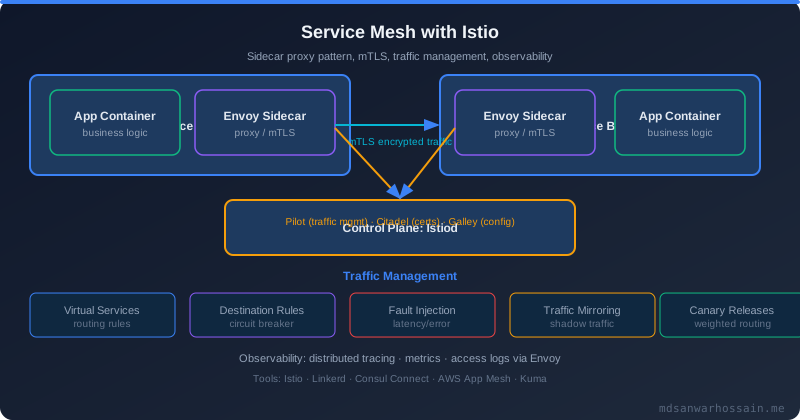
Table of Contents
- Introduction: The Rewrite Validation Problem
- Real-World Problem: Why Pre-Prod Testing Fails
- Deep Dive: Mirroring, Shadowing, and Dark Launch Defined
- Solution Approach: The Shadow Architecture Pattern
- Architecture and Code Examples
- Failure Scenarios and Trade-offs
- When NOT to Use Traffic Mirroring
- Optimization Techniques
- Key Takeaways
- Conclusion
1. Introduction: The Rewrite Validation Problem
An e-commerce platform's order-processing service was originally written in Python with a synchronous Flask architecture. After two years of growth, the team had conclusive evidence that the service was the primary latency bottleneck: p99 latency at 1,200ms during peak load, with the majority of that time spent in blocking I/O operations waiting for inventory, pricing, and fulfillment downstream calls. The decision was made to rewrite the service in Go with a concurrent request fanout design. Six months later, the new service passed every unit test, every integration test, and performed three times faster in load testing.
But the team's tech lead raised a hard question: their load testing used a synthetic request corpus generated from a 30-day traffic sample. Production order requests had a long tail of complexity — bundle products, regional tax edge cases, loyalty point redemptions with concurrent cart modifications — that the synthetic corpus captured poorly. She had seen rewrites before. A service that passes synthetic tests can still fail on the 0.3% of real requests that exercise code paths your test data never hit. The business impact of an incorrect order calculation, even at that rate, was unacceptable.
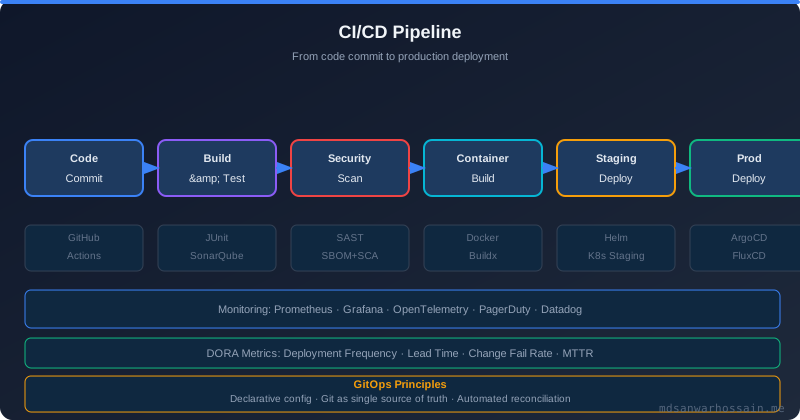
The solution was traffic mirroring: route 100% of production order requests to the old Python service (which continued to handle and respond to all customer requests) while simultaneously sending shadow copies of those same requests to the new Go service. The Go service processed each request, but its responses were discarded. The team ran comparison tooling to detect any divergence between the two services' outputs. Over two weeks of shadow testing at full production load, they identified seven behavioral differences — two of which were genuine bugs in the Go rewrite that would have caused incorrect order totals for loyalty redemptions and international shipping calculations.
2. Real-World Problem: Why Pre-Prod Testing Fails
Traditional pre-production validation relies on three techniques, each with a fundamental limitation. Unit and integration tests validate the code paths you thought to test. They are necessarily based on assumptions the developer made while writing the service. A rewrite introduces new assumptions — about floating-point rounding, about time zone handling, about how certain upstream responses are parsed — that the original developer's test suite never challenged because the original service handled those paths correctly without anyone thinking explicitly about them.
Load testing with synthetic traffic validates throughput and latency under controlled conditions. But synthetic corpora are statistical models of real traffic, not the real traffic itself. An order placed for a product bundle with a flash-sale discount code applied concurrently with a loyalty point redemption and a gift card partial payment is a real request type in any mature e-commerce system. Generating a realistic synthetic version of that request requires knowing it exists — and you discover these edge cases from production, not before reaching it.
Feature flags and canary deployments are often proposed as alternatives, but they have a critical limitation for rewrite validation: the canary serves real users. Even a 1% canary means 1% of your users experience the new behavior — including potential bugs. For a service handling financial calculations, patient records, or legal documents, exposing any percentage of real users to unvalidated logic is unacceptable. Feature flags also cannot validate correctness against the original implementation without a separate comparison layer.
Real-world failure modes from skipping dark launch testing are instructive. One payments team deployed a rewritten fee calculation service that passed all tests but rounded currency amounts differently than the original at the fourth decimal place. The discrepancy was $0.0001 per transaction but accumulated to thousands of dollars of reconciliation errors before detection. Another team rewrote an inventory reservation service and missed a race condition that only manifested under the bursty, correlated traffic pattern of their daily 9am flash sale — a pattern their load tests had never replicated accurately.
3. Deep Dive: Mirroring, Shadowing, and Dark Launch Defined
The terms traffic mirroring, traffic shadowing, and dark launch are often used interchangeably but have subtle distinctions worth clarifying. Traffic mirroring is the infrastructure mechanism: a proxy (Envoy, nginx, HAProxy) duplicates an incoming request and forwards the copy to a secondary destination, while the original request continues to the primary destination. The proxy does not wait for the shadow response and does not return the shadow response to the client. This is a purely infrastructure-level operation.
Traffic shadowing is a higher-level pattern that uses mirroring as the mechanism. It includes the comparison layer: capturing both the primary and shadow responses, diffing them, and recording divergence metrics. Shadowing implies an active monitoring and analysis workflow built on top of mirroring infrastructure.
Dark launch is a broader product engineering concept: deploying new features or services to production infrastructure, receiving real traffic, but keeping results invisible to end users. Dark launch encompasses traffic mirroring but also includes feature flag-gated code paths that execute silently in the request path and async precomputation of results that are not yet shown to users. The common thread is: real production inputs, no user-visible output.
Envoy implements mirroring at the proxy layer using an async fire-and-forget copy. When a request matches a mirroring rule, Envoy forwards the original request to the primary cluster, then creates an independent copy of the request and sends it to the mirror cluster. Critically, Envoy does not wait for the mirror response before returning the primary response to the client. The mirror request runs on a separate connection pool and its response is discarded at the proxy. This means mirroring adds zero latency to the client-visible request path — the only overhead is the additional CPU cost of request serialization and the network egress to the shadow service.
The fire-and-forget async copy that Envoy sends to the shadow service needs the shadow service to handle concurrent requests with low overhead. For JVM-based shadow services, Java's Structured Concurrency with virtual threads is ideal — each mirrored request gets its own virtual thread with no pool exhaustion risk under 2x traffic.
A critical operational concern for mirroring is side effects. The shadow service receives real production requests — which means if it performs database writes, sends Kafka messages, triggers emails, or calls payment APIs, it will cause duplicate real-world effects. Shadow services must be designed with idempotency guards: an environment variable or request header that signals "shadow mode" and causes write operations to be suppressed, redirected to a test database, or wrapped in transactions that are immediately rolled back.
4. Solution Approach: The Shadow Architecture Pattern
The standard shadow architecture consists of four components working together. The primary service (v1) is the existing production implementation. It receives 100% of live traffic and its responses are returned to clients as normal. Nothing changes about its behavior.
The shadow service (v2) is the new implementation under test. It receives mirrored copies of all requests (or a configured percentage). It processes each request fully, including all internal logic and database reads, but suppresses write side effects using shadow mode guards. Its responses are discarded by Envoy — they never reach the client.
The response comparison layer captures outputs from both services. In Envoy-based setups, this is typically implemented as a sidecar that reads from a local response log, or as part of the Istio telemetry pipeline. The comparison layer records latency deltas, response body diffs (for JSON APIs), error rate deltas, and any divergence in business-logic outputs. Teams often build this using a dedicated comparison proxy like Twitter's open-source Diffy tool, or by emitting both responses to a Kafka topic and running comparison logic as a stream-processing job.
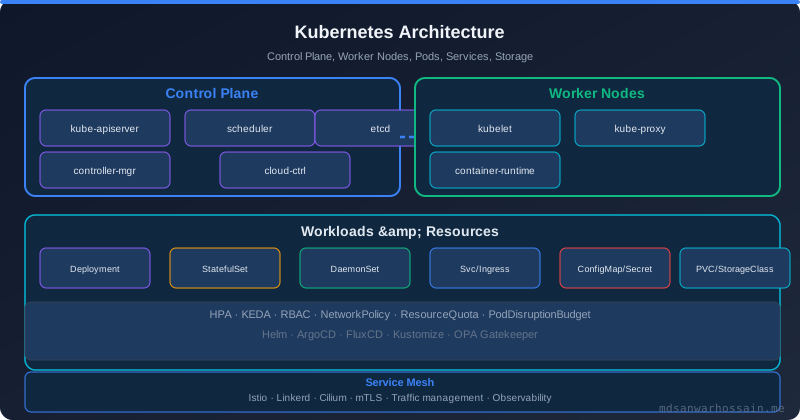
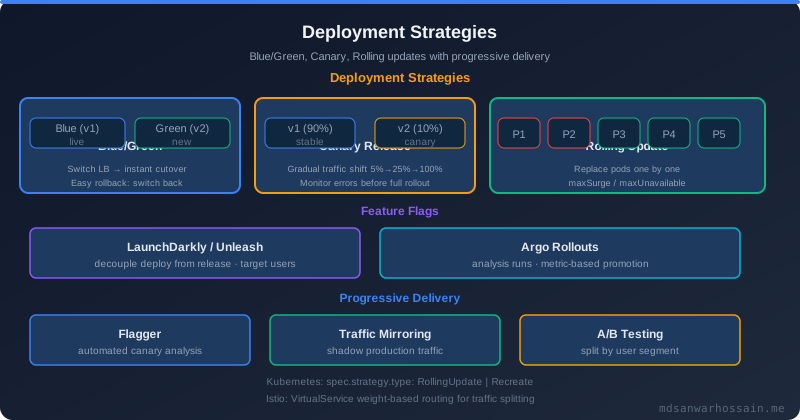
The gradual traffic shift is the final phase. After a validation period where the comparison layer shows acceptable divergence rates (ideally zero divergence in business logic, with acceptable latency delta), the team begins shifting real traffic percentage to v2 using a canary deployment. At this point, v2 has already been validated against the full production traffic distribution, so the canary rollout is low-risk confirmation rather than discovery testing.
5. Architecture and Code Examples
Configure Istio's VirtualService to mirror a percentage of live traffic to the shadow service. The mirror field specifies the destination for mirrored requests, and mirrorPercentage controls what fraction of requests are duplicated:
# istio-virtual-service.yaml
apiVersion: networking.istio.io/v1beta1
kind: VirtualService
metadata:
  name: order-service
  namespace: production
spec:
  hosts:
    - order-service
  http:
    - match:
        - uri:
            prefix: /api/orders
      route:
        - destination:
            host: order-service
            subset: v1
          weight: 100
      # Mirror 100% of traffic to v2 shadow (responses are discarded)
      mirror:
        host: order-service
        subset: v2-shadow
      mirrorPercentage:
        value: 100.0
---
apiVersion: networking.istio.io/v1beta1
kind: DestinationRule
metadata:
  name: order-service
  namespace: production
spec:
  host: order-service
  subsets:
    - name: v1
      labels:
        version: v1
    - name: v2-shadow
      labels:
        version: v2-shadow
For teams not using Istio, Envoy's HTTP connection manager supports mirroring directly via its route configuration filter. The equivalent Envoy filter config for request mirroring is:
# envoy-filter-mirror.yaml — Envoy route config with request_mirror_policies
static_resources:
  listeners:
    - name: listener_0
      address:
        socket_address: { address: 0.0.0.0, port_value: 8080 }
      filter_chains:
        - filters:
            - name: envoy.filters.network.http_connection_manager
              typed_config:
                "@type": type.googleapis.com/envoy.extensions.filters.network.http_connection_manager.v3.HttpConnectionManager
                route_config:
                  virtual_hosts:
                    - name: order_service
                      domains: ["*"]
                      routes:
                        - match: { prefix: "/api/orders" }
                          route:
                            cluster: order_service_v1
                            request_mirror_policies:
                              - cluster: order_service_v2_shadow
                                runtime_fraction:
                                  default_value:
                                    numerator: 100
                                    denominator: HUNDRED
  clusters:
    - name: order_service_v1
      connect_timeout: 1s
      type: STRICT_DNS
      load_assignment:
        cluster_name: order_service_v1
        endpoints:
          - lb_endpoints:
              - endpoint:
                  address:
                    socket_address: { address: order-v1, port_value: 8080 }
    - name: order_service_v2_shadow
      connect_timeout: 2s
      type: STRICT_DNS
      load_assignment:
        cluster_name: order_service_v2_shadow
        endpoints:
          - lb_endpoints:
              - endpoint:
                  address:
                    socket_address: { address: order-v2-shadow, port_value: 8080 }
The shadow service Kubernetes Deployment should be configured with the SHADOW_MODE environment variable and reduced resource requests, since it doesn't serve real user traffic:
# shadow-deployment.yaml
apiVersion: apps/v1
kind: Deployment
metadata:
  name: order-service-v2-shadow
  namespace: production
  labels:
    app: order-service
    version: v2-shadow
spec:
  replicas: 3
  selector:
    matchLabels:
      app: order-service
      version: v2-shadow
  template:
    metadata:
      labels:
        app: order-service
        version: v2-shadow
      annotations:
        sidecar.istio.io/inject: "true"
        # Emit shadow response latency as a custom metric
        prometheus.io/scrape: "true"
    spec:
      containers:
        - name: order-service
          image: myregistry/order-service:v2-candidate
          env:
            - name: SHADOW_MODE
              value: "true"
            - name: DB_READ_REPLICA_ONLY
              value: "true"
            - name: KAFKA_DRY_RUN
              value: "true"
          resources:
            requests:
              cpu: 200m
              memory: 256Mi
            limits:
              cpu: 1000m
              memory: 512Mi
          readinessProbe:
            httpGet:
              path: /health/ready
              port: 8080
            initialDelaySeconds: 10
            periodSeconds: 5
Inside the shadow service itself, use the SHADOW_MODE environment variable to suppress side effects. Here is a Python/OpenTelemetry example showing how shadow mode intercepts write operations:
# order_service.py — shadow mode side-effect suppression
import os
from opentelemetry import trace

SHADOW_MODE = os.environ.get("SHADOW_MODE", "false").lower() == "true"
tracer = trace.get_tracer("order-service")

class OrderRepository:
    def save_order(self, order: Order) -> Order:
        with tracer.start_as_current_span("order.save") as span:
            span.set_attribute("shadow_mode", SHADOW_MODE)

            if SHADOW_MODE:
                # In shadow mode: validate the SQL but do not commit
                # This exercises the full write path for correctness testing
                # without persisting data to the production database
                span.set_attribute("db.write_suppressed", True)
                self._validate_write(order)
                return order  # Return as-if-saved without actual persistence

            # Normal production path: commit the write
            saved = self.db_session.add(order)
            self.db_session.commit()
            return saved

class KafkaProducer:
    def publish_order_event(self, event: OrderEvent) -> None:
        if SHADOW_MODE:
            # Serialize the event to validate schema compatibility,
            # but do not actually produce to the Kafka topic
            serialized = self.schema_registry.serialize(event)
            metrics.increment("shadow.kafka.event_validated")
            return

        self.producer.produce(
            topic="order.events",
            value=self.schema_registry.serialize(event)
        )
6. Failure Scenarios and Trade-offs
Unintended writes to production databases. The most dangerous failure mode. A shadow service that missing a SHADOW_MODE guard on a write path will double-write to the production database. Depending on the data model, this could mean duplicate orders, doubled inventory reservations, or corrupted financial records. Defense in depth is essential: use a read-only database user for the shadow service, route all shadow writes to a separate database instance, and add integration tests that assert no data is persisted when SHADOW_MODE=true. Never rely solely on application-level guards for a safety-critical property like this.
Memory pressure from doubled traffic. With 100% mirroring enabled, the nodes hosting the shadow service receive the same request volume as the primary service. If the shadow service is less efficient than v1 (as is often the case early in a rewrite), it may consume significantly more memory per request. On a node running both v1 and v2-shadow pods, a memory-hungry shadow service can trigger OOM evictions that affect the primary service. Always deploy the shadow service to a dedicated node group or use Kubernetes pod anti-affinity rules to prevent co-location with primary service pods.
Metrics dashboard inflation. Mirrored requests appear as normal HTTP requests to the shadow service, and its metrics are scraped by Prometheus just like any other service. If you're using a shared Grafana dashboard for service-level metrics, the shadow service's request count, error rate, and latency will pollute aggregate views. Tag all shadow service metrics with a shadow="true" label and create filtered dashboard panels that exclude shadow traffic from SLO calculations.
Envoy mirroring overhead on slow uplinks. In environments with constrained intra-cluster bandwidth — common in multi-region setups or edge deployments — Envoy's mirroring doubles the network egress for mirrored routes. For large request payloads (file uploads, bulk order APIs), this can saturate the network interface and cause latency spikes on the primary request path, even though Envoy processes the mirror asynchronously. Use mirrorPercentage to limit mirroring to a sampling rate (5–20%) for high-bandwidth routes. Shadow services receiving mirrored writes often trigger parallel database calls for validation. Without proper task lifecycle management (see Java Structured Concurrency patterns), these parallel calls can leak threads under the doubled load that mirroring introduces.
7. When NOT to Use Traffic Mirroring
Traffic mirroring is not appropriate for services where all write side effects are genuinely impossible to suppress. Payment processing services that call card networks, ACH processors, or bank APIs cannot be safely mirrored without full stub infrastructure for the downstream APIs — and if you have that infrastructure, you're essentially running an integration test environment, not a true shadow. The same applies to SMS and email sending services where shadow-mode message suppression would need to be perfectly reliable, and a single failure would result in duplicate customer communications.
Very high-traffic services where 2x load is cost-prohibitive should use sampled mirroring (1–5%) rather than full mirroring, or accept that shadow validation will take longer. If the service handles 100,000 requests per second, running a shadow service at that volume means doubling your compute costs for the shadow period. For many teams, sampling at 10% for a longer validation period provides adequate statistical coverage at acceptable cost.
Simple CRUD services with deterministic logic and minimal traffic distribution variance get little benefit from shadow testing. If a service has 100% test coverage, simple read/write semantics, no complex business logic, and a traffic distribution that your synthetic tests replicate accurately, the engineering investment in mirroring infrastructure may not be justified. Shadow testing has the highest return on investment for services with complex business logic, long-tail traffic distributions, stateful operations, or correctness requirements that make even a brief canary rollout with user exposure unacceptable.
8. Optimization Techniques
mirrorPercentage for statistical sampling. For high-traffic services, mirroring 100% of requests is often unnecessary. A 5–10% mirror sample provides statistically significant coverage for most production traffic distributions while halving the cost impact on the shadow service tier. Configure Istio's mirrorPercentage.value to 5.0 and run the shadow period for a longer duration (weeks instead of days) to accumulate adequate coverage of rare request types. For the e-commerce order service example, 5% of 50,000 daily orders is still 2,500 mirrored orders per day — more than enough to catch edge case bugs within a week of shadow testing.
Response diff tooling with Diffy. Twitter's open-source Diffy is a comparison proxy purpose-built for shadow testing. It sits between the primary and shadow services, captures both responses, and generates a diff report highlighting semantic differences (not whitespace or field-order differences). Diffy understands JSON structure and can be configured to ignore fields that are expected to differ (timestamps, trace IDs, session tokens). Its web UI shows a ranked list of differences sorted by frequency and magnitude, making it straightforward to distinguish genuine bugs from expected divergence.
Async response comparison with Kafka. For high-throughput services where in-path comparison adds latency, emit both the primary and shadow responses to a Kafka topic as a side effect. A separate stream-processing application (Flink or Kafka Streams) consumes both topics, joins them by request ID, and runs the comparison logic asynchronously. This approach decouples comparison latency from the request path entirely and allows the comparison logic to be updated without redeploying either service. The tradeoff is that divergence detection is delayed by the stream processing lag, typically seconds rather than real-time.
# kafka-comparison-topology (Kafka Streams DSL — pseudocode)
KStream<String, Response> primaryResponses =
    builder.stream("order.primary.responses");

KStream<String, Response> shadowResponses =
    builder.stream("order.shadow.responses");

primaryResponses
    .join(
        shadowResponses,
        (primary, shadow) -> ResponseDiff.compute(primary, shadow),
        JoinWindows.ofTimeDifferenceWithNoGrace(Duration.ofSeconds(30)),
        StreamJoined.with(Serdes.String(), responseSerde, responseSerde)
    )
    .filter((requestId, diff) -> diff.hasDivergence())
    .to("order.shadow.divergences");
Header-based mirroring for targeted user segments. Rather than mirroring all traffic uniformly, use Istio's match conditions to mirror only requests from specific user segments — internal employees (identified by a header set at the API gateway), beta program users, or specific geographic regions. This lets you validate the shadow service against high-value edge cases while limiting total mirrored volume. Use an EnvoyFilter to inject a request header identifying mirrored traffic, allowing the shadow service to distinguish between header-targeted mirror requests and percentage-sampled ones for metrics segmentation.
9. Key Takeaways
- Traffic mirroring sends a fire-and-forget async copy of live requests to a shadow service; Envoy and Istio implement this at the proxy layer with zero latency added to the client-visible request path.
- Shadow services must implement shadow-mode guards for all write operations — database writes, Kafka produces, external API calls — to prevent unintended duplication of real-world side effects.
- Istio's
VirtualServicemirror andmirrorPercentagefields provide declarative, zero-code-change traffic mirroring for any Kubernetes service in an Istio mesh. - The most dangerous failure mode is unintended production database writes from shadow services that lack write suppression guards; defense in depth requires read-only database users and separate database instances for shadow deployments.
- Response comparison tooling (Diffy, Kafka-based async diff) is essential for extracting value from mirroring; raw mirroring without comparison analysis only validates availability, not correctness.
- For JVM-based shadow services under doubled load, Java's virtual threads with structured concurrency provide efficient per-request concurrency without thread pool exhaustion — a critical consideration when shadow traffic doubles the service's concurrent request volume.
10. Conclusion
Traffic mirroring and dark launch testing represent a fundamentally different philosophy about production validation: rather than trying to simulate production in a test environment, bring the test to production in a controlled, non-impacting way. The technique has been used by Netflix, Twitter, GitHub, and other high-reliability engineering organizations for years precisely because it surfaces the class of bugs that no other testing methodology can reliably catch — the bugs that only appear under the specific, complex, statistically rare combinations of real user behavior.
The engineering investment is real. Setting up shadow mode infrastructure, configuring Istio mirroring rules, building or deploying response comparison tooling, and maintaining the shadow deployment adds operational complexity. But the alternative — a canary rollout that exposes real users to unvalidated logic, or a production incident caused by an edge case that synthetic testing never covered — has a much higher cost in debugging time, customer trust, and on-call fatigue.
The e-commerce team from our introduction shipped their Go rewrite with confidence precisely because two weeks of shadow testing had consumed the full uncertainty of the migration. The bugs were already found and fixed. The cutover was a known-safe operation. That is the promise of traffic mirroring: not that you eliminate all risk from production changes, but that you find the risks before your users do.
Leave a Comment
Related Posts

Software Engineer · Java · Spring Boot · Microservices